Long before roads, churches and towns transformed the landscape of Machakos, its hills and rocky outcrops were already woven into the spiritual and cultural life of the Akamba.
Today, some of the same landscapes carry new meanings.
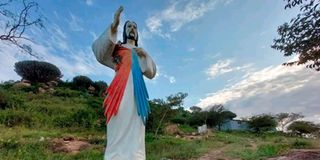
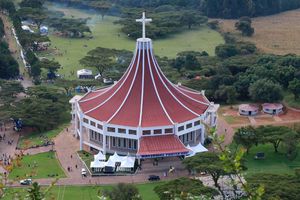
At Koma in Matungulu stands a towering Christian monument where thousands of Catholic faithful gather for prayer. At Kiima Kimwe, a rocky hill is associated with Masaku, one of the most celebrated figures in Kamba oral history. At Kyumbi in Mavoko, a modern shrine draws pilgrims seeking spiritual renewal.
Together, the sites offer a glimpse into how faith, culture and memory have continued to evolve in Machakos, with newer religious traditions adding layers of meaning to an older landscape.
Approaching Tala town in Matungulu, the rocky outcrop of Koma gradually comes into view.
At its summit stands a towering concrete sculpture depicting the Pietà — the Virgin Mary holding the body of Jesus after his removal from the cross.
The approximately 70-foot statue, erected in 2000, transformed the once little-known hill into a major place of prayer and reflection.
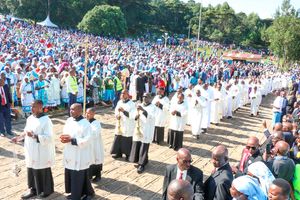
Every year, thousands of Christians gather at Komarock Shrine, particularly during the annual pilgrimage held on the first Sunday of February. Pilgrims walk about three kilometres from the foot of the hill to the summit, following the Stations of the Cross.
But long before the giant statue was erected, Koma already occupied a special place in Akamba beliefs.
Research by the University of Nairobi into Kamba beliefs in the Muvuti/Kiima Kimwe area describes the ithembo as a traditional place of worship where sacrifices were offered and prayers made to Mulungu during calamities and seasons of thanksgiving.
The study provides a window into a religious world in which certain hills, rocks and other natural features were not viewed merely as parts of the landscape, but as places associated with community beliefs and rituals.
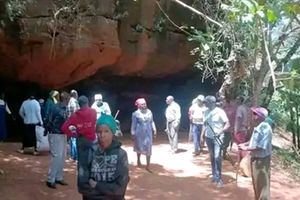
At Koma, elders are said to have climbed the western side of the rock to offer traditional sacrifices.
The prayers included requests for rain, protection from disease, fertility and good harvests.
Catholic pilgrims at Kyumbi shrine.
Photo credit: Pool
Today, Catholicism has given the hill another chapter.
The late Rev Fr Thomas Vadassery, a Jesuit priest who served in the Catholic Diocese of Machakos, is credited with developing Komarock Shrine.
When he died in February 2013, the then Bishop of Machakos, Martin Kivuva Musonde, praised his commitment to the church and his work in different parishes.
“He was very committed to his work. A sacramental priest, from confessions to Eucharistic retreats that he offered in addition to being very selfless,” Bishop Kivuva said.
Fr Vadassery spent the latter part of his priesthood developing Komarock Shrine, which Catholic records say attracted thousands of Catholics and non-Catholics for pilgrimage, retreats and prayer.
His contribution gave Koma a new identity — not just as a hill associated with traditional beliefs, but as a Catholic spiritual centre.
The current Catholic Diocese of Machakos Bishop, Norman King'oo Wambua, has also presided over diocesan pilgrimages and Thanksgiving Masses at the shrine.
His message to pilgrims has focused on contemporary concerns, including the challenges facing ordinary Kenyans and the need to pray for the country and its leaders to safeguard citizens' interests.
A landscape associated in local tradition with older forms of worship has become a place where Catholics bring contemporary anxieties before God.
The Catholic presence has not necessarily erased the cultural memory attached to the hill. Instead, it has added another layer to its story.
Local accounts describe unusual experiences associated with attempts to alter the rocky landscape and encounters that believers regarded as unexplained.
One story concerns Mwĩthĩ, who is said to have lived on the hill with his family. According to the oral tradition, members of the family sometimes reported seeing an unusually bright figure resembling a woman carrying a child.
According to local accounts, machinery used during road construction repeatedly developed problems when workers tried to extract stone from the hill.
“Drills reportedly failed, and explosives that worked elsewhere were said to be ineffective on the hill. Local elders had warned the workers that the place was sacred,” says 82-year-old resident Kioko Muathe.
Such accounts, however, remain oral traditions and local beliefs rather than established historical facts.
The distinction matters because the history of these places is preserved through several forms of memory — academic research, Church records, county documents and oral accounts — which do not necessarily make the same claims.
Further south lies Kiima Kimwe, a hill whose story is closely associated with Masaku, one of the best-known figures in Akamba oral history. Local accounts say Masaku lived on the hill in the 1700s. A University of Nairobi study conducted in the Muvuti/Kiima Kimwe area describes Masaku as a Kamba prophet, medicine man, rainmaker and political leader.
The research also records the importance of traditional religious beliefs among the Akamba, including the role of the ithembo as a place where people offered sacrifices and prayed during difficult times or in thanksgiving.
At the summit stands a large Kiuumo tree, believed by locals to have served as Masaku's shrine.
The tree is said to be more than 200 years old. Masaku is remembered in oral accounts as a prophet who foretold events such as rain, famine, war and attacks by Maasai warriors. “He lived at the top for security purposes. He knew no one could find him there,” says Mwikali Mulei, a local familiar with the story.
Another striking feature is a huge rock, estimated by locals to be about 26 metres high, with a broad base.
Climbing it is difficult, but local tradition holds that Masaku was able to reach the summit because of his special powers.
The University of Nairobi research found that traditional beliefs continued to influence how some people in the area understood important aspects of life.
For example, the study found that respondents associated male infertility with several cultural and religious explanations and sought assistance from a range of traditional and religious providers.
The findings do not establish the supernatural claims associated with individual hills. They instead illustrate the continuing importance of traditional belief systems in understanding the social and religious history of the community.
While Koma and Kiima Kimwe are steeped in older traditions, Kyumbi in Mavoko represents a more recent chapter in Machakos' religious landscape.
The Divine Mercy Shrine was established in 2007 and has since attracted Catholic faithful for prayer and devotion.
The shrine is associated with the message of Divine Mercy and attracts pilgrims from different parts of the country. During one pilgrimage, more than 1,200 pilgrims visited the site.
Unlike Koma, available Catholic records do not provide a similarly detailed account of an ancient sacred tradition associated with the site. But the shrine has become an important venue for prayer, recollections and spiritual formation.
In November 2024, staff from Tangaza University, a Catholic institution, held a recollection at Divine Mercy Shrine, Kyumbi, facilitated by Rev Fr Peter Imaji, OSA, under the theme “Call to Holiness: Living out the Catholic Mission in Academia”.
St Catherine of Siena Catholic Church, Kitisuru, also organised a one-day Lenten recollection at the shrine on March 18, 2023.
For pilgrims, however, the appeal of the shrine goes beyond the physical location.
It is a place where they come to pray, meditate and seek spiritual strength.
“This is not just a shrine; it's a place of solace. I come here twice a year for divine intervention,” says Cathy Wambui from Nairobi.
The county's Department of Tourism and Culture says it is responsible for safeguarding traditional practices, promoting cultural festivals and protecting the county's heritage while developing sustainable tourism that benefits local communities.
The county government has identified Komarock Shrine and Masaku's Rock at Kiima Kimwe among its cultural and tourism attractions.
Its wider tourism strategy seeks to preserve Kamba heritage while opening cultural sites to visitors.
Chief Officer for Tourism and Culture Stephen Mulei, who participated in the county's recent Tourism Products and Experiences Mapping exercise, says the exercise “is intended to update its database of tourism products, facilities and experiences and contribute to a national tourism inventory”.
In a statement following a meeting with a delegation from Komarock Parish, the county said it would upgrade the Matuu ma Mwiitu and Shrine road, alongside other infrastructure interventions in the area.
The road may appear to be an ordinary piece of infrastructure. For a pilgrimage site, however, access can determine whether a place remains a local curiosity or develops into a destination capable of attracting visitors from beyond its immediate neighbourhood.