For the first time since their harrowing ordeal, five chiefs abducted by Al-Shabaab militants in Mandera County earlier this year have spoken out about their captivity.
The administrators, Mohamed Adawa, Mohamed Hassan, Abdi Hassan, Mohamed Noor Hache and Ibrahim Gabow were abducted on February 2, 2025, along the Wargadud-Elwak road while traveling for an assignment ahead of President William Ruto’s development tour.
They were held at Jilib, a perceived Al-Shabaab stronghold which is some 400 kilometers from their homes and released on April 7, 2025. Negotiations involved local elders, though the State denied direct involvement.
President Ruto, who visited Mandera on February 4, had vowed to do everything to secure their release.
President Ruto vows to ensure safe return of five chiefs abducted in Mandera
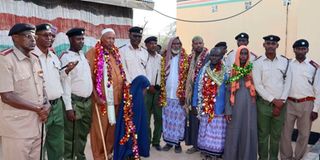
At the Jukwa la Usalama bazara in Elwak town, Mandera South on Tuesday, the chiefs recounted the chilling experiences they endured in Jilib while thanking the national government for securing their release.
Led by Senior Chief Mohamed Adawa, they described their survival as nothing short of miraculous.
“We are grateful to everyone who played a role in our release. We know our President was instrumental, and we are thankful for the protection he provided,” said Adawa.
Immediately after returning home, the government organised trauma counselling sessions, helping the chiefs recover from the life-threatening ordeal. At least two of them have since retired.
Speaking exclusively to the Nation , one chief described the isolation they faced when the militants separated them upon arrival in Jilib.
“Being alone for 60 days was the most traumatising experience. I had no one to talk to or encourage me. It was an incredibly lonely ordeal,” he said.
Food was provided, but they were barred from making calls or interacting with one another. They reunited only in the final days of captivity.
“Those with health conditions had no medicine; we survived on prayers. We ended up with anxiety and other mental health issues, but the government helped us heal once we returned,” the chief explained.
“We had seen videos of executions by Al-Shabaab. Some victims were tied to poles and killed in broad daylight. We never knew when it would be our turn,” he said.
Back home, the community welcomed them with open arms.
“The Mandera county government held a huge baraza to thank the community for their prayers and support. It wiped away our emotional distress and the stigma of captivity,” the chief said.
Despite their trauma, the chiefs chose to continue serving in their roles.
“The government we served did not abandon us in Jilib. It followed us and rescued us. We decided to continue serving because our employer stood with us,” he said.
They are slowly readjusting to daily life, working normally, and although cautious, none live in fear of being abducted again.
The militants reportedly demanded Sh7 million as ransom but the State has denied paying. During captivity, the Interior CS reached out to them five times though details of the communication were not disclosed.
“Life has been interrupted. We need support, including help for our families and children’s education,” said Adawa addingg they have requested a three-year extension of their service contracts to rebuild their lives.
They also called on the national government to support local peace and security initiatives led by clan elders.
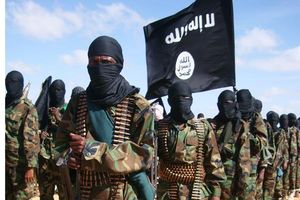
Al-Shabaab has long targeted chiefs in Mandera and tthis has forced many to manage their areas remotely under heavy security.
Deputy Inspector General of Police Gilbert Masengeli urged residents to cooperate with authorities in addressing insecurity.
“When we hide criminals among us and crime thrives, we should not be surprised,” Mr Masengeli warned.
Director of the Department of Criminal Investigation Mohamed Amin noted that Mandera continues to record cases of civil servants colluding with criminals, including issuing crucial government documents to foreigners, fueling insecurity.
“Because of these chiefs’ bravery and resilience while working in a very challenging environment, we will give them state commendation in this year’s Mashujaa Day fete,” CS Murkomen said.
The CS promised improved welfare and security to all local administrators in the high areas across the country.