Two years ago, when James Odhiambo set out to build a modest wooden bridge across a stream that drains into Lake Victoria in North Kadem Ward, Migori County, his ambition was simple and private. He wanted his family to cross the water safely.
He could not have imagined that the rough-hewn structure would one day carry hundreds of people daily, spare traders crippling losses and ignite a political storm in Nyatike.
At the time, Mr Odhiambo’s concern was immediate and domestic. His children struggled to cross the stream on their way to school and church, especially during the rainy season, when the waters swell and the crossing becomes treacherous.
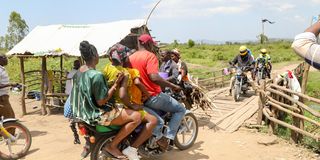
: A vehicle with passengers on board crosses a makeshift wooden bridge in Kuoyo Majiwa village, North Kadem Ward, Nyatike Constituency, on January 18, 2026. The bridge, constructed by a local resident on private land, serves as an alternative route after the Sori-Nyakweri Road became impassable.
Photo credit: Alex Odhiambo | Nation Media Group
With no resources to spare, he turned to what he had.
Near his home in Kuoyo Majiwa village stood several trees, which he cut and fashioned a simple bridge using thick tree stems as piers and supports. Timber planks formed the deck, while branches were shaped into railings to steady those crossing. It was crude, but it worked.
It was later christened Angugo Bridge. It served only Mr Odhiambo’s household and a handful of neighbours, but that was only for a while.
In December 2025, motorists operating between Sori and Migori who had grown weary of constant breakdowns and costly repairs due to the pathetic state of the road between Lwanda Trading Centre and Nyakweri, learnt of the Angungo Bridge.
Word had spread of a wooden bridge in Kuoyo Majiwa that offered a detour - a way to bypass the worst stretch of the road. Drivers began diverting from Lwanda, crossing communal land to Angugo Bridge and rejoining the Sori–Migori road at a far better section.
“A lot of people going to the market prefer using the bridge because it is very convenient. At first, it was mainly used by people from around here, until traders who were tired of the bad road started using it,” explained Yunia Owino, one of the earliest beneficiaries of the bridge.
The Sori-Migori route via Masara is notorious. It snakes through stretches of intermittent tarmac, abruptly dissolving into dusty, potholed sections. Between Lwanda Trading Centre and Nyakweri, movement becomes especially punishing.
Residents say the road is so badly scarred that a motorcyclist can vanish into a pothole, barely visible to an onlooker standing a short distance away.
The damage, locals say, is worsened by sand harvesting, one of the region’s main economic activities. Heavily laden lorries grind over the untarmacked sections daily, their weight accelerating the road’s decay.
“This is the only road we have. Its condition is so deplorable that we struggle every time we use it. The government says it is repairing it, but the work has not reached this area,” said Tom Ocholla, a resident.
As traffic grew, Mr Odhiambo saw a chance to recover something from his labour. He introduced a small fee: Sh50 for cars and Sh30 for motorcycles.
By day’s end, the collections were substantial for a project built entirely with his own hands.
A boda boda rider crosses a makeshift wooden bridge in Kuoyo Majiwa village, North Kadem Ward, Nyatike Constituency, on January 18, 2026. It has become a critical lifeline for residents accessing schools, markets, health facilities, and farms.
Photo credit: Alex Odhiambo | Nation Media Group
Angugo Bridge soon resembled a makeshift toll station. A wooden barrier is raised to allow passage once payment is made. When Nation visited Kuoyo Majiwa village on Sunday, a woman was manning the barrier.
“People only pay once a day. Some pass here many times because of their business. I have to remember their faces so I don’t charge them twice,” she explained.
Small vehicles such as the Toyota Probox which are common on the route cross it with ease, even when carrying up to 10 passengers.
For days, the arrangement went largely unnoticed until a video surfaced online showing two 14-seater vans and a Toyota Prado using the bridge turned the once noble cause championed by Mr Odhiambo into a fierce political competition.
Angugo Bridge quickly became a campaign metaphor in Nyatike, capable of building or eroding political support ahead of the 2027 election.
Critics of the incumbent Member of Parliament Tom Odege quickly seized on Angugo Bridge as a symbol of failed leadership and a reminder that a private citizen had succeeded where the constituency leadership had not.
Seeking to contain the backlash, Mr Odege warned motorists against using the bridge, insisting that the government had provided adequate designated roads.
He claimed the State had worked to improve infrastructure in the constituency and accused users of the bridge of deliberately tarnishing his image.
“From tomorrow, I will order my youths,” he said in a video shared on social media. “If you use that road, you will pay dearly. We have been patient enough to allow you to use our farms, but you are using them to spoil our names. The use of that road will end at midnight,” he warned.
And true to his words, on Saturday, January 17, during nightfall, a group of men armed with machetes was spotted at the bridge, attempting to uproot it. They were however repulsed by local residents, the bridge’s chief beneficiaries.
Mr Odege said the poor state of the Sori–Masaba road was due to delays by the contractor, Gogni-Rajope, who has been on the project for four years without completing the work.
“We cannot have a contractor on a road for more than four years doing nothing. If Gogni cannot return to work, I will use my people to eject them from the road,” he threatened.
Soon after, attempts were made to stop motorists from using the bridge and force them back onto the damaged Lwanda section.
Security officers at Lwanda Police Post - who themselves rely on the bridge when responding to emergencies - were alerted to a plan by youths to destroy the structure.
Caught in the middle is Mr Odhiambo, who is bewildered by the turn of events.
“I built this bridge with an innocent heart, just to help my family and the community, but now politicians have dragged me into their fight, and people’s lives are being put at risk,” he said.
Tensions spilled over on Sunday when Nation journalists Ouko Okusah, Alex Odhiambo and George Odiwuor were accosted while filming and interviewing residents over the bridge.
“Who are you? Who sent you here? What are you doing here?” This is private property. You should not be filming here,” he demanded.
When the journalists identified themselves as employees of Nation Media Group, the angry man dismissed them. He accused the journalists of wrongdoing, threatened to mobilise goons to attack them, hurled insults and even vowed to set their vehicle on fire.
He made several frantic phone calls at the scene, including one to a person he referred to as ‘mheshimiwa’, to report the journalists’ presence.