Located about five kilometers from the Jomo Kenyatta public beach, Bamburi hums with the energy of a thriving economic hub in Mombasa.
A few decades ago, the area's story was different. It was one of neglect, an overlooked forested and swampy land struggling to find purpose.
Life moved slowly, and opportunities were few and far apart. Whenever the skies opened up, the land turned soggy and waterlogged, reinforcing its reputation as a neglected expanse on the fringes of a growing city.
“Bamburi, like most of the areas in Kisauni, was largely dominated by coastal bushes,” Mr Kazungu Kenga, 70, recalls.
Pockets of farmers tried to cultivate the challenging terrain. Some grew maize, cassava and a variety of vegetables, battling both the promise and unpredictability of the land.
As a longtime resident of Kisauni, Mr Kenga is well versed with the area’s past. He remembers how the swampy conditions during rainy seasons, coupled with poor infrastructure, made the area unattractive for major investments.
Mr Thomas Njuma has watched Bamburi grow into what it is today. He lived in Mombasa town before relocating to Bamburi, where he now runs a garage.
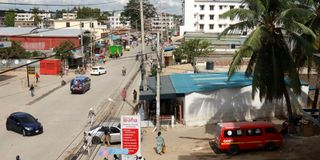
An aerial view of the Bamburi area in Mombasa, which has now become a 24-hour economic hub from its initial bushy Locality in this photo taken on April 6, 2026.
Photo credit: Kevin Odit| Nation Media Group
“This place was bushy and swampy. Only a few people used to live here long ago. But as time went by, people began to come here as rural-urban migration intensified,” he says.
That migration would prove to be a turning point. As Mombasa expanded and its population swelled, largely driven by rural-urban migration, the vast stretches of Kisauni began attracting settlers.
A few wealthy businesspeople saw opportunity where others saw difficulty. They invested in low-cost housing to cater for the growing number of people arriving in search of a better life.
Those modest residential buildings became magnets for low-income earners who needed affordable housing as they hustled in Mombasa town.
Soon, small shopping centres began cropping up, responding to the daily needs of a population that was steadily taking root in Bamburi.
The growth was gradual, almost imperceptible at first, but it gained momentum over time. It later peaked with the coming of devolution, which accelerated the expansion of social amenities as more people streamed into Mombasa in search of opportunity.
“Looking at Bamburi today, it tells a story of growth through resilience amid neglect. Residential buildings and commercial properties have played a central role in making the area what it is today,” he says.
To many, Bamburi’s journey from a bushy, neglected wetland to a 24-hour economic engine is a story of vision, investment and the unrelenting drive of its people.
Mr Njuma says one of the earliest catalysts of this transformation was the establishment of industrial enterprises, most notably Bamburi Cement.
The factory, which opened operations in the 1950s and expanded in subsequent decades, brought with it employment opportunities, infrastructure development and a ripple effect that attracted ancillary businesses.
As factory workers outgrew the firm’s housing capacity, the demand for additional residential buildings surged, creating an opportunity that private investors were quick to exploit.
The expansion of the Mombasa-Nairobi Highway further improved accessibility, encouraging residential development and urbanisation. Later, devolution would enhance road networks, connecting Bamburi more efficiently to the rest of the city and beyond.
With improved infrastructure and the presence of industry, communities began to sprout around the area. Schools, clinics, modern housing and small markets gradually replaced the once dense bushland.
An aerial view of the Bamburi area in Mombasa, which has now become a 24-hour economic hub from its initial bushy Locality in this photo taken on April 6, 2026.
Photo credit: Kevin Odit| Nation Media Group
Today, Bamburi offers a 24-hour economy. It boasts high-end shopping malls, supermarkets, banks, hospitals and a thriving entertainment scene that has come to define its identity.
“Bamburi is the home of nightlife and entertainment. You are more likely to be met with an empty street within Mombasa Central Business District, but in Bamburi, there is no difference between day and night. All are the same,” says Mr Jared Lameck, a resident.
Mr Lameck is among many young people carving out livelihoods in this ever-awake economy. He operates a ‘nyama choma’ (grilled meat) business along the busy roadside with a friend. Their day ends where most people’s begins.
“We have to go and rest, not because there are no people, but because we are tired and have to rest to recharge before returning at around 4pm when the trading centre gets busier,” he says.
He explains that in Bamburi, unlike many parts of Mombasa where evening signals the end of business, life begins when the sun goes down.
“There are so many people in Bamburi at night. Everyone is busy with their lives, and in this way, we all contribute to the revenue basket of the country,” he says.
Across the area, local entrepreneurs have seized the moment, offering 24-hour services ranging from convenience stores and food joints to entertainment outlets, all catering to a dynamic, round-the-clock lifestyle.
Real estate has also boomed. Modern apartments and gated communities now stand alongside older settlements, reflecting the area’s growing affluence and urban sophistication.
According to Mr Njuma, most, if not all, developments in Bamburi are the result of personal investments by individuals who saw the demand for housing and business opportunities. He is, however, critical of the role played by leadership.
“We elected leaders to feed their stomachs. What you see here today is the sweat of private citizens. There is nothing you can say the county government did for the kind of improvements we see today,” he says.
He states that the county has only constructed some feeder roads and installed street lighting to enhance security in the area.
Life in Bamburi begins at 7pm. Loud music from clubs greets the neighbourhood with a booming energy, reinforcing its reputation as the home of nightlife and entertainment.
Tens of bars and nightclubs line both sides of the road, a vivid testament to the area’s after-dark economy.
“Just walk along this line, count the number of bars and clubs and compare it with anything you want, like the number of churches around. This trading centre is filled with bars and clubs. Many people have entered into this business,” says Njuma.
Inside these establishments, DJs compete for attention, their mixes spilling into the streets and giving revellers a wide variety of options.
To attract customers, club owners have invested heavily in large screens, high-quality sound systems, stylish interiors and spacious parking areas. Many also invite famous DJs as guest performers to spice up their night shows.
Such investments have gradually drawn revellers away from traditional hotspots like Mtwapa and even Mombasa town centre, firmly positioning Bamburi as the new entertainment capital of the region.
Affordable and modern housing has also played a role in this shift. Many young people prefer to live and party within the same locality, making Bamburi an attractive residential option.
However, the rapid growth has not come without challenges.
Traffic congestion has become a daily reality. By 5pm, roads leading into Bamburi are often clogged with private vehicles and Public Service Vehicles, with some drivers encroaching onto pavements in a bid to beat the jam.
Commuters can spend significant time stuck in traffic, a situation worsened by the increasing number of three-wheelers, commonly known as tuktuks, plying the route.
The area serves as a key residential hub for the low- to middle-income population. Traditional Swahili houses that once dotted the area are slowly being replaced by high-rise apartments that reflect the pace of urbanisation.
Today, anything that a person may need, including hospitals, banks and supermarkets are in Bamburi, giving the area an urban appeal.
“Apartments like those that only existed in leafy suburbs of Nyali, Kizingo and Tudor are in Bamburi. This place has experienced gradual development over time,” Mr Waweru Mwangi, who has lived in Bamburi for over eight years since his college days says.
To support a 24-hour economy, the county government of Mombasa last year announced the implementation of a comprehensive street lighting programme in Bamburi Ward. The initiative targets key areas such as Ugatuzi, Florida and Magahawani, with the aim of enhancing security and supporting night-time business activity.
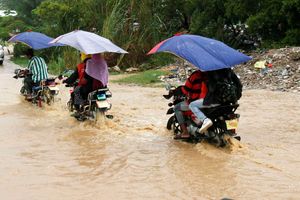
The programme involves the installation of new street lights as well as the repair of existing infrastructure. However, the area continues to face a significant flooding challenge during the rainy season.
Although the county has constructed feeder roads to improve access to residential estates, they visibly lack drainage systems.
However, the leadership of Mombasa County maintains that the flooding is not solely due to faulty or inadequate drainage systems. According to county officials, unplanned and haphazard construction along natural waterways has exacerbated the problem.
The county government cites instances where entire settlements have been built directly on natural drainage channels. Consequently, during periods of excessive rainfall, there is no clear path for water to flow, resulting in flooding.
Bamburi can be accessed via two main routes, off the Mombasa-Malindi Road at the Bamburi Cement junction, and another through the old Mombasa-Malindi Road via Kisauni.
Under normal conditions, it takes approximately 30 minutes to travel from Bamburi to the Central Business District. However, during peak hours, the journey can take considerably longer due to heavy traffic.
Commuting costs range between Sh50 and Sh100 by matatu or tuk-tuk, depending on the time of travel.