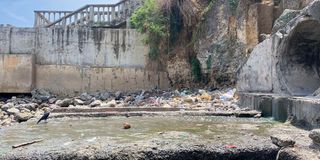
An open public access point to the Indian Ocean near Fort Jesus in Mombasa, where stormwater and sewage runoff flow directly into the sea. While the view remains a tourist attraction, the pollution prevents most visitors from swimming, leaving the water to only the bravest locals.
Across the world, iconic coastal cities like Barcelona, Miami, Cape Town, and Tel Aviv are known for urban beaches that function as a seamless extension of everyday city life.
In these cities, residents jog, swim, and socialise just steps away from busy city streets. In Mombasa, Kenya's island city surrounded by the Indian Ocean, the situation is different.
Residents and visitors to the island often have to head to the North Coast mainland, some as far as 20 kilometres away, for recreation at the beach. The island's own shores, such as Madhubaha, the Fort Jesus waterfront, and Tudor Beach, remain largely underutilised and neglected.
A high-angle view of Tudor Beach, one of Mombasa’s underutilised shores. Despite its potential as a vibrant public beach, the area remains neglected due to a persistent stench from nearby sewage lines that scares away ocean lovers.
The public beachfront recreational facility worth visiting on the island is the Mama Ngina Waterfront near the Likoni ferry crossing channel. The park was officially opened on October 20, 2019, by then President Uhuru Kenyatta after a major refurbishment project costing about Sh460 million, following decades of neglect that had rendered it a hideout for petty criminals.
A spot check at some of the island's neglected shores revealed concerns over stormwater runoff and raw sewage discharge that continue to push crowds toward the cleaner stretches of Nyali, Bamburi, and Jomo Kenyatta Public Beach, commonly known as Pirates.
Mr Ahmed Said Mbarak from Fort Jesus, believes the area is a missed opportunity for a public beachfront. He points to infrastructure failures as the primary deterrent coupled with stormwater drains that have been infiltrated by sewage lines, rendering the water unsuitable for swimming.
“This place has immense potential because Fort Jesus attracts so many people. If we had a proper recreational facility, things would be different. Right now, it’s just rocks and stormwater; transforming this place would take a massive effort,” he says.
He recalls a time when the situation was different. Those were days when young men would gather here for diving and swimming sessions, especially over the weekends.
"Initially, even with the stormwater, it was still a nice place to swim. Now, people just come for the view and leave. Residents have sneaked their sewage lines into the stormwater drains, making people detest swimming here," he adds.
Call for renovation
Nowadays, only a few residents can brave the stormwater and enjoy a swim.
Mr Samuel Abdi, a resident of Mbaraki, agrees that the stormwater leaves them with no choice but to go to the North Coast.
“I live on the island, but I have to go to Bamburi to enjoy the ocean. Once guests see the drains, they simply leave without even getting into the water,” he said.
Mr Athman Imran, another resident, said the beachfronts should be renovated to make the most of the island, enhancing the city’s vibrancy for ocean lovers who do not want to travel 30 kilometres just to swim.
In the Tudor area, there lies another beach that should be buzzing with activity. A vibrant beach here would reduce travel distances for residents while boosting local businesses within the city.
Just like other areas on the island, the stench of sewage draining into the ocean here scares people away; it only works for those brave enough to enter waters stained by waste.
Mr Abdalla Mangale, a volunteer lifeguard at Tudor Beach since 2020, says that despite his efforts to clean and beautify the area, he only attracts a few visitors who can brave the stench at the entrance. He, however, notes that the smell does not reach those already out in the ocean.
“I decided to stay here for the sake of the children who come to swim; accidents used to occur because they were never accompanied by guardians. We have tried beautifying the place and even securing space for temporary lavatories. However, what causes people to leave and never come back is the smell from the sewage. Some get to the water but will not enter because they perceive it as dirty,” said Mr Mangale.
He explained that while some tourists visit and stay to enjoy the ocean view, providing a boost to his beverage business, their discomfort is often evident. He adds that if the sewage were managed well, and amenities like showers, benches, and lighting installed, it would significantly benefit businesses and the local environment.
A high-angle view of Tudor Beach, one of Mombasa’s underutilised shores. Despite its potential as a vibrant public beach, the area remains neglected due to a persistent stench from nearby sewage lines that scares away ocean lovers.
“We have an association that investors could work with to ensure the community benefits from the upgrade. I have hope that if this happens, our beach will finally be brought to life,” said Mr Mangale.
The Mombasa county government said that the situation at beaches within the island has been a matter of concern. According to the County Executive Committee Member for Lands and Urban Planning Mohamed Hussein, the county has plans to rehabilitate the beaches to harness their full potential.
“We are committed to identifying underutilised beaches and finding ways to make them more attractive for both residents and visitors. We are currently addressing the sewage menace by ensuring that all new developments in Mombasa include a biodigester. This ensures that the water released from these properties is no longer harmful to the environment,” said the CECM.
He added that the department was working on a sewage treatment plant that would ensure all water redirected into the ocean is clean.
“Beaches have the power to bring people together and even transform lives; that is why we are working tirelessly to eliminate the few obstacles preventing our shores from flourishing. We want our people to enjoy the beaches, which is why our public health officers are already on the ground taking action,” said Mr Hussein.
According to the Kenya Hotel Keepers and Caterers Association CEO Sam Ikwaye, Mombasa’s beaches are some of the region’s most attractive assets, supporting tourism, the blue economy, and related businesses. However, poor management, conflicting regulations, and unclear responsibilities between national and county agencies have limited their full potential.
“Over the years, our beaches have not been properly managed. This stems from challenges in planning and conflicts in mandates between county and central government, making it difficult to determine who has sole responsibility for investing in infrastructure, beach security, access, and development,” said Dr Ikwaye.
Dr Ikwaye, who is also the Chairperson of the Mombasa Tourism Council, explained that efforts have been made to craft regulations aimed at enhancing the value of both beaches already in use and those that remain underutilised.
“Through the association of hotel keepers, we have been able to work together with the Kwale County Government and the Mombasa County Government. As we speak today, we have submitted draft beach management legislation in these counties,” said Dr Ikwaye.
Follow our WhatsApp channel for breaking news updates and more stories like this.
[email protected]