More trouble for Mackenzie, 11 others as court convicts them of child abuse charges
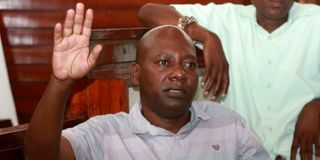
Pastor Paul Mackenzie during proceedings at the Mombasa Law Courts from Shimo la Tewa Prison during the Judgment of the Tononoka Children's Courts over child tourture accusations and cruelty in the Shakahola Forest massacre in this photo taken on November 25, 2026.

Parental responsibility emerged as a central issue on Tuesday as the Children’s Court in Mombasa distinguished the obligations of parents from the criminal liability of doomsday preacher Paul Mackenzie over the assault and cruelty inflicted on children in Shakahola Forest between 2020 and 2023.
While the court found Mackenzie and 11 others guilty of various offences against children, it held that his influence over followers did not, on its own, make him legally responsible for every violation suffered by minors in the forest. The convicts will be sentenced on December 17, 2026.
In her judgment, Principal Magistrate Nelly Chepchirchir emphasised that the prosecution was required to prove each accused person's responsibility beyond reasonable doubt, warning that the scale and notoriety of the Shakahola tragedy could not substitute for individual proof of guilt.


“The evidence against each accused was considered separately; the scale of events or public notoriety cannot replace proof,” the magistrate said.
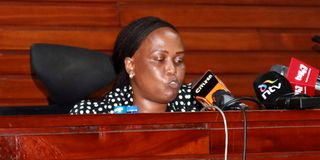
Tononoka Law Courts Principal Magistrate Nelly Chepchirchir delivers a judgment in Pastor Paul Mackenzie's and co-accused's case.
The court distinguished Mackenzie's influence over his followers from the parental obligations of those who took their children into the forest. It noted that there was no evidence that he had parental responsibility for the children or was directly involved in their day-to-day protection.
On the children's right to education, the magistrate observed that Mackenzie was not the parent of the six children cited in the relevant charges. Although he and other preachers taught that formal education was not part of God's plan, the prosecution had not demonstrated that he instructed parents to withdraw their children from school.
The court, however, held that religious freedom could not be used to justify practices that harmed children, dismissing the defence argument that the actions were motivated by religious beliefs or constituted lawful discipline.
“Freedom of religion protects belief and its peaceful practice, and preaching a belief is not in itself a crime. A religious motive is no defence to an offence otherwise proved. The defence of lawful discipline is hereby rejected,” the magistrate said.
The court also distinguished between torture and assault, acquitting all the accused of torture charges because the prosecution had failed to establish the involvement, consent or acquiescence of a public officer, as required under the legal definition of torture.
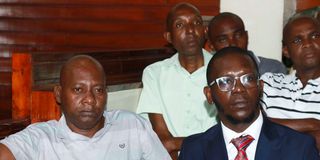
Pastor Paul Mackenzie (left) with his Advocate Lawrence Obonyo (right) at the Mombasa Law Courts during the delivery of the Judgement in the Tononoka Children Courts case on November 25, 2026.
It consequently considered the alternative assault charges alongside counts of cruelty to children and violation of their right to education.
In determining individual criminal responsibility, the court relied on Sections 20 to 22 of the Penal Code, which provide for liability arising from aiding, enabling, counselling or procuring an offence, as well as participation in a shared unlawful purpose.
It rejected the argument that the prosecution had to establish that each accused made an essential contribution to the offences under the Rome Statute, holding that liability had to be determined under Kenyan law.
The magistrate further cautioned that belonging to Mackenzie's religious community or performing roles such as guarding or digging graves was not, on its own, sufficient to establish criminal responsibility. Each accused had to be linked to an offence involving a particular child.
Applying these principles, the court found Mackenzie guilty of assault causing actual bodily harm under the alternative to Count Two and five counts of cruelty to children.
On Counts 12 and 17, the magistrate found that advice given by Mackenzie contributed to children being denied food, holding him criminally responsible for the resulting cruelty. The other accused persons charged alongside him in those counts were acquitted.
However, the court dismissed other allegations where the prosecution failed to establish responsibility beyond reasonable doubt. It found that Counts Five and Ten, which related to cruelty to children, had not been proved because there was no evidence that the children involved had been denied food or subjected to the alleged cruelty.
Mackenzie's deputy, Smart Deri Mwakalama, and church plant operator Stephen Sanga Muye were also convicted of assault and cruelty to children, while Evans Kolombe Sirya and Titus Munyao Musyoka were found guilty of cruelty to children.
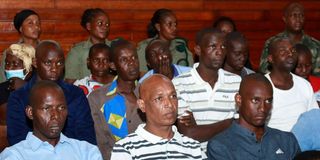
Pastor Paul Mackenzie's co-accusedfollow proceedings at the Mombasa Law Courts.
Other convictions involved violations of children's right to education. Gilbert Kea Katana and Peris Mupa alias Kadzo Yeri Katana were convicted of both cruelty and education-related offences.
Catherine Wanjiru Henry and Agnes Shihale Jumba were also convicted of cruelty and infringement of the right to education, while Alice Kawira, Felix Katana and Frida Katana were found guilty of education-related offences.
The remaining 24 accused persons were acquitted on all counts after the court found that the prosecution had failed to establish their individual responsibility.
Initially, 39 people were jointly charged over offences allegedly committed against children among followers of Mackenzie's Good News International Church in Shakahola Forest, Kilifi County, between 2020 and 2023.
The 17 counts comprised two charges of torture, each with an alternative charge of assault causing actual bodily harm, nine counts of cruelty through denial of food and six counts of violating children's right to education.
The cases against two accused persons, Edison Safari Nyambu and Kelvin Sudi Asena, abated following their deaths, while charges against Enos Amanya Ngala were withdrawn under a plea agreement, leaving 36 accused persons.
During the trial, the prosecution presented witnesses drawn from several categories, including 13 children, adult survivors and former GNI members, children's officers, relatives of child witnesses, police officers and forensic experts.
The child survivors described how they were denied food, assaulted and locked inside temporary structures when they attempted to escape the enforced fasting.
They testified that Mackenzie ordered children to begin fasting before women and men, monitored compliance and prohibited members from seeking food from neighbours. Those caught breaking the fast were reportedly tied by their wrists and legs and beaten.
Some witnesses recounted seeing children die and their bodies transported on motorbikes for burial. Others described how breastfeeding mothers were denied the opportunity to nurse their babies.
Several survivors said their families moved into the forest from 2021 after initially being hosted in Malindi town.
One 14-year-old testified that his mother poured hot water on him and that he was beaten by Mackenzie and Mwakalama after seeking food from a neighbour.
Other witnesses described how children were withdrawn from school following teachings that formal education was against God's plan.
The defence called 11 witnesses, who denied assaulting children or forcing them to fast, insisting that participation was voluntary. They argued that any punishment administered was intended to discipline disobedient children rather than harm them.
Some also blamed parents' decisions and the children's reluctance to attend school for their lack of education.
In total, the prosecution presented 76 witnesses and 112 exhibits over one year and two months. The evidence included survivor testimonies, medical and post-mortem findings, laboratory analyses, photographs, videos and digital forensic material.
Investigators detailed the rescue of 27 children from the forest, while clinical psychologists testified about the lasting trauma suffered by survivors, including nightmares, grief, withdrawal and fear.
A digital forensic report extracted from Mackenzie's mobile phones also revealed communications between him and his followers about fasting, prophecy, the Antichrist, the Beast, the New World Order and the number 666. Prosecutors argued that the messages were used to indoctrinate followers and justify the deadly practices.
On Thursday, November 26, the Shanzu court is also expected to deliver judgment in a radicalisation case against Mackenzie and others.
Follow our WhatsApp channel for breaking news updates and more stories like this.