When nearly 200 countries packed up after roughly 48 hours of overtime at COP31 in Antalya, Türkiye, on Sunday, November 22, 2026, they left without a final political deal. Only COP15 in Copenhagen in 2009 and COP25 in Madrid in 2019 had ended without an overarching cover decision before this.
"We will not pretend that Antalya delivered for Africa," Kenya's Cabinet Secretary for Environment, Climate Change and Forestry, Dr. Deborah Mlongo Barasa, told the closing plenary. "Africa leaves without agreement on what mattered most. Many issues that mattered to us were linked to the cover decision. Now we feel shortchanged."
For audiences across Africa, the breakdown in Antalya is far more than a diplomatic hiccup. It stranded vital finance and institutional support while pushing unresolved fights onto Ethiopia ahead of COP32 in Addis Ababa next year.
Why did the talks break down?
Every UN climate summit aims to adopt a "cover decision," a political text setting the direction on emissions cuts and climate support. In Antalya, talks hit a wall over fossil fuels and money.
Three years after countries agreed at COP28 in Dubai to transition away from fossil fuels, major polluters pushed to strip explicit phase-out wording from the COP31 draft and elevate unproven, gigatonne-scale Carbon Capture, Utilisation, and Storage (CCUS) technologies instead. When the joint Turkish and Australian presidency put forward a compromise text that omitted fossil fuel phase-outs, dropped a $120 billion annual floor for adaptation finance by 2035, and reduced the Just Transition Mechanism to a lightweight forum without real funding, a coalition led by the European Union and vulnerable island states rejected it.
"What collapsed on the plenary floor in Antalya was an attempt by historical emitters and fossil fuel interests to force developing nations to accept an empty shell," said Dr. Mithika Mwenda, Executive Director of the Pan African Climate Justice Alliance (PACJA). "While the breakdown of talks is a bitter indictment of global climate diplomacy, rejecting a retrogressive deal prevents a dangerous step backwards."
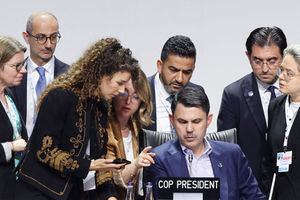
COP31 President Murat Kurum is surrounded by advisors during a session of the closing plenary at the UN Climate Change Conference (COP31) in Antalya, Turkey, November 22, 2026.
Photo credit: REUTERS
Why are Africans frustrated with both sides?
African negotiators went to Antalya expecting concrete progress on adaptation funding, specifically grants rather than debt-inducing loans, to help communities deal with droughts, floods, and failing harvests. Instead, tying key mandates to the failed cover decision left Africa without agreements on the Mitigation Work Programme, the Global Environment Facility, or a funded Just Transition for workers and communities. Even the Global Goal on Adaptation lost Paragraph 50, which recalled tripling adaptation finance.
"An adaptation goal without the means is a house without a foundation, designed to fail," Barasa told delegates.
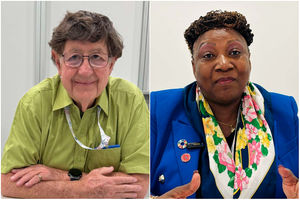
Environment Cabinet Secretary Deborah Barasa.
Photo credit: Dennis Onsongo| Nation Media Group
Addressing the closing plenary on behalf of the African Group of Negotiators, Ghanaian Environment Minister Zanetor Agyeman-Rawlings also pointed out that Africa was missing from the text's framing.
"First of all, Africa is not named," she said, noting that the text mentioned least developed countries and small island states while omitting Africa's special needs and circumstances. "We didn't come here to beg. We came here to claim what is rightfully ours for our people who are suffering the brunt of anthropogenic activities of developed countries."
At the same time, civil society leaders faulted Europe for walking away without delivering finance while claiming moral leadership.
"Europe’s hypocrisy is staggering," said Mohamed Adow, Director of Nairobi-based Power Shift Africa. "Its governments demand fossil fuel roadmaps from others while expanding fossil fuels themselves and blocking the finance poorer countries need to make the transition."
What Africa wanted vs. what it got across its agenda
Across its core negotiating priorities in Antalya, Africa went in with concrete demands and walked out mostly with unfinished business and partial technical steps:
Adaptation finance & tripling : Africa wanted a dedicated agenda item on tripling adaptation finance and a clear $120 billion annual floor by 2035, backed by grants rather than loans. AGN Chair Dr. Antwi-Boasiako Amoah of Ghana confirmed that the requested dedicated agenda item on tripling adaptation finance was not adopted, and the $120 billion floor and Paragraph 50 on tripling were stripped out or lost with the cover decision, leaving African negotiators with a technical report request from the Standing Committee on Finance and a climate finance work programme rather than guaranteed cash.Just Transition Mechanism: Africa pushed to operationalise a funded, permanent Just Transition Mechanism to support workers, communities, clean energy access, and green industrialisation. Instead, agreement on a funded mechanism failed in the cover decision, leaving African advocates warning that it was reduced to a powerless forum without finance.Loss and Damage & climate funds: African nations sought predictable, grant-based funding under the Convention and Paris Agreement Article 9.1 for the Loss and Damage Fund, the Santiago Network, the Green Climate Fund, and the Climate Technology Centre and Network. With 119 countries requesting $2.8 billion from the Loss and Damage Fund against $342 million in the fund (and $486 million disbursed out of $823 million pledged), falling Green Climate Fund pledges since 2025, and a frozen budget at the Climate Technology Centre, funding fell far short of needs.Mitigation, fossil fuels & carbon capture: While African countries are split internally between clean-energy pushers like Kenya and Ghana and producers defending gas and development space, African advocates opposed scrubbing fossil fuel commitments in favour of unproven carbon capture or shrinking Africa's development room. The final cover text dropped explicit fossil fuel transition language and elevated CCUS before collapsing altogether.Carbon markets & trade measures: Africa pushed back against unilateral trade barriers like carbon border taxes that penalise African exports. Trade measures were dropped from the work programme fight, though negotiators did reach a technical agreement mandating that at least 5% of revenues from UN Article 6.4 carbon credits go toward adaptation.
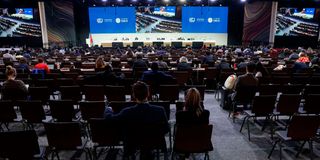
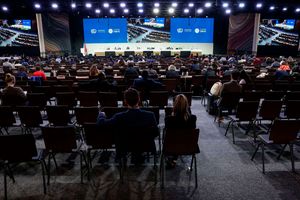
Participants gather at the UN Climate Change Conference (COP31) in Antalya, Turkey, November 20, 2026.
Photo credit: Reuters
"COP31 was a ghost COP, and its lack of progress will haunt climate-vulnerable communities in Africa and around the world," Adow said in his reaction to the meltdown. "Countries drowning in debt need resources they can use, without being pushed further into poverty to protect themselves from a crisis they did little to cause."
Barasa warned that the UN process is starting to echo the 1997 Kyoto Protocol, where binding commitments were slowly rewritten as optional invitations.
"The Paris Agreement was built on a bargain: ambition from all, and support from those with the means," she said. "Remove the support, and what remains is not the Paris Agreement. It is another Kyoto Protocol, waiting for its obituary."
What does this mean for Africa’s COP32?
With Ethiopia set to host COP32 in Addis Ababa in November 2027, unresolved disputes over fossil fuels, adaptation finance, and the Just Transition Mechanism now move onto African soil.
"As the COP gavel moves to Addis Ababa next year, Africa must not become a dumping ground for COP31's unfinished business," said Dr. Augustine B. Njamnshi, Chair of PACJA’s Political and Technical Affairs Committee. "We must mobilise domestic and regional resources, protect our ecosystems and communities, and build an unshakeable continental front that demands enforceable public finance and genuine climate justice in 2027."
Addressing the closing plenary to formally invite the world to Addis Ababa, Ethiopia's delegation sought to steady a bruised multilateral process and set expectations for next year.
"COP32 will be the COP of hope, grounded in cooperation, strengthened by trust and hope made credible by delivery, hope for the people impacted by climate change," Ethiopia told the plenary.
Kenya's delegation said it will head to Addis Ababa in good faith alongside the Africa Group, urging partners to bring the financial support they promised. For communities living with extreme weather across Africa, turning speeches in Addis Ababa into real, accessible finance will be the true test of COP32.