Cult leader Paul Mackenzie may have been handed one of the longest prison sentences in Kenya’s history, but the shadow of Shakahola continues to loom over him, with his legal troubles far from over.
His conviction and lengthy sentence have not brought his courtroom battles to an end.
Three courts are set to deliver crucial judgments in separate cases arising from the Shakahola massacre, in which more than 450 followers of Good News International Ministries (GNI) died after embracing a deadly religious doctrine that promised them a chance to fast their way to heaven and meet Jesus.
photo 33
Photo credit: Kevin Odit | Nation Media Group
The first of the three judgments is scheduled for November 24, when the Mombasa Magistrate’s Court will determine the manslaughter case in which Mackenzie and his 95 co-accused face charges over the deaths of 238 people in what the prosecution describes as a suicide pact.
The prosecution alleges that the accused, acting in furtherance of a common suicide pact, jointly caused the deaths of 238 people, including themselves and others who are not before the court. The alleged offences occurred on unknown dates between January 2021 and September 2023 in Shakahola, Malindi Sub-County, Kilifi County.
A day later, on November 25, the Tononoka Children’s Court is expected to deliver its verdict in the child torture case, in which Mackenzie and 34 associates face charges relating to cruelty, torture and denial of education to minors.
The prosecution alleges that children living in Shakahola were withdrawn from school, subjected to forced fasting and denied basic needs, with some beaten and whipped when they resisted or attempted to escape.
The State closed its case after presenting 76 witnesses and 112 exhibits, including expert reports, photographs, videos and literature, over a period of one year and two months. Sixteen witnesses, among them 13 children, testified under protective measures.
The evidence paints a picture of children drawn into an environment of religious indoctrination, isolation and violence. Some survivors described how their families abandoned their homes and sold their property before relocating to Shakahola after being persuaded that formal education was sinful.
Rescue teams recovered 27 children aged between one-and-a-half and 17 years from the forest. Some were severely malnourished and traumatised, while others described living in settlements where followers gathered for prayers and burial ceremonies. Several subsequently identified Mackenzie during an identification parade.
Psychological assessments documented the lasting effects of their experiences, including nightmares, grief, fear and social withdrawal. Some of the rescued minors had never attended school, having been raised under teachings that also discouraged medical treatment.
The prosecution further relied on forensic and medical evidence, including laboratory analyses of samples collected from the forest and post-mortem findings from exhumed bodies, which pointed to prolonged starvation.
A 74,658-page digital forensic report extracted from Mackenzie’s mobile phones contained communications concerning fasting, prophecy, the Antichrist, the Beast, the New World Order and the number 666. The State relied on the material to demonstrate how the preacher’s teachings were communicated and reinforced among his followers.
Telephone and M-Pesa records obtained from Safaricom, including information linked to four numbers associated with Mackenzie, also formed part of the evidence used to reconstruct communications and activities during the period under investigation.
The legal battles will continue on November 26, when the Shanzu Law Courts are expected to deliver a verdict in the radicalisation case, which prosecutors link to the mass exodus of followers into Shakahola Forest.
Mackenzie, his wife Rhoda Mumbua Maweu and 94 co-accused face charges relating to radicalisation and organised criminal activity within GNI, which the prosecution alleges was used to indoctrinate followers and facilitate the deaths in Shakahola.
The charges include engaging in organised criminal activity, radicalisation, facilitating the commission of a terrorist act and possessing publications allegedly intended to instigate terrorism.
Mackenzie, Maweu, Mary Kadzo Kahindi and 28 others are accused of engaging in organised criminal activity that endangered lives and led to the deaths of 429 followers. The same group faces radicalisation charges, alongside a separate group comprising Baron Chahenza and 63 others.
Mackenzie and Mwakalama are separately accused of facilitating a terrorist act by transporting GNI followers between Shakahola Forest and Malindi, allegedly exposing them to danger. Mackenzie and his wife also face charges of possessing CDs, DVDs, books and pamphlets allegedly intended to instigate terrorist acts. The offences are said to have occurred at Furunzi in Malindi between 2020 and 2023.
The prosecution closed its case after presenting 96 witnesses and close to 500 exhibits in a trial that began on July 8, 2024. Its evidence portrays GNI as an organisation allegedly transformed into a radicalisation network through which Mackenzie propagated extremist religious teachings for more than a decade.
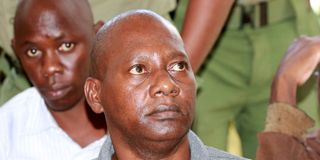
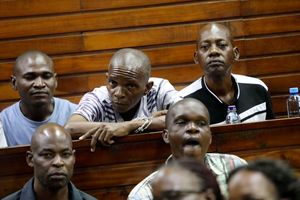
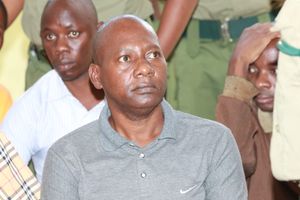
Pastor Paul Mackenzie (in stripped t-shirt) with his co-accused persons at the Mombasa Law Courts on October 19, 2026 after they were found them guilty in 191 counts of murder in the Shakahola case.
Photo credit: Kevin Odit | Nation Media Group
Investigators presented evidence showing how he used Times Television, YouTube channels, seminars, crusades and WhatsApp groups to spread his ideology and recruit followers. The indoctrination allegedly intensified between 2020 and 2023, when members were encouraged to abandon education, reject medical care, sever social ties and relocate to Shakahola.
The prosecution also presented evidence that Mackenzie acquired 480 acres of land in Shakahola, which was subdivided into settlements bearing biblical names. The settlements operated under a rigid hierarchy of guards, overseers, grave diggers and cooks, allegedly tasked with enforcing the teachings and preventing followers from escaping.
Forensic and medical evidence established that 426 bodies had been exhumed from the forest, with starvation identified as the primary cause of death. Investigators also presented accounts from 28 rescued children describing coercion and mental torture linked to fasting, alongside DNA findings indicating that several accused persons were the parents or close relatives of children who had died.
The State further relied on evidence that followers abandoned employment, sold property and surrendered their livelihoods under Mackenzie’s influence. GNI, which operated at least 25 branches countrywide, was gazetted as a criminal organisation in January 2024.
The judgments scheduled for November 24, 25 and 26 will determine whether Mackenzie and his co-accused are guilty or innocent of the charges. Those found guilty will proceed to mitigation and sentencing, while those found to be innocent will be free to leave the dock.
For Mackenzie, the three consecutive court dates represent another critical test of his legal troubles, even after the 200-year sentence.