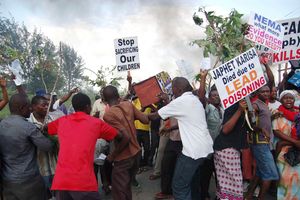
When environmentalist Phyllis Omido sued the state over lead poisoning in the impoverished Owino Uhuru slums in Mombasa more than a decade ago, she never imagined she was stepping into a battlefield that would pit her against powerful government institutions.
She never imagined that her courtroom victory against the government would eventually evolve from a fight for the rights of thousands to a battle for her freedom.
Ms Omido, the Executive Director of the Centre for Justice, Governance and Environmental Action (CJGEA), secured one of the most significant legal wins in Kenya’s environmental justice history six months ago, when the Supreme Court upheld an award of Sh1.3 billion to the slum dwellers.
The judgment, delivered on December 6, 2024, affirmed an earlier ruling of the Environment and Land Court that awarded more than 3,000 residents of Owino Uhuru Sh1.3 billion in compensation for health injuries and loss of life caused by lead poisoning.
In addition, the court held that the National Environment Management Authority (Nema) must either decontaminate the slum within four months or pay CJGEA Sh700 million to undertake the environmental remediation.
However, the remediation part of the judgment now appears to have brought Ms Omido into direct conflict with the state, judging by documents filed in the High Court in Mombasa.
Barely six months after this historic verdict, Ms Omido now finds herself at the centre of what she terms a politically motivated attempt to derail justice.
In an urgent application filed at the High Court, she is seeking protection from what she describes as imminent and arbitrary arrest orchestrated by state agencies.
She has sued the Directorate of Criminal Investigations (DCI), the Inspector General of Police, and the Director of Public Prosecutions (DPP).
“I humbly beseech the court to grant me anticipatory bail. I discharged my responsibilities as CJGEA’s director with integrity, patriotism, and in strict adherence to the rule of law. I have defended communities like the victims of the Owino Uhuru lead poisoning,” she pleaded through her lawyer, Lempaa Suyianka.
According to her affidavit, officers from the Kenya Police have reliably informed her of direct orders to arrest and charge her. However, no formal summons or arrest warrants have been issued.
She believes this is a retaliatory move meant to stall the implementation of the Supreme Court's orders and silence her voice.
At the heart of her claims is that Nema, the very agency that failed the Owino Uhuru community for years, is now leveraging state machinery to evade financial accountability.
The Court of Appeal (CoA) had apportioned Nema 30 per cent responsibility on grounds that its inaction provided the causal link between Metal Refinery’s negligence and the injury occasioned to the slum dwellers.
According to both the Apex court and CoA, Nema had on numerous occasions the opportunity to avert the discharges from the factory, but it clearly failed on its mandate, and this led to the unwarranted suffering occasioned to the residents of Owino-Uhuru Village.
“Despite this huge mandate, it is discernible that Nema was negligent in the conduct of its duties in the present case or, as the ELC held, Nema’s actions assisted Metal Refinery in breaching the law instead of holding them to account,” said the Supreme Court Judges Mohamed Ibrahim, Smokin Wanjala, Njoki Ndung’u, William Ouko, and Isaac Lenaola.
The activist further claimed that Nema and the police had made attempts to arrest her to prevent her from carrying out the remediation ordered by the Supreme Court after the state agency failed to comply with the court’s directive and is now attempting to evade financial accountability.
“Nema is using state power and extrajudicial means, inciting security forces against CJGEA and the Owino Uhuru community to avoid spending the Sh700 million required for remediation,” said Omido.
She has expressed concern that she remains under imminent threat of arrest, adding that the situation amounts to a breach of due process and has created a justifiable apprehension that her fundamental rights are being violated.
“The powers of arrest are being abused to harass, intimidate, and oppress me and to achieve extraneous political purposes unconnected with upholding the law,” she said.
She has claimed that the threats intensified after she and her staff held a community engagement meeting in Owino Uhuru on March 23, 2025, to disseminate the contents of the Supreme Court judgment.
Following this meeting, she claims the Mombasa Deputy County Commissioner instructed Nema to report her to the police and obtain an occurrence book (OB) entry against her.
“The Deputy County Commissioner further referred to me as ‘that woman’ and accused me of trying to usurp Nema’s mandate,” she stated, asserting that such remarks and actions show malicious intent and disregard for the rule of law.
Ms Omido wants the DCI, IG Douglas Kanja, the DPP, the County Commissioner of Mombasa, and Nema barred from arresting or interfering with her without proper investigation and an opportunity to be heard.
Justice Wendy Micheni has certified her case as urgent and issued interim orders barring the respondents from arresting, detaining, or interfering with Ms Omido’s freedom.
“For avoidance of doubt, the order should not be construed as interference with investigations the respondents may be conducting or intending to conduct against Ms Omido,” Justice Kagendo ruled.
She added that the respondents are at liberty to summon Ms Omido for questioning and that the activist is required to honour such summons and may be accompanied by her advocate or agent.
The court also directed that the documents be served upon the respondents, who are to file their respective responses ahead of the inter-partes hearing of the matter.
Last week, the court extended interim orders barring the police from arresting Ms Omido.
In the civil case, which began at the Environment and Land Court in 2014 and ended at the Supreme Court, Nema was held liable for 30 per cent of the environmental disaster, while Metal Refinery EPZ Ltd bore 40 per cent.
Other government entities, including the Ministry of Water and the Ministry of Health, were apportioned lesser responsibilities.
More significantly, the Apex Court reinstated a Sh700 million award to CJGEA, an amount that would be triggered if Nema failed to undertake the necessary environmental clean-up within four months.
The judges made it clear that this money was not a gift but a mechanism for restorative justice, an effort to reverse years of state negligence that turned an entire neighbourhood into a toxic wasteland.
Even as Ms Omido fights for her freedom at the High Court, the victims of lead poisoning are also still waiting for the billions that they were awarded by the highest court in the land, but whose decision is yet to be implemented.