Doomsday preacher Paul Mackenzie has pleaded for mercy and leniency ahead of his sentencing on Friday, after being convicted of murdering 190 children and an adult at Shakahola Forest between January 2021 and September 2023.
This comes as the prosecution seeks a death penalty for Mackenzie and life sentences for the other convicts.
In his final plea before Justice Diana Kavedza, Mackenzie portrayed himself and his 28 co-accused as victims of the tragedy in which 429 people died after being led to believe they would see Jesus.
“In a way, we lost property and our children. Something we regret, and we pray that this court have mercy and takes into account before passing a harsh sentence on us,” he pleaded through his lawyer.
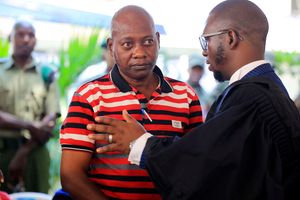
Pastor Paul Mackenzie (left) confers with his lawyer Lawrence Obonyo (right) at Mombasa Law Courts on October 19, 2026. Mackenzie and 30 co-accused were found guilty in 191 counts of murder in the Shakahola case.
Photo credit: Kevin Odit | Nation Media Group
The defence urged the court to consider the convicts’ personal circumstances and their conduct in custody, arguing that sentencing should leave room for rehabilitation.
In their mitigation, they acknowledged the scale of the loss, describing the deaths of 191 people, including 190 children, as a tragedy of immeasurable proportions. They stressed that their plea was not intended to undervalue the suffering of bereaved families or suggest that their loss could be remedied.
“At the outset, the convicts acknowledge the gravity of the offences for which they have been convicted and the immense loss of human life involved,” the defence submitted.
The lawyers asked the court to assess remorse through the convicts’ conduct, recognition of wrongdoing, willingness to reform and commitment to lawful living.
“A sentence which leaves room for reform is not a sign of weakness,” they submitted, arguing that the justice system should recognise people’s capacity to change.
The convicts said they had been in custody since 2023, during which they had attended religious programmes and other training. They singled out a deradicalisation programme held between August 20 and 23, 2025, as evidence of their willingness to change and return to society.
They also claimed their religious beliefs and outlook had shifted since their arrest, urging the court to consider this alongside the pre-sentencing reports.
The defence proposed prison terms of no more than 10 years, with the time already spent in custody taken into account.
“We propose a prison term not exceeding 10 years, taking into account the period the convicts have already spent in custody,” they submitted.
The lawyers further argued that all 28 convicts were first offenders, presenting police clearance certificates issued by the Directorate of Criminal Investigations on October 30, 2026, showing that none had previous convictions. They urged the court to impose individualised sentences based on each person’s role and level of responsibility.
“The convicts do not contend that the Constitution prevents the court from imposing a severe sentence where the circumstances warrant it. Rather, they submit that even a severe sentence must be lawful, proportionate and imposed through a fair and individualised judicial process,” they added.
The impact of imprisonment on their families was also raised as a mitigating factor. The defence said some convicts had children, spouses and elderly parents who depended on them, while their absence had left families with additional financial and caregiving responsibilities.
“The convicts are individuals who, notwithstanding their convictions, remain members of families and communities. Before their incarceration, some were parents, spouses, sons, daughters and providers,” the lawyers submitted.
Mackenzie also invoked Article 28 of the Constitution, which guarantees human dignity, arguing that the right continues to apply after conviction. The defence cited Section 333(2) of the Criminal Procedure Code, which requires courts to take account of time spent in custody when passing sentence.
They argued that the period already served should be deducted when determining the effective sentence.
The prosecution, however, urged the court to impose sentences that reflect the gravity of the offences, alongside structured rehabilitation and disengagement programmes.
Deputy Director of Public Prosecutions Jami Yamina told the court that all the convicts, except Enos Amanya Ngala, had maintained their innocence. Ngala admitted participating in the murders.
“They have maintained innocence, denied responsibility for the crimes and negatively framed the charges against them. Essentially, the convicts expressed no remorse or regret on their part. It is also absurd that they persist with the adherence to the teachings that caused the deaths,” Mr Yamina submitted.
The State argued that the sentences should reflect the scale, magnitude and seriousness of the crimes. It proposed an 11-year prison term for Ngala, taking into account the period he had spent in custody since his arrest in April 2023.
The prosecution also proposed a rehabilitation programme lasting between 24 and 30 months, with periodic progress reports to guide a review of his sentence.
For Mackenzie, the State sought the death penalty, while proposing life imprisonment for the remaining 27 convicts. Mr Yamina argued that capital punishment was appropriate for Mackenzie because of the gravity and nature of the offences.
“The prosecution supports the imposition of capital punishment for Mackenzie, subject to consideration of his mitigation, remorse, regret, and prospects of rehabilitation,” he submitted.
Should the court find the death penalty unsuitable, the prosecution argued that Mackenzie should remain incarcerated for life or receive lengthy consecutive sentences to protect the public.
The State described the other convicts as heavily indoctrinated and at risk of reoffending, arguing that Mackenzie bore greater moral responsibility because he had counselled and influenced them.
It further submitted that their continued adherence to the teachings that led to the deaths raised concerns about the possibility of reoffending, including while in prison.
“Therefore, indefinite detention is necessary until they can be safely reintegrated,” Mr Yamina submitted.
Paul Mackenzie during the hearing of his case at Mombasa Law Courts on July 17, 2026.
Photo credit: Kevin Odit | Nation Media Group
The prosecution warned that sentences without effective disengagement and rehabilitation would leave the convicts at risk and difficult to manage.
“In their current psychological state, they cannot function as normal citizens,” he added.
The State urged the court to balance retribution, deterrence, public protection, denunciation of crime, restorative justice and rehabilitation. It also proposed grouping the victims by age: children up to seven years, those aged between eight and 14, and minors aged between 15 and 18.
The prosecution further presented a proposal by the National Counter Terrorism Centre recommending voluntary participation in rehabilitation programmes and engagement with counter-narratives to support the convicts’ eventual reintegration.
Mackenzie and 28 others were convicted of 191 counts of murder arising from deaths at Shakahola Forest in Malindi Sub-County, Kilifi County, between January 2021 and September 2023. The court will deliver its sentence on November 6.