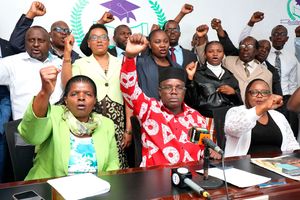
But while the court has delivered its findings, the scale of the tragedy, the suffering of the victims and the circumstances that allowed it to unfold remain difficult to comprehend.
In its October 19 decision, the High Court found controversial preacher Paul Nthenge Mackenzie and 28 others guilty of murdering 190 children and one adult in Shakahola Forest between January 2021 and September 2023.
The victims died under a deadly fasting regime that the court found was driven by Mackenzie’s radical teachings and the promise of salvation through Jesus.
The judgment laid bare how religious teachings were allegedly turned into instruments of control, with followers subjected to deprivation, coercion and violence. Mackenzie issued directives requiring followers to fast, while those who resisted faced physical abuse.
The court found that Mackenzie did not act alone. His associates played different roles in sustaining the operation, including providing security, enforcing fasting, preventing children from escaping and frustrating rescue attempts.
Some converted dwelling structures into fasting bays, while others helped dig graves, transport bodies and conceal deaths. The court found that the accused persons performed interdependent roles in an organised system that led to the deaths.
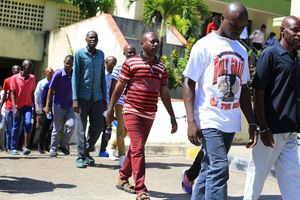
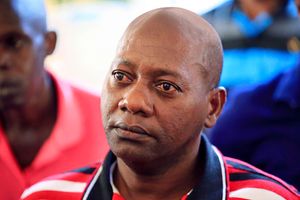
Pastor Paul Mackenzie (in stripped t-shirt) with his co-accused persons at the Mombasa Law Courts on October 19, 2026 after they were found them guilty in 191 counts of murder in the Shakahola case.
Photo credit: Kevin Odit | Nation Media Group
The consequences were devastating. A total of 429 bodies were recovered from shallow graves in Shakahola, although the murder convictions in this case concerned 191 victims.
Those involved in concealing the deaths went further, flattening graves and planting vegetables over them in an apparent attempt to hide the burial sites and prevent the tragedy from being discovered.
Yet the conclusion of the trial is not the end of the Shakahola story. Beyond the convictions lie lives cut short, survivors struggling to rebuild and families still searching for answers.
The judgment marks a significant step towards accountability, but it also leaves Kenya with the responsibility of confronting the warning signs exposed by the tragedy and preventing similar abuses committed in the name of faith.
With the verdict delivered, attention has now shifted to sentencing, the next stage in determining the punishment for the 29 convicts.
Justice Diana Kavedza has set an expedited timetable, instructing the Director of Probation and Aftercare Services to assign an individual probation officer to each convict and prepare pre-sentencing reports to guide the court.
Justice Diana Kavedza delivers her verdict on the Shakahola mass deaths at the Mombasa Law Courts on October 19, 2026.
Photo credit: Kevin Odit | Nation Media Group
"I am giving you a very short period. That's why I am giving each convict an individual probation officer," said the judge.
She directed that no probation officer should interview more than one convict, insisting that each must have an individual report.
"The order is that one probation officer will not interview two convicts. Every convict shall be assigned an individual probation officer," the judge said.
The reports will provide information about each convict’s background, including their place of birth, education, family relationships and character. They will also assess their attitude towards the offences, whether they have shown remorse and whether they have previous criminal records.
Probation officers are expected to obtain views from family members, including whether they would be willing to receive the convicts back into their homes and communities.
The reports will also incorporate Victim Impact Assessments, documenting victims’ experiences, feelings about the crimes and views on the sentences the court should impose.
The recommendations may be favourable or unfavourable, depending on a convict’s conduct in the community, criminal history and attitude towards the offence. A favourable report may support a plea for leniency, while an unfavourable one may weigh against it.
However, the reports will not determine the sentences. That responsibility rests with the judge, who must consider the law, the gravity and circumstances of the offences and other relevant factors, including the probation officers’ recommendations.
Shakahola verdict: Mackenzie, 30 co-accused guilty on all 191 counts of murder
The court will mention the matter on October 30 to receive the reports for all 29 convicts. From November 2, it will hear mitigation submissions from each of them.
Mitigation is the stage at which convicts ask the court to consider circumstances that could warrant leniency before sentencing. They may express remorse, explain their personal circumstances and present other factors they believe should persuade the court to impose a lesser sentence.
The submissions will be made orally, either by the convicts themselves or through their advocates. Justice Kavedza directed prison officers to ensure all the convicts are produced in open court for the proceedings.
The judge has set November 6 as the sentencing date, warning probation officers that they must complete their work within the limited time available.
"Sentencing will be delivered on November 6. Probation officers, you do not have time, but you must act," said Justice Kavedza during the delivery of the verdict.
The court has also addressed how victims’ views will be considered before sentencing. Justice Kavedza said she already had 68 Victim Impact Assessment reports from across the country and would not take further evidence from victims at this stage.
"So the victims are already represented, so I am going to skip taking evidence from the victims. I took them when Enos Amanya confessed . What therefore remains is mitigation from the convicts," the judge said.
Enos Amanya, a follower of Pastor Paul Mackenzie, testifies in court on February 25, 2026.
Photo credit: Kevin Odit | Nation Media Group
The court had earlier directed that three children be physically presented to express the views of children who suffered during the Shakahola tragedy as part of the victim impact assessment process.
To protect their identities, their voices will be distorted. The Office of the Director of Public Prosecutions was directed to liaise with the Witness Protection Agency to make the necessary arrangements.
Justice Kavedza emphasised that she wanted to hear directly from the children rather than rely on accounts presented by child protection officers.
"I do not want to hear from child protection officers, but from the children themselves as victims of the crime," said the judge.
In its detailed analysis, the court found that the deaths resulted from an organised system of radicalisation, coercion and deliberate deprivation of food and water.
Justice Kavedza found that Good News International (GNI) exhibited characteristics of a doomsday cult, including absolute leadership, isolation, manipulation and domination. However, she clarified that classifying the group as a cult did not, by itself, establish criminal guilt.
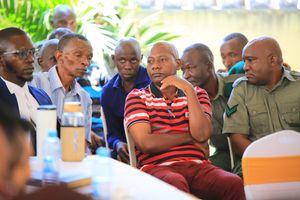
Pastor Paul Mackenzie with his Co-accused during the reading of the Judgement in a case where is charged with murder of 191 Children in the Shakahola Massacre.
Photo credit: Kevin Odit | Nation
The court found that Mackenzie and associate pastors radicalised followers through the deliberate misinterpretation of scripture, promoting extreme beliefs that led to children being withdrawn from school, denied medical care and isolated in Shakahola, while followers were encouraged to reject government authority.
The judge also upheld the reliability of the recovery and examination of human remains, rejecting arguments that the absence of a forensic archaeologist rendered the process defective.
Starvation was confirmed as the cause of death in 72 cases. Other deaths involved asphyxia, manual neck compression and traumatic head injuries. Although decomposition prevented pathologists from determining the precise cause of death in 110 cases, the surrounding circumstances supported the conclusion that the victims had also died from starvation.
The court found that Mackenzie directed followers to fast to death, beginning with children, while violence, confinement and the withholding of food and water were used to enforce compliance. Children who resisted were beaten, restrained or locked inside houses.
It rejected the argument that the children had freely consented to the fasting regime, finding that they lacked the free and informed consent required to make such a decision.
The court further found that criminal responsibility had to be established individually, with evidence linking each accused person to the common purpose and showing that the deaths were a probable consequence of pursuing it.
Having evaluated the evidence, the court convicted all 29 accused of murder under Section 203 of the Penal Code.