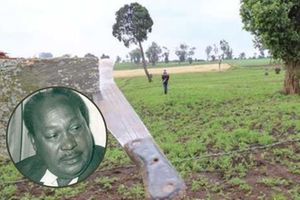
For nearly two decades, 4,500 small-scale coffee farmers in Murang’a County have been locked in a bruising legal fight to recover their prime land worth Sh6 billion.
What began as a cooperative dream in the 1970s has turned into one of Kenya’s longest-running land disputes, exposing loopholes in government registries, judicial lapses and the devastating cost of corruption for ordinary citizens.
At the centre of the dispute is the Samuru-Gituto Farmers’ Cooperative Society, which once held 543 acres of fertile land near Thika town in Kiambu County.
Through forged government documents, questionable court orders and shadowy land dealings, a group of impostors managed to seize control of the society’s property, leaving its members dispossessed and in endless litigation.
The Court of Appeal in 2019 declared the scheme fraudulent, but the land remains tied up in court battles.
Hotels, homes and other investments now sit on portions of the disputed land, deepening the complexity of the case and making restitution increasingly elusive.
Samuru-Gituto Farmers’ Cooperative was born in the 1970s, during the golden years of Kenya’s coffee industry.
Murang’a, along with Nyeri and Kiambu, was at the heart of the coffee belt that powered the national economy. Farmers pooled resources, bought the 543-acre parcel registered as LR NO. 10743 and planted coffee as a long-term investment.
But by the 1990s, global coffee prices had collapsed, hitting smallholder farmers hard.
Societies across central Kenya struggled to repay loans and keep afloat. By 2005, Samuru-Gituto was grappling with a Sh15 million debt to Co-operative Bank. In a Special General Meeting (SGM), members resolved to sell part of the land to settle the debt.
The land was subdivided into 11 parcels, some sold off by the bank to offset arrears. After write-offs and repayments, 301 acres remained under the society’s control. For the farmers, this was their safety net — land that could be leased or sold later to support livelihoods.
Until 2006, the society’s affairs were managed by an elected committee led by Chairman Hiram Kamau. Their leadership had been duly registered with the Commissioner for Cooperative Development. Then came the first challenge.
In September 2006, a rival group led by three men — Francis Mwaura, Peter Nduati and Simon Ngure — emerged, claiming to be the rightful officials. Their rise was tied to a meeting presided over by then Assistant Minister for Cooperative Development, the late David Mwenje.
Unlike the earlier SGM, this gathering was more of a “baraza” than a legally constituted cooperative meeting. Yet from it, the so-called “Mwenje group” was born, contesting the authority of the Hiram-led team.
The conflict escalated in 2008 when the three appeared at the Nairobi offices of the society’s lawyers. They presented a letter, allegedly from the Thika District Cooperative Officer, confirming them as the legitimate officials.
That single letter — dated August 1, 2008 — proved to be the pivot of the entire fraud. With it, the impostors obtained court orders from the Thika Magistrate’s Court, secured duplicate deed plans for the land, and began disposing of parcels.
Later, the real District Cooperative Officer disowned the letter, calling it a forgery and reporting it to the Directorate of Criminal Investigations (DCI). But by then, damage had been done.
On August 20, 2008, armed with the forged letter, the Mwenje group secured an order from a Thika magistrate declaring them the bona fide officials of Samuru-Gituto. Within days, they obtained further orders compelling the Hiram-led group to hand over the title deed, company seal, receipt books, and even access to the cooperative’s bank account at Co-operative Bank, Thika.
The orders effectively handed them control of the society — and its most prized asset, the 301 acres.
Alarmed, the Commissioner for Cooperative Development moved to court, seeking to have the orders set aside. He argued that his office had no record of the Mwenje officials, and that the foundation of their case — the letter — was a forgery. But on December 9, 2008, a magistrate dismissed the application, leaving the orders intact.
The Hiram group escalated the matter, filing cases at the High Court and later the Court of Appeal. But in the meantime, the disputed land was being transferred, subdivided, and sold to unsuspecting third-party buyers.
Since 2006, the case has passed through at least nine judicial officers — two magistrates and seven judges. Each stage added twists, delays, and costs for the farmers.
In January 2009, Justice Joseph Nyamu issued conservatory orders barring any further dealings on the land.
"Conservatory orders were necessary to stop alienation of the Society land and were issued accordingly. Surprisingly, despite the court orders and numerous complaints laid before the Government offices, who were reluctant to register the court orders and caveats against the Titles, the supplementary record shows that Duplicate Deed plans were issued and sales of the Society land were processed," said the Court of Appeal.
Yet, according to appellate judges, government registries failed to enforce those orders. Duplicate deed plans were issued, and sales processed, despite clear restrictions.
The High Court initially dismissed the Hiram group’s case in 2010, ruling it should have been filed at the Cooperatives Tribunal. That decision left the society in limbo until 2019, when the Court of Appeal overturned it.
In a scathing judgment, appellate judges Phillip Waki (retired), Daniel Musinga, and the late Otieno Odek described the leadership squabbles as a smokescreen for corruption.
Justice Daniel Musinga at the Supreme Court in Nairobi on May 24, 2021.
Photo credit: Dennis Onsongo | Nation Media Group
“"We have carefully perused the record of appeal and we are persuaded that the alleged leadership dispute is a red herring, tailored at masking the scramble for the fraudulent alienation of the Society's land," said the judges in the verdict dated March 22, 2019,” the court observed.
They nullified the magistrates’ orders, restoring hope to the farmers. But by then, much of the land had already changed hands.
For the 4,500 members of Samuru-Gituto, the dispute has been devastating. Many are elderly, their hopes of retirement pinned on proceeds from the land. Others passed away waiting for justice.
Some farmers told the court they had expected to use the land to educate children or start small businesses. Instead, they have spent years attending hearings, contributing funds for legal fees, and watching others occupy their property.
Adding insult to injury, new landowners — some with hotels and residential estates on the disputed plots — have filed their own suits, claiming they bought the land legally. This has left the farmers fighting not only impostors but also powerful third parties with deep pockets.
The Samuru-Gituto saga is not just about one cooperative. It exposes weaknesses in Kenya’s land governance system.
Forgery Vulnerabilities: A single fake letter was enough to unlock court orders and land records, with devastating consequences.
Judicial Gaps: Magistrates issued sweeping orders without fully interrogating documents, later described by appellate judges as a “nullity.”
Registry Complicity: Despite court injunctions, officials at the Lands Ministry and Survey Department processed transactions on the disputed land.
Endless Litigation: Farmers have been dragged through overlapping courts — magistrates’, High Court, Tribunal, Court of Appeal, and now the Environment and Land Court — prolonging justice.
For many, it is a textbook case of how ordinary Kenyans are outmatched in legal and bureaucratic battles when powerful interests move in on land.
Today, the case sits before Justice Anne Omollo at the Environment and Land Court in Nairobi. The current Samuru-Gituto leadership, now headed by Chairman George Kuria Njuguna, is pitted against the remnants of the Mwenje group and land buyers.
The buyers argue they purchased the land for valuable consideration and hold titles issued by government registries. The society insists that those titles rest on fraud and illegality.
The outcome will determine whether the 4,500 farmers regain their land or remain among Kenya’s countless victims of land fraud.
“The motivating factor for the leadership squabbles is greed for power and influence — or simply put, corruption.”
For the farmers, it has been nearly two decades of waiting. For the justice system, it is a test of whether fraud and forgery can be allowed to defeat the rights of ordinary Kenyans.
What began as a cooperative dream in Murang’a has become a cautionary tale — how a forged letter, unchecked by government officers and courts, can rob thousands of people of their heritage.
And until the final verdict is delivered, the members of Samuru-Gituto Farmers’ Cooperative Society remain in limbo: landless landlords of a Sh6 billion estate.