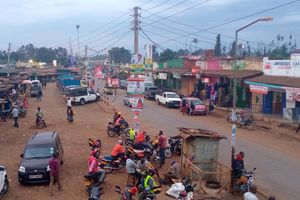
Part of Mukuyu town on March 26, 2026.

Mukuyu town in Murang’a County is often described as a place of unexploited potential, a settlement brimming with opportunity, yet trapped in an economy largely driven by the “sin industry.”
Barely a kilometre from Murang’a town, the county headquarters, Mukuyu sits along the busy Nairobi–Murang’a highway. A Sh10 ride on an NTS Sacco matatu is all it takes to move between the two towns. But beyond this proximity to administrative and economic power lies a starkly different reality.
The town has, in recent years, gained notoriety for insecurity linked to the Gaza gang and its proximity to troubled villages such as Maragi, Muchunguca and Ndikwe.
It is surrounded by low-income estates including Mjini, Kiawamburi, Majoyce and Soweto and has increasingly become a hideout for criminals fleeing neighbouring Maragua town.
Yet, for many residents, survival here is built on a fragile, informal economy where even Sh100 can stretch remarkably far. With it, one can buy food, alcohol, tobacco, muguka and even unprocessed cigarettes locally known as kiraiku.
Also Read: Kenol - Murang’a’s dangerous Las Vegas
A typical breakdown paints a vivid picture of life in Mukuyu: Sh20 for a measure of alcohol, Sh20 for a meal, Sh20 for tobacco, Sh30 for muguka and Sh10 for cigarettes. It is an economy sustained by low incomes and high vulnerability.
On Wednesdays, the town comes alive as it hosts one of the largest banana markets in Murang’a County. For many struggling families, this market offers a lifeline and not through trade but through what is left behind. Scattered bananas aftermarket hours are collected by residents for meals, a quiet testament to the depth of poverty.
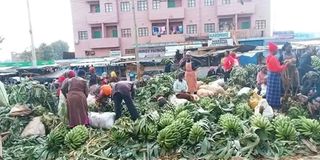
Part of Mukuyu town banana market that happens every Wednesday.
Equally striking is the town’s social landscape. It is not uncommon to encounter heavily intoxicated youths as early as 5am, with the same scenes stretching late into the night. Enforcement of the Liquor Control Act is virtually absent, residents say, with cartels allegedly controlling the trade, collecting protection fees and shielding illegal operations.
Despite repeated assurances from the Murang’a County Security Committee, little appears to have changed.
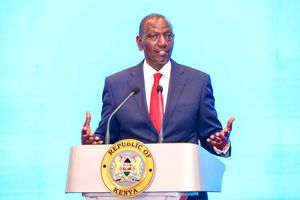
“We are on top of things in the whole county and especially Mukuyu. Every security team knows what has to be done. We must eradicate illicit brews and gangs and deal firmly with narcotic cartels,” County Commissioner Hassan Bule said on March 16, 2026, directing local security teams to restore order.
But on the ground, residents describe a different reality e of chaos, neglect and lost opportunity.
“This is a major town along a key highway used by some of Murang’a’s wealthiest individuals heading to their rural homes,” says Mzee Simon Karani, 85, a lifelong resident. “Yet the town survives on the lowest form of economic activity. It reflects the joblessness of our youth, who are not empowered to grow but are instead trapped as consumers in this cycle.”
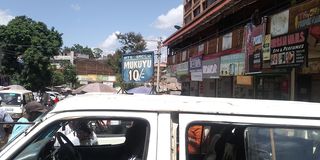
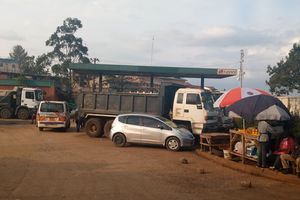
A bus stage in Mukuyu on March 26, 2026.
Amid the gloom, some see untapped potential. Rwathia Distributors Company director Kanene Kabiru believes Mukuyu could transform into a banana processing hub, unlocking value for farmers and creating jobs.
“The bananas you see here are a classic case of raw exploitation. A farmer sells a bunch for Sh100, but by the end of the value chain, it can fetch up to Sh1,200. That value is lost to middlemen,” he says.
He argues that small-scale industries producing banana flour, snacks, animal feed and even local brews could revolutionise the town’s economy.
“We can create jobs, generate taxes and build a sustainable local economy instead of relying on this cycle of exploitation,” he adds.
However, beneath the visible struggles lies a more complex and shadowy transformation. There are growing concerns over a wave of property acquisitions in the town, suspected to be driven by organised cartels and possible money laundering.
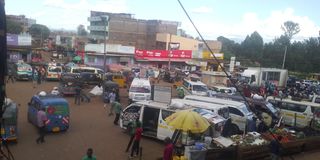
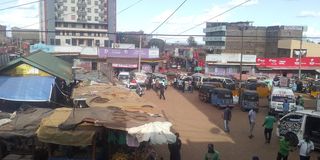
Part of Mukuyu town matatu terminus on March 26, 2026.
Murang’a Property Brokers Association chairman James Kimani says the trend is displacing small traders and low-income tenants, reshaping the town in ways that raise more questions than answers.
“We are seeing a monopoly of property ownership emerging. Small traders are being pushed out as buildings change hands. Residents have a right to know who is taking over their town,” he says.
According to Mr Kimani, the pattern suggests coordinated buying, possibly by groups pooling resources in a manner similar to a savings scheme, but with the effect of distorting the local property market.
As Mukuyu grapples with crime, poverty and informal economies, its story is one of stark contrasts — between proximity and neglect, potential and stagnation, survival and exploitation.
For now, it remains a town waiting to be discovered — or perhaps, rediscovered — beyond the shadows of its current reality.
Follow our WhatsApp channel for breaking news updates and more stories like this.