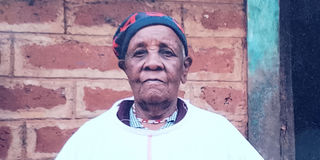
Ms Tabitha Muthike.

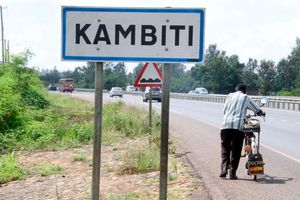
As residents living along the Kenol–Sagana highway turned out every morning in 1971 to marvel at tractors rolling onto tarmac the road, a woman named Tabitha Muthike, then aged 52, was quietly unfolding a spiritual narrative along the same route—one that would later manifest as Kwa Muthike town.
By the time she died in 2014 at the age of 95, Muthike had amassed considerable wealth while founding a powerful witchcraft folklore that has stubbornly endured, defining the identity of the town to this day.
One of the dominant narratives surrounding Muthike was the belief that she caused road accidents in the area to harvest human blood for her rituals.
Another was that her black magic protected charcoal traders at the local market from thieves. Charcoal sellers would reportedly leave their sacks by the roadside clearly marked with prices and go home. Buyers were said to help themselves—placing payment under a hewn stone near the sacks before taking what they needed.
“We grew up believing that if one stole the charcoal, Muthike’s powers would either drive you mad until you returned it or you would be unable to remove the stolen merchandise from your back,” says Jacinta Syokau, 73, a resident of Kwa Muthike market in Murang’a.

Charcoal laid out for sale on the Kenol–Sagana highway.
She adds that it was also believed that if stolen charcoal was transported by bicycle or vehicle, the transport would stall or mysteriously catch fire.
“However, we never encountered any real incident to prove these beliefs. From time to time, charcoal would still get stolen,” Syokau says.
According to Muthike’s daughter-in-law Margaret Ndasya, the woman was largely misunderstood.
“Many called her a witch but she was a medicine woman. She converted from a sergeant major in the Jeshi la Wokovu (Salvation Army) faith into the world of traditional gods,” says Ndasya.
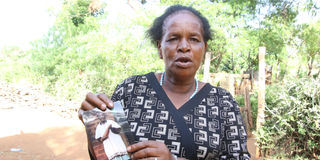
She claims her mother-in-law cured ailments, cast away spells, foretold personal and societal futures and acted as an “intermediary between the community and the spirit world”.
“What we never fully understood is which side of the spirit world she drew her power from. But politicians and businessmen from far and wide sought her services and paid her handsomely.”
Early years
Ms Tabitha Muthike.
Muthike’s journey began in Mwala, Machakos County where she was born. At the age of 10 in 1929, she moved to Yatta then later to Mwea in Kirinyaga County. In 1969, she settled in Mananja, where she established herself as a full-time medicine woman accompanied by her husband Michael Ndelevu, who died in 1979.
In Mananja, she acquired 50 acres of prime land—part of it bordering the Kenol–Sagana highway and another touching the Tana River. The land was financed through proceeds from her traditional healing practice according to family members.
She was the first person in the area to build a modern house. Over time, her land boundaries separated from Mananja village and came to be known as Kwa Muthike giving rise to what was once a dusty, ghostlike settlement that has since become a permanent landmark.
“This town is almost an accident. It is named after a woman we feared growing up. We heard she kept giant snakes for rituals and caused accidents to feed her gods. This town was founded under what many considered savage witchcraft,” says Dennis Mutinda, 63, a resident.
However, Muthike’s family strongly disputes this portrayal. Her great-grandson Musyoki Ndasya, 23, says that although their matriarch abandoned Christianity to pursue traditional spiritual practices, she remained modern-minded.
“She ensured all her six children—three sons and three daughters—were well educated. Some of her descendants live abroad,” he says.
Musyoki adds that Muthike insisted her descendants remain Catholic and even donated two acres of land for the construction of a church.
This duality gave Kwa Muthike an aura where dark spiritual beliefs coexisted with Christianity. Behind the town stand two trees that remain deeply revered and visitors are sternly warned about them. One is a Mugumo tree, which served as Muthike’s shrine.
“This is where she performed rituals to ward off bad omens and disease outbreaks and where she received spiritual visitations. She administered medicines under this tree,” says Ndasya.
The second is a massive Mukuyu tree, with a trunk measuring about 20 square feet and a canopy spreading nearly 50 square feet. No resident dares harvest any part of it.
“This was her main worship centre,” Ndasya says.
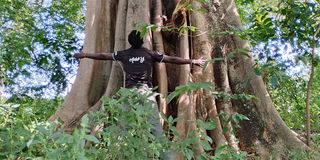
“She would gather with about 50 male and female council members to dance and pray, carrying paraphernalia that made many suspect witchcraft.”
Muthike also served as the community’s unofficial weather forecaster.
“If she planted maize and beans, we all followed suit. She only planted when her spirits assured her of sufficient rain,” says Martin Kasyoki, 83, a resident.
Ms Muthike died of old age in her home. Local clergy, including those from the church built on her donated land, declined to bury her, saying they could not endorse her lifetime beliefs. Her children in the US brought in their own clergy who conducted the burial.
Her casket was buried alongside another box containing her ritual paraphernalia.
The family chose not to mark her grave hoping to put her resting place behind them. Yet her name lives on—over 50 of her descendants have named daughters after her.
Follow our WhatsApp channel for breaking news updates and more stories like this.