Murang’a County is the fastest-growing devolved unit in the Mt Kenya region in terms of economic output, recording a steady contribution to Kenya’s gross domestic product (GDP), a report has shown.
The report by the Kenya National Bureau of Statistics (KNBS) showed the Governor Irungu Kang’ata-led county’s economy recorded a more than 13 percent growth between 2023 and 2024 alone.
The growth saw the county’s economy now estimated at 295.89 billion, having posted a more than 34,000 growth in its nominal gross county product (GCP) boosted by diversified economic and agricultural activities.
The percentage growth saw the county outpace its closest challenger – Nyeri County – by close to a five percent margin, signifying its growing economic stature in the Mt Kenya region.
Although still lagging behind economic giants such as Nakuru and Kiambu Counties, the report indicated that Murang’a currently boasts the third biggest contribution to Kenya’s GDP from the region, with some 295.89 billion having grown from 261.52 billion.
However, despite Nakuru being the fourth largest county in terms of contribution to the GDP, it had the slowest growth of only 2.1 percent.
On the other hand, Murang’a County outgrew Nairobi County by some six percentage points, boosted by its strong performance in agricultural and service sectors.
Embu, with a growth rate of 8.3 percent represents the third fastest-growing devolved unit in the Mt Kenya region, followed by Meru at eight percent and, Kiambu at 7.7 percent and Kirinyaga at 7.1 percent.
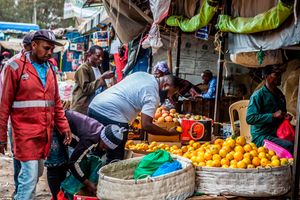
A view of Kenol town in Murang’a county on November 10, 2025. The town continues to grow as improved infrastructure and new businesses attract more residents.
Photo credit: Lucy Wanjiru | Nation
Nominal GCP measures the absolute value of goods and services produced within a specific county’s borders, expressed in current prices without adjusting to inflation. It indicates a county’s direct economic output and its share of the national GDP.
Nairobi County’s economy is estimated at Sh4,105.6 billion, followed by Kiambu at Sh819.8 billion and Nakuru at 771.8 billion. Only five counties recorded GCP of more than Sh500 billion, with others being Mombasa and Meru, the latter being boosted by a strong performance in the agricultural sector
Murang’a’s vibrant agricultural sector saw it post strong performance nationally of 4.1 percent only bettered by Meru, Nakuru and Nyandarua Counties.
GCP provides the value of goods and services produced within each county, forming a basis for analysing regional economic structures, growth trends, and contributions to national output.
In the manufacturing sector, Murang’a was also not left behind, as it was among the best-performing counties, with Kiambu and Nakuru also strong performers in a sector dominated by Nairobi County.
Nairobi contributes some 36.4 percent of total manufacturing gross value addition through manufacturing activities conducted in the capital city, followed by Mombasa at 9.8 percent, Kiambu 8.3 percent, Machakos eight percent, Kilifi 4.6 percent and Nakuru at four percent.
Overall, four counties of Nairobi, Kiambu, Nakuru and Mombasa contributed about 43 percent of Kenya’s gross value added share in 2024.
“Counties with major commercial hubs including Nairobi, Kiambu, Nakuru, Mombasa and Machakos consistently posted higher gross value addition shares while agriculturally strong and economically diverse counties such as Meru, Kakamega, Nyeri and Murang’a also made notable contributions,” reads the report.
“In total, 33 out of 47 counties each accounted for less than two percent of gross value addition, underscoring the concentration of economic activities within a few counties,” adds the report
The devolved unit was followed by Kiambu (3.7 percent), Bungoma and Nandi both at 3.6 percent, rounding off the top five.
Kenya’s economy is largely anchored on agriculture, with the largest population depending directly or indirectly on agricultural activities for their livelihoods, making it a cornerstone of Kenya’s socio-economic development. Agriculture contributes, on average, about a fifth of Kenya’s total GDP.
As of 2024, Kenya’s overall nominal GDP per capita was Sh309,460.4 billion, up from 291,769.7 billion in 2023.
While the services sector continued to dominate county economies, agriculture remains the mainstay in rural and high-potential areas.