Imagine you are a towering Kenyan political figure facing imminent death—someone like Kenneth Matiba, Jaramogi Oginga Odinga, Mzee Jomo Kenyatta, or Charles Rubia. You have one final chance to share your thoughts on Kenya. What would you say?
Personally, I would pen a bold, truthful, and unfiltered dossier exposing hidden political truths. I would entrust this document to three independent lawyers, unknown to each other, with instructions to reveal its contents publicly at my funeral.
The dossier would likely be scandalous, unveiling secrets long concealed. Yet, it would serve a higher moral purpose. Politicians, by the nature of their craft, obscure vital public information. Which leader would willingly stir controversy? In other democracies, memoirs are common, but they are often written during a politician’s lifetime, tempered with social pressures to soften the truth. On a deathbed, such restraints vanish.
Imagine if Moi had been candid about Robert Ouko’s death or Peter Okondo about Bishop Alexander Muge. Such revelations would carry profound weight, fostering a more moral and enlightened generation through disclosures that shame or inspire.
These reflections could also be constructive, offering a leader’s vision for their nation’s future.
Augustus, often regarded as Rome’s greatest ruler, unified the empire, brought peace through political mastery, and spurred economic progress. He ruled for over 40 years, almost entirely peacefully. This was after the turmoil that followed Julius Caesar’s assassination. On his deathbed, Augustus reportedly said, “I found a city of clay. I leave Rome a city of marble.”
US President John F. Kennedy, moments before his assassination, replied, “No, you certainly can’t,” to a friend’s remark about the warm welcome in Dallas, Texas. Napoleon Bonaparte of France murmured, “France, army, head of the army, Josephine,” reflecting his devotion to his nation and family.
US President George Washington’s final words were, “’Tis well,” expressing contentment with his care and circumstances. UK Prime Minister Winston Churchill’s recorded last words were, “I’m bored with it all,” revealing his weariness with life’s struggles.
Mahatma Gandhi of India exclaimed, “Oh God,” a poignant cry of shock and pain after being shot. Russia’s Tsar Alexander II, fatally wounded in an assassination attempt, said, “Home to the palace to die.”
Chile’s Salvador Allende declared, “I pray you to bear witness that I meet my fate like a brave man,” before taking his life during a military coup.
Julius Caesar, betrayed and stabbed by his friend, gasped, “You too, Brutus?” or “Et tu, Brute?” Russia’s last tsar, Nicholas II, said, “You know not what you do,” aware of the revolution’s dire consequences.
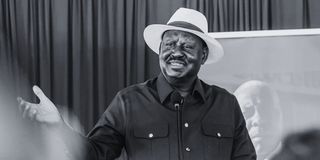
If Raila Odinga had the chance to speak his final words, what might he have said?
Likely, he would address ethnicity and politics. Kenya, independent for over 60 years, remains deeply divided along tribal lines. Raila would have urged Kenyans to build a society that values merit over tribe, lamenting how his own political aspirations were often viewed through an ethnic lens rather than as the efforts of a man striving to improve Kenya.
He might have noted that Africa’s arbitrary colonial borders, drawn with disregard for ethnic and cultural realities, sowed conflict and instability by splitting ethnic groups or forcing rivals into single states.
Ethnic diversity, coupled with struggles for power and resources, has fuelled violence, displacement, and marginalisation, hindering economic progress and social cohesion. Raila would likely have revealed how politicians prioritise their ethnic groups, leading to unequal resource distribution and eroded trust in institutions. He might have exposed how leaders manipulate ethnic identities to advance their interests, escalating tensions and deterring investment.
To address these challenges, he would have advocated for inclusive governance to manage ethnic diversity and drive economic development. This could be achieved by valuing diversity as an asset, establishing institutions that ensure equal representation and justice, and fostering equitable economic growth to reduce poverty and inequality.
These were themes Raila championed in life. In death, he would have reiterated them with urgency, and Kenyans might have heeded the words of a sage with greater attention, potentially ushering in a new era.