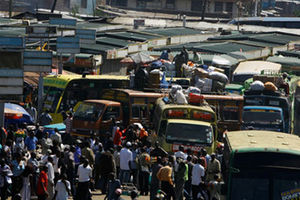
City Hall is losing at least Sh300,000 daily to illegal “parking boys” operating across Nairobi Central Business District, exposing motorists to extortion, theft and vandalism while undermining one of the county’s top revenue streams.
County officials admit they have struggled to dismantle the entrenched syndicate, which operates on major streets including Banda Street, Kimathi Street and around the Sunken Car Park. The groups, often working in collusion with rogue county attendants and private security guards, direct motorists to spaces—some not officially designated—then demand cash to “secure” vehicles.
Nairobi County Revenue Administration Chief Officer Tiras Njoroge said the network, estimated at more than 200 individuals, poses both a security risk and a major revenue leak. “It could be more if you factor in motorists who exploit the chaos to avoid paying daily parking fees,” he said, noting that in some streets, the illegal operators outnumber authorised attendants.
Parking fees are among the county’s five largest revenue sources—alongside land rates, business permits, advertising and building approvals—and rank third in internal revenue. Yet collections have consistently fallen short of targets over the past four financial years, with losses attributed partly to collusion and weak enforcement.
In the year ending June 2022, the county collected Sh1.87 billion against a Sh3 billion target, missing by Sh1.14 billion. The following year, it raised Sh1.86 billion, falling short by Sh1.16 billion. In the 2024 financial year, Sh1.97 billion was collected—Sh1.03 billion below target. In the year ending June 2025, revenue stood at Sh1.89 billion, while only Sh910.4 million had been realised halfway through the current financial year.
A parking boy directs a motorist on Banda Street in Nairobi on February 1, 2015.
Photo credit: File | Nation Media Group
County officials estimate annual losses of at least Sh1 billion due to systemic weaknesses, including collusion between attendants and the illegal operators. Despite automation of parking payments, cash transactions continue informally on the streets.
The county has attempted reforms, including expanding marked parking slots from about 12,000 to at least 16,900 and automating collections at key sites such as Sunken Car Park and the County Bus Station. But enforcement gaps persist.
Director of Revenue John Ntoiti said the problem has reached crisis levels. “We are almost declaring this a county disaster. The cartels are deeply entrenched. You arrest them, and within minutes they are back on the streets,” he said, blaming weak penalties and prosecution thresholds.
Under current by-laws and the Nairobi City County (Designated Parking Areas) Regulations, 2025, it is illegal to direct vehicles into parking spaces without authority, reserve spaces, or obstruct enforcement officers. Offenders risk clamping, towing and prosecution. However, officials say low bail amounts—between Sh1,000 and Sh2,000—have emboldened offenders.
“We conduct swoops, clamp and tow vehicles, but the menace persists. Cases are often dropped because they do not meet prosecution thresholds,” Mr Ntoiti said, adding that political considerations may also hinder stricter legislation.
The impact is felt directly by motorists, many of whom pay unofficial fees to avoid damage or theft. Those who refuse risk vandalised vehicles or stolen parts. Some drivers, under pressure to find parking quickly, hand over keys to the attendants—further exposing themselves to risk.
Investigations reveal a structured, territorial system underpinning the operations. Each street is controlled by a group led by a “chairman,” who vets new entrants and assigns zones. Operators often coordinate with rogue attendants and security guards to reserve slots, sometimes using parked vehicles as placeholders until a paying client arrives.
One operator along Kimathi Street said he joined the trade in 2005 and now earns between Sh1,500 and Sh2,500 daily. “This is how I pay rent and school fees,” he said, describing a system where access to parking depends on payment, vehicle type and familiarity with the operators.
Another operator along Moi Avenue said security guards provide access to reserved spaces for short-term use, with motorists paying Sh100 to Sh200, shared among the group. “Slots are always full, but some are controlled by us,” he said.
A man directs a motorist out of a parking lot on Banda Street in Nairobi. The number of parking boys and men has grown enormously on many streets in Nairobi. PHOTO | EVANS HABIL
The syndicate’s resilience is not new. Previous administrations, including that of former governor Mike Sonko, attempted crackdowns, including special enforcement units, but failed to dismantle the networks.
Urban analysts say the persistence of the problem reflects deeper governance failures, including weak enforcement, corruption and inadequate deterrence. They warn that unless systemic reforms are implemented—including stronger penalties, accountability for rogue officials and full automation of parking systems—the county will continue to lose revenue while motorists remain vulnerable.
For now, the streets of Nairobi’s central business district remain a contested space—where official systems coexist uneasily with an informal economy that thrives on gaps in enforcement, leaving City Hall counting losses and motorists paying the price.