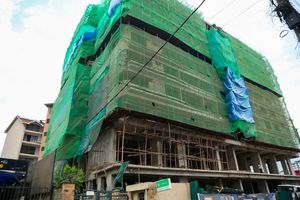
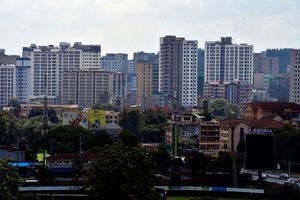
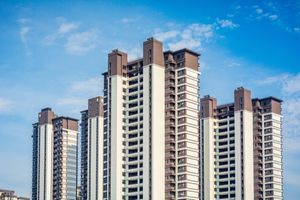
When you walk through many of Nairobi's residential neighbourhoods, it is hard to miss the transformation. In many residential estates, once popular for detached homes, towering apartment blocks now dominate the skyline.
The changing landscape is a deliberate county plan to replace low-density housing in parts of the city with high-rise developments.
Nairobi Governor, Johnson Sakaja, has, on previous platforms, argued that the city ought to build upwards to accommodate the growing population.
“We are going up, even up to 25 floors. And Nairobi-based people should understand very well. I have heard people in places like Kileleshwa and Lavington complain that our houses were one-storey, but now there are apartments everywhere. Nairobi is 696 square kilometres. By 2050, the city will have a population of 10.5 million people. Will we expand Nairobi? The only place we have to go is up,” he said in a video dated March 24, 2024.
Nairobi Governor Johnson Sakaja.
Photo credit: File | Nation Media Group
How should the city accommodate a fast-growing population without overwhelming the infrastructure that supports it? It is a question that has fuelled years of disputes between developers, county planners and resident associations. While supporters of high-density housing argue it is the only practical way to meet demand in a land-constrained city, some residents say the development has often outpaced investment in roads, drainage, water, sewerage and other essential services.
On June 18, members of the county assembly approved and adopted the Development Control Policy 2026, which provides a legal framework to guide land development and the approval of buildings across the city. Consequently, it was gazetted last month.
“Under the new policy, development approvals will be guided by clearly defined zoning regulations, building height limits, density controls, environmental safeguards and infrastructure capacity. New developments will also be aligned with the availability of essential services such as water, sewerage systems and road networks to prevent undue strain on existing infrastructure,” said Governor Sakaja.
Some of the upcoming new buildings under construction and an advertising post in Kileleshwa Estate in Nairobi on September 17, 2025.
Photo credit: Evans Habil| Nation Media Group
However, members of the Kileleshwa Ward Neighbourhood Association (KIWANA), an upmarket estate in Nairobi, are challenging the new framework, saying it ignores the fact that roads, sewerage systems, drainage, and other public services are already under pressure and will only worsen the situation.
Frustrated by what they describe as years of unchecked development, court cases that drag on for months and a lack of action by oversight agencies such as the National Environment Management Authority (NEMA), the residents are now seeking political intervention, hoping that the Senate will push for an overhaul of the policy.
According to Robert Omamo, a member of the Kileleshwa Ward Neighbourhood Association (KIWANA), the community has mobilised support for a petition to reject the policy, collecting 55 signed hard-copy petitions and more than 1,000 signatures through an online campaign.
“In other words, the gazetted policy is an illegal document that the county has come up with to avoid oversight from residents. Because, you know, in places like Kileleshwa, for instance, they have gone ahead to approve up to 30 floors and without the required infrastructure development. They have not given provision for road expansion and sewerage expansion. I mean, a local physical and land use development plan would actually be put into account before such things are done.”
He said that they have presented the petition to Nairobi Senator Edwin Sifuna, whom they claim has agreed to be a co-petitioner, and urged him to table their concerns before the Senate and push for an overhaul of the planning and development decisions, that they say will transform the once low-density neighbourhood into an area struggling with overstretched infrastructure.
Nairobi Senator Edwin Sifuna speaks to the congregation during a Sunday service at St Stephen's ACK Cathedral in Kisumu on July 12, 2026.
Photo credit: Alex Odhiambo | Nation Media Group
They say overloaded sewer systems, inadequate drainage and increased waste generation have created conditions that threaten the wellbeing of those living in the area.
“And that’s why we are seeing lots of traffic in these areas. This is happening in many neighbourhoods but I am biased about Kileleshwa because I live there. The people living downstream like Waruku are bearing the brunt of this drama because the sewer line cannot accommodate everything,” he added.
They also contend that the loss of green spaces has reduced areas for recreation and environmental conservation.
“We have seen a systematic scenario where there’s been an increase of buildings, the increase of the limit of floors without the requisite development of infrastructure. So, for us, the problem is not the development. The problem is that it’s being done in the wrong way. There is no infrastructure development to accompany these new buildings,” he said.
Some of the upcoming new buildings under construction in Kileleshwa Estate in Nairobi on September 17, 2025.
Photo credit: Evans Habil| Nation Media Group
The petition asks the Senate to investigate the planning processes that have allowed continued densification of the neighbourhood and to examine whether Nairobi County has complied with constitutional principles on public participation, environmental protection and sustainable urban planning.
It also calls for a review of development policies affecting established residential neighbourhoods, arguing that planning decisions should strike a balance between accommodating urban growth and protecting the character, liveability and environmental sustainability of communities.