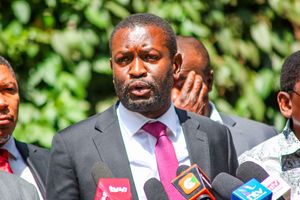
Questions over who will ultimately oversee Nairobi’s governance dominated debate at the County Assembly on Friday, after members raised concerns about a cooperation pact signed by Governor Johnson Sakaja and President William Ruto, even as its supporters defended it as long overdue and necessary for service delivery.
The agreement, tabled in the Assembly for the first time, establishes a two-tier governance framework a high-level Steering Committee and an Implementation Committee intended to coordinate the running of the capital between the county and national governments.
But MCAs said they had yet to be clearly briefed on their place within the new structure, particularly their constitutional role in oversight and control of public funds.
Under the deal, strategic oversight is vested in a Steering Committee chaired by Prime Cabinet Secretary Musalia Mudavadi, bringing together senior Cabinet secretaries, the Nairobi governor as vice-chair, the attorney general, and county officials.
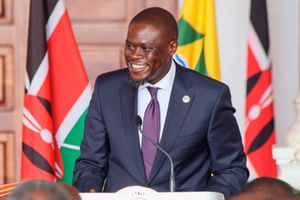
Nairobi Governor Johnson Sakaja delivers his speech during the signing of a cooperation agreement between the national government and the Nairobi City County Government at State House, Nairobi on February 17, 2026.
Photo credit: Wilfred Nyangaresi | Nation Media Group
An Implementation Committee, chaired by the governor, is tasked with day-to-day execution and may establish project-specific subcommittees.
Ngara MCA Mwaura Chege warned that the agreement risked weakening the assembly’s oversight mandate if no clear feedback and reporting mechanism was built in. Oversight, he argued, was not merely about applauding completed projects but about continuous scrutiny of how decisions are made and funds used.
“There must be a framework where members’ concerns are captured and followed up,” Mr Chege said, cautioning that without a formal reporting line back to the assembly, authority could drift toward the national executive while accountability thinned out.
Kileleshwa MCA Robert Alai questioned both process and intent, arguing that MCAs were being asked to interrogate an agreement they had not seen in advance. He also criticised the decision to route scrutiny through an ad hoc committee rather than existing sectoral committees dealing with garbage, sanitation and water.
“This is a house of law and order,” Mr Alai said, warning that the composition of the ad hoc committee risked giving the impression that key decisions had already been settled.
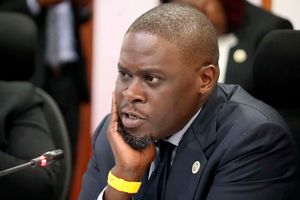
Nairobi County Governor Johnson Sakaja at State House on February 17, 2026.
Photo credit: Wilfred Nyangaresi | Nation Media Group
County assemblies, under Article 185 of the Constitution, are mandated to authorise local taxes and fees, approve budgets and appropriations, and oversee the collection and use of both own-source revenue and national transfers.
The cooperation agreement is silent on who ultimately controls Nairobi’s revenue streams, how collection and sharing will work, and whether existing contracts including garbage collection and other service concessions fall under county.
From the questions raised by the Assembly, central to this debate is the role and accountability of the committee chaired by Musalia Mudavadi. It remains unclear whether the committee reports to Parliament, the Nairobi County Assembly, or directly to the Presidency. This ambiguity extends to oversight: can the County Assembly summon the committee or its officials to account for expenditure and service delivery, or does scrutiny lie exclusively with Parliament?
The arrangement also raises practical concerns about accountability where mandates overlap. In the event of service delivery failures, it is uncertain whether responsibility rests with the governor, the committee, or the national executive.
Further, the fate of existing county contracts, including those for garbage collection and infrastructure works, remains unresolved.
Supporters of the pact, however, argued that the concerns were premature.
Assembly Speaker Kennedy Ngondi, who now chairs a 21-member committee established to scrutinise the agreement, said the timing of the agreement is 13 years late.
“We have been doing a disservice to Nairobi residents,” Mr Ngondi said, arguing that under the Urban Areas and Cities Act, such an agreement should have been in place since the advent of devolution. “All that residents need is service.”
He dismissed claims that the assembly had been side-lined, saying the document needed to be signed before it could be legally processed. The next steps, he said, would include public participation, debate, and formal approval by the house.
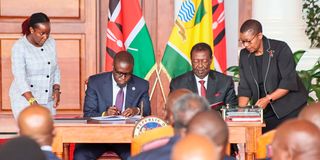
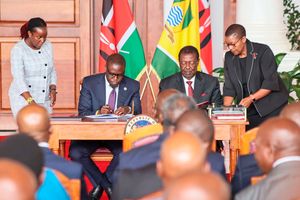
Nairobi County Governor Johnson Sakaja (centre left) and Prime Cabinet Secretary Musalia Mudavadi (centre right) during the signing of a cooperation agreement between the National Government and the Nairobi City County Government at State House, Nairobi.
Photo credit: Wilfred Nyangaresi | Nation Media Group
Majority Leader Peter Imwatok echoed that view, accusing critics of spreading fear. He said the agreement, initiated by the national government, could not simply be rejected if it promised development.
“The MCAs will debate and scrutinise this cooperation agreement,” Mr Imwatok said, adding that public participation would be conducted across all 85 wards.
Minority Leader Anthony Kiragu said the deal did not strip the assembly of its oversight powers, stressing that it was a cooperation framework rather than a transfer of functions.
The debate has also revived memories of the Nairobi Metropolitan Services, a national government–run experiment that ended in 2022 amid stalled projects, weak records and billions of shillings in unresolved liabilities.
During that period, the County Assembly was unable to summon NMS leadership for audit queries because the accounting officer reported to State House, not City Hall.
The assembly has given its 21-member committee, chaired by Speaker Ngondi, 11 days to scrutinise the agreement and table a report.