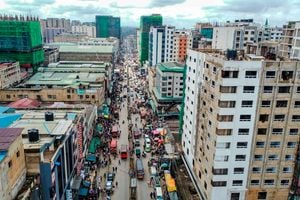
On Nairobi’s eastern edge, Pipeline Estate hits one’s senses before it hits the eyes.
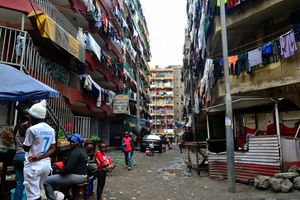
Concrete towers standing on every available inch of land loom over choked alleys where children splash through puddles, boda bodas battle for space with chapati and mandazi sellers and the air hangs heavy with the stench of sewage, sweat and smoke.
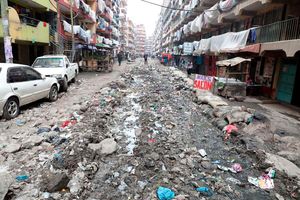
From balconies above, splashes of dirty water rain on garbage-strewn paths below. Woe unto you if you cannot hop, skip and jump while in Pipeline because one way or the other, you will need to jump over something; be it garbage, a trader’s wares or a puddle.
Pipeline was once marketed as an estate with affordable housing for Nairobi’s growing working class. Built from the late 1990s to serve labourers in Industrial Area, Jomo Kenyatta International Airport and the City Centre, the flats were meant to be a lifeline for thousands.
With no space left for roads, playgrounds or proper sewer systems, the dream of affordable living quickly turned into a nightmare.
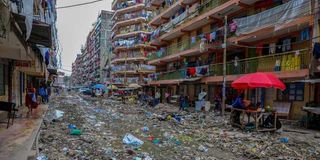
Residents walk past uncollected garbage and stagnant water mixed with raw sewage in Pipeline Estate, Nairobi County, on Sunday, August 24, 2025.
Photo credit: Dennis Onsongo| Nation Media Group
The estate is one of the most congested in the city. More than 100 families share a handful of toilets in some blocks. The stench of burst sewers often fills the air, flooding footpaths with murky water when it rains.
The houses are squeezed so tightly that neighbours can shake hands from their windows. Sunlight barely touches the lower floors and children play in dim, garbage-strewn alleys.
Whereas humans typically rejoice when it rains, residents of Pipeline are happy with dry seasons.
“We don’t pray for rain. Waste is contained on the roads if it does not rain,” Mr John Mutua, a resident, told the Saturday Nation.
In the towering blocks competing to host as much humanity as possible, life is squeezed to the limit. Families of five or more often share single rooms no larger than 10-by-10 feet.
“I and my husband are in a single room with three children. When it rains, water freely flows into the house as the drainage system is blocked. We have to wade through sewage to reach the market,” said Ms Mary Atieno, another resident.
“There are very many people and virtually no space. Accessing a toilet is almost impossible at times. The stench is sickening. Children fall ill all the time.”
Most houses in the estate are hubs of what experts call the sick building syndrome – structures that can lead to health complications if people spend long periods inside. Vulnerable people like asthmatics and children fare worse in such buildings.
Mr Stephen Lutta, an architect, told the Daily Nation earlier in the year that the problem with Pipeline lies in overlooking the city’s development blueprint.
“What has led to the proliferation of sick buildings is neglect of plans. A place like Pipeline that is meant to be industrial, is residential, hence the challenges with water and drainage,” the Architectural Association of Kenya official said.
According to Mr Patrick Analo, the Urban Planning Chief Officer at Nairobi City County, Pipeline was originally a savannah grassland, much like areas in Kenya with few acacia trees and grass in between.
These lands, he explains, were historically intersected by transport routes connecting neighbourhoods, making them strategically important but initially underutilised.
It was only when land-buying companies began acquiring these portions, he says, that the area started transitioning into formal settlements.
According to Mr Analo, development in the area dates back to the 1970s and 1980s, when businessman Gerishon Kirima divided large parcels of land into smaller plots and sold them to individual investors. Kirima died in December 2010.
By the 1990s, Nairobi was experiencing a surge in demand for housing, and many property owners began putting up apartments in response.
However, much of the growth occurred without a coordinated urban planning, resulting in irregular layouts and limited access to essential infrastructure and municipal services.
“It was just savannah grassland, mostly covered by clay. There was a transport route from Juja, Outer Ring and Mombasa roads passing through the area. The land was bought by companies. Kirima subdivided it into blocks and sold them in the 1970s and 1980s,” Mr Analo said.
“Those who bought the plots began constructing apartments in the 1990s. But there was no comprehensive plan for amenities like sewer systems, electricity or social facilities. It wasn’t until the late 1990s and early 2000s that the City Council of Nairobi and national organisations started moving in to regulate the development.”
Mr Analo also highlights the complexity of plot ownership through land-buying companies – a model that past governments encouraged to foster citizen investment and shareholding.
Through the system, residents would acquire shares in these companies, which would in turn borrow funds from institutions such as the Kenyan Development Corporation to purchase land.
However, dividing the land, selling plots to individual shareholders, submitting returns to the Ministry of Lands and paying statutory duties created legal and administrative hurdles.
“Legal requirements for these companies, including duties to submit returns and pay levies, have created challenges in processing applications,” he said.
Mr Analo adds that the devolved government of Nairobi faces challenges in managing urban growth and enforcing planning regulations.
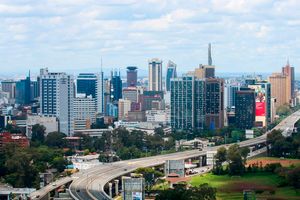
Residential flats in Nairobi’s Pipeline estate on March 16, 2025.
Photo credit: Dennis Onsongo | Nation Media Group
Despite efforts to formalise development and provide infrastructure, some areas still experience irregular growth due to transient populations and unauthorised construction.
He says enforcement is difficult in zones criminals are engaged in illegal building activities, making it hard for authorities to maintain order.
“During the last census in 2019, we indicated a population of around 750,000. But those people are not there today. There are people who come there in the morning and leave in the evening,” he said.
“As far as our involvement with other enforcers is concerned, it’s one of the areas we have a problem, especially when it comes to enforcing the law. Some people are engaged in illegal constructions. They mostly do it at night and on weekends.”
Uncollected garbage and stagnant water in Pipeline Estate, Nairobi County in this photo taken on July 27, 2025.
Photo credit: Dennis Onsongo | Nation
Area MP Julius Mawathe says the Pipeline construction project was started and later dissolved by many individuals, including those in the land business.
“There is a pending issue on the land once owned by Kirima. Some plots have not been surrendered. The place is not really planned,” the lawmaker said.
The Embakasi South lawmaker says four full-fledged police stations have been established in the area, adding that there used to be only one in the past.
The phrase “in the pipeline” means something is on the way, and in Pipeline Estate, that sadly refers to the many health tragedies that have been experienced or are waiting to happen in the sick buildings, the sicker alleyways and sewer lines.