For paramedics of Nairobi, the capital’s rush hour isn't just a daily headache, it's a battlefield where minutes are measured in heartbeats. Kevin Odwar, a 12-year veteran with Okoa Ambulance Services, doesn't just drive an ambulance; he navigates a life-or-death gauntlet.
He pulls back the curtain on a brutal reality where the city's notorious traffic congestion transforms a straightforward medical emergency into a systemic threat, forcing EMS crews to fight the gridlock as desperately as they fight to save a life. This isn't mere inconvenience; it’s a fatal urban flaw that directly dictates whether a patient makes it to the operating table alive.
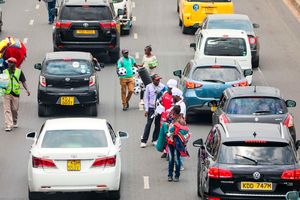
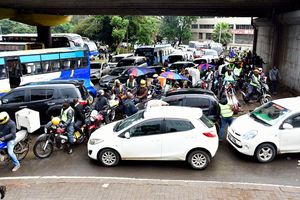
Odwar notes that the severe delays are a daily occurrence, peaking during the morning and evening rush hours and worsening drastically during the rainy seasons. The problem is compounded by driver behaviour, as many commuters listen to loud music with their windows closed, effectively deafening them to the sirens meant to clear the way. The gridlock is most critical on roads leading to major referral hospitals, specifically naming Thika Road, Ngong Road, Mombasa Road, and Waiyaki Way.
The infrastructure itself, says Odwar, contributes to the danger, and he has witnessed the tragic consequences first-hand.
“In one instance, we received a high-priority dispatch to transport a patient suffering from an impending stroke from near Safari Park to Kenyatta National Hospital, with a critical target of reaching the hospital in 25 minutes for High Dependency Unit (HDU) management. The moment we pulled out, however, we were swallowed by the notoriously crippling traffic on Thika Road,” narrates Odwar.
“Manoeuvring the ambulance was agonising because the highway has a rigid design. It offers no emergency exits, forcing us to crawl and weave through gridlock, all the while knowing that even a single minute's delay could mean the difference between the patient surviving or succumbing to a debilitating stroke,” he adds.
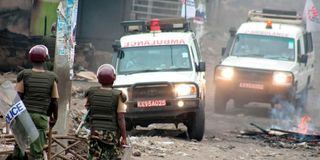
An ambulance arrives at Mathare, Nairobi, on August 12, 2017 to ferry injured people.
Photo credit: File | Nation
While his team successfully navigated that situation by calling traffic police directly, he recounted a number of scenarios where the traffic proved fatal. In one tragic case, an ambulance was transporting a road traffic accident victim from Ruaraka to Kenyatta National Hospital. Enroute, the patient's condition deteriorated.
“In a transit emergency, standard protocol allows an ambulance to divert to the nearest hospital for immediate resuscitation before continuing the journey. In this case, there was a lot of traffic. There is nowhere you can exit to seek emergency services at a nearby hospital. When we eventually arrived at the hospital the patient was confirmed dead,” says Odwar.
“This inability to act, to fight for a life within sight of a hospital, often leaves us with profound feelings of failure. Compounding the trauma is the need to face grieving relatives, who often blame the crew or the traffic system, making an already devastating situation even more difficult to navigate.”
Beyond generalised traffic, Odwar detailed several shocking instances of individual negligence and a lack of awareness that led to dangerous delays.
“We were transporting a woman with dangerously high blood pressure to hospital for an emergency C-section. Her husband was driving separately to meet us there. At a congested exit, our ambulance was blocked by the car immediately ahead. The driver of that car threw up his hand dismissively, refusing to move. The delay cost the ambulance three vital minutes. We finally managed to break through, and got to the hospital on time. The theatre and medics were ready on arrival, and the patient was immediately attended to,” he explains.
“Once we handed her over, we met the family, and realised then that the vehicle that was blocking our path was being driven by the woman’s husband. He had blocked his own family’s emergency transport.”
An ambulance, parked at Kenyatta National Hospital, Accident and Emergency wing, on June 21, 2025.
Photo credit: File | Nation
“Our crew was transporting an ambulance casualty, a severely burned wife and child, to Kenyatta National Hospital for medical attention after their house caught fire. A traffic officer on the road was reluctant to clear the way for the ambulance. His phone was also off, so it was impossible to reach him. Later, through the police network, the officer discovered that the family injured in the fire belonged to him. The ambulance he had denied passage to was, in fact, carrying his wife and child, and they both succumbed due to the delay,” he says, noting that sometimes, those entrusted to manage the roads fail to prioritise emergency services.
To combat the delays, paramedics have developed informal strategies. Some, like Odwar, maintain traffic police contacts to call ahead and request that junctions be opened. They also rely on the use of megaphones mounted on the siren system to directly communicate their emergency to officers who might be ignoring the standard siren sound.
“Sometimes, we depend on motorcycle riders, who rush ahead to police at roundabouts and manually request the lane be cleared for the ambulance. This confusion is magnified by the proliferation of sirens on non-emergency vehicles and even motorcycles, which has desensitised both the public and police to the emergency sound,” notes Odwar.
Ambulances ferry injured people on June 13, 2020.
Photo credit: File | Nation
The intense, frequent exposure to trauma means the EMS crew needs robust support. Odwar highlighted the systemic failure of many private institutions to care for the mental health and well-being of paramedics. While his company has recently started debrief sessions, Odwar pointed to E-plus (managed by Red Cross) as one of the few organisations offering structured support, including a toll-free line for crew members to access therapy.
Ultimately, Odwar’s experience boils down to a desperate plea for public awareness.
"When you hear a siren, you know there is an emergency. Give way.”
Until a shift in public consciousness occurs and the systemic issues of traffic management are addressed, the paramedics of Nairobi will continue their daily, lonely, and life-or-death battle against the traffic gridlock.