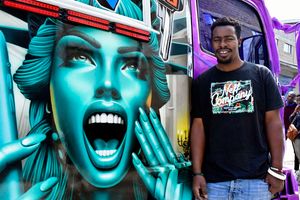
At 4am, Peter Muchiri’s alarm pierces the quiet of a sleeping city. While most of Nairobi is still in deep slumber, the 35-year-old is already up—splashing water on his face, gulping down a cup of tea, and heading out into the cold dawn. By 5am, he’s on Thika Road, racing to complete his first trip before the city wakes and the traffic locks everything.
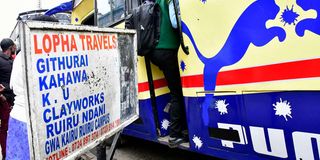
This is the reality for thousands of matatu drivers who keep Nairobi moving. For the past 15 years, Mr Muchiri has been behind the wheel, navigating some of the city's busiest routes – Thika Road, Limuru Road – ferrying office workers, mama mboga, and labourers from Ruiru's Lopha Sacco stage to the CBD's Odeon Stage. “You have to love this job to keep doing it,” Mr Muchiri tells the Nation . “Some days, Nairobi's traffic can swallow you whole.”
Mr Muchiri's target is simple: five trips a day. On paper, it sounds achievable. In reality? It's a different story. On a good day, he wraps up by 9pm. When traffic is particularly brutal, he's still on the road at midnight. That's up to 18 hours behind the wheel, all for a daily take-home of around Sh1,000.
A new matatu can bring in about Sh10,000 on a smooth day, while older vehicles average Sh6,000 to Sh7,000. But when gridlock turns what should be five trips into three, hours spent crawling through traffic mean fewer passengers, fewer trips, and less money. “On a good day, I make Sh1,000, but when traffic holds us for hours, the trips reduce and so does the money.”
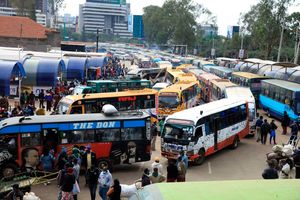
Matatus wait for passengers at a matatu stage.
Photo credit: File | Nation
The real ‘hustle’ happens between 7am and 9am. This is when passengers, especially corporate workers afraid of being late, are literally fighting to board matatus. The evening rush, which starts around 6pm, is equally lucrative. But the morning commute is when things get wild. From as early as 6:30am, thousands of vehicles converge in the city from every direction, creating chaos at major junctions like Allsops, Roysambu, Survey, and Ngara. “Traffic is heavier in the morning, especially at these junctions. Everyone is rushing to get into town,” he says.
Here's where the problem lies: four or more lanes of highway traffic get squeezed into narrower CBD roads, creating long queues. Matatus, private cars, and boda-bodas all jostle for space, worsening an already bad situation. Evenings are heavy too, but Mr Muchiri notes that traffic moves more smoothly as people disperse to different estates, unlike the concentrated morning rush towards the CBD.
“That up and down in passenger numbers is normal,” he says. “It determines how much I take home at the end of the day.”
At busy stages, the first matatu to arrive gets the passengers. This creates intense pressure to outpace rivals, with many drivers weaving dangerously in pursuit of an advantage. Mr Muchiri says he refuses to play that game.
“There's no need to drive like that,” he says, gesturing at a reckless driver trying to overtake. “I let them go. Maybe they get one or two more trips, but at what risk?”
Passengers board a matatu belonging to Lopha Sacco on Tom Mboya Street, Nairobi on July 5, 2023.
Photo credit: File | Nation
His approach is shaped by Lopha Sacco, which he's worked with for 15 years. Unlike rogue matatu operators, the Sacco enforces strict rules: the first driver in line gets the passengers, no queue-skipping allowed. Vehicles must be clean and roadworthy; drivers must be sober.
“You cannot come to work drunk. You cannot skip your fellow driver. The Sacco makes sure of that,” he explains while parking to let new passengers board.
It's his turn in line, and everyone respects it. Mr Muchiri believes Nairobi's traffic nightmare stems from poor urban planning. The CBD's narrow roads simply can't handle traffic from three or four-lane highways.
Everything gets funnelled into single lanes at choke points. He remembers when matatu drivers pitched a radical solution to former Governor Mike Sonko: one-way traffic in and out of the CBD. River Road as entry, Tom Mboya Street as exit, linking back to Murang'a Road and Thika Superhighway.
“They never implemented it. So we keep suffering the same way,” he says with a shrug.
But if you ask Mr Muchiri about Nairobi's biggest traffic menace, he won't say matatus. He'll point at boda-bodas. Motorcycles weave between lanes, overtake from any side, and rarely follow rules. The result? Frequent accidents, many caused when cars swerve suddenly to avoid hitting a rider. “I once saw a saloon car crash onto an oncoming vehicle while trying to avoid a boda-boda that had carelessly cut across its path,” he recalls.
He recommends that motorcycles be restricted to service lanes rather than main highways. “It would reduce accidents and ease congestion for everyone.”
When Mr Muchiri started driving in 2005, matatus ruled the road. They carried most Nairobians, and a hardworking driver could easily double the trips he manages today. “I'm currently struggling to hit five,” Mr Muchiri explains. “The passengers we relied on have bought cars. They'd rather sit in their own traffic jam than in a matatu jam.”
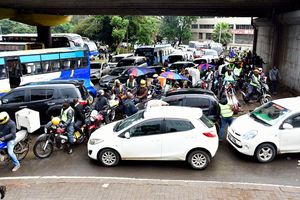
Traffic jam on Jogoo Road in Nairobi.
Photo credit: File | Nation
Nairobi's road network was never designed for the number of vehicles currently registered, and everyone's paying the price, including former matatu passengers now stuck in their own cars. The grind leaves little time for family. Mr Muchiri's wife and children live in Kiambu County. He only sees them on weekends.
Childcare and household responsibilities have fallen almost entirely on his wife, who's had to adjust to raising their children with minimal support from him.
“It's hard, but this is what puts food on the table,” he says quietly.
His path to driving started after high school. With few options available, he enrolled in driving school and started with saloon cars. He got employed as a company driver, and after five years, transitioned to matatus, first in Mombasa, then in Nairobi.
“At first, it was tough. The police were strict, the hours were long. But slowly, I learnt. Now, I can't imagine doing anything else,” he says. “This is where the work is, where the ‘hustle’ is. If you can survive Nairobi roads, you can survive anywhere.”
Mr Muchiri doesn't believe Nairobi's traffic will improve anytime soon. But he acknowledges the progress made by previous governments. “At least they built Thika Superhighway and other roads. If they hadn't, we'd be finished,” he says.