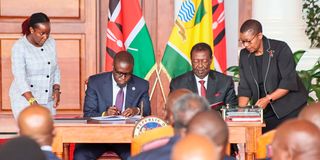
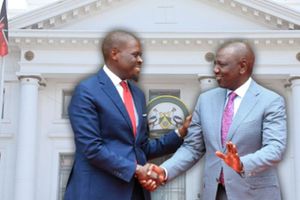
The future of the Sh80 billion cooperation agreement between the National Government and Nairobi City County remains unclear, with legislators raising concerns over vague provisions. This comes a month after the deal was formalised.
Appearing before the Senate Standing Committee on Devolution and Intergovernmental Relations on Monday, Prime Cabinet Secretary Musalia Mudavadi struggled to provide clarity on the financing of the partnership and the Sh16 billion in pending bills inherited from the previous Nairobi Metropolitan Services (NMS) arrangement.
Committee members flagged gaps in the implementation mechanisms, the specific roles of each party, and the overall lack of detail in the agreement.
While Governor Johnson Sakaja has indicated that the funds will come from the national government through the “Nairobi Rising” agenda, the committee described the financing provisions as “vague.”
“We still do not know where the Sh80 billion is. The clause on financing says the parties shall agree on the modalities of financing. That clause is so vague,” said Committee Vice Chairperson Senator Catherine Mumma.
Prime Cabinet Secretary and CS for Foreign and Diaspora Affairs Musalia Mudavadi.
Photo credit: File | Nation Media Group
Senator Mumma added that if the cooperation deal only entails meetings and planning, it mirrors what the Nairobi County cabinet has been doing, making it appear as though the national government is performing county functions.
“With this vague description, it is unclear what the national government is coming to do,” she said.
The committee chairperson, Mohamed Abbas, who is Wajir Senator, also questioned the role of the Nairobi County Assembly in providing oversight under the new partnership.
The two-year deal, which began last month, aims to address persistent challenges in the capital, including drainage, solid waste management and urban infrastructure.
Senators expressed concern over the long-term plan, asking what would happen after the 24-month period ends.
Kiambu Senator Karungo Thang’wa also questioned the legal safeguards if a future government refuses to continue the arrangement.
“What if the next government does not want to enhance it? We need clear guidelines within the law,” he said.
Senator Thang’wa further criticised the “special status” accorded to Nairobi, arguing it undermines devolution.
Nairobi Governor Johnson Sakaja delivers his speech during the signing of a cooperation agreement between the national government and the Nairobi City County Government at State House, Nairobi on February 17, 2026.
Photo credit: Wilfred Nyangaresi | Nation Media Group
“There is nowhere in the law that gives Nairobi a special status. Mombasa is a port city, and Kisumu is a regional hub. How is Nairobi different? Giving it special status risks making devolution conditional rather than constitutional,” he said.
The senator highlighted gaps in the Urban Areas and Cities Act, particularly regarding leadership and oversight of Nairobi.
“Even if Nairobi is recognised as special, it remains a county. Funding, coordination and implementation should not result in the national government taking over county functions,” he said.
Mr Mudavadi described the agreement as a legal transformative framework aimed at addressing the capital’s chronic problems.
Regarding pending NMS bills, he said a dedicated committee chaired by former Auditor-General Edward Ouko is handling the matter.
“The details will be shared by the Nairobi County Government. A cooperation framework is not a detailed document. Specific areas will be worked out systematically,” he said, refuting claims that the deal amounts to a takeover.
Mr Mudavadi added that the two-year timeline allows for review and potential extension, safeguarding devolution.
He added that relocating the capital is not feasible due to private land ownership and compensation issues, citing lessons from the Standard Gauge Railway (SGR) project.
“We must invest in our capital city. Neighbouring countries have overtaken us in infrastructure,” he said.
President William Ruto delivers his speech during the signing of a cooperation agreement between the national government and the Nairobi City County Government at State House, Nairobi on February 17, 2026.
Photo credit: Wilfred Nyangaresi | Nation Media Group
The Sh80 billion package prioritises several areas including Nairobi River regeneration (Sh50 billion), roads, bridges and drainage (Sh8.7 billion), solid waste management (Sh6 billion) and water supply improvements (Sh2.1 billion).
Other areas of focus are sanitation and sewer infrastructure, including a new treatment plant (Sh33 billion), streetlights (Sh3.7 billion), informal settlement electricity connections and slum upgrades (Sh3.3 billion) and the establishment of a Nairobi Metropolitan Police Unit within 60 days to enhance urban security.