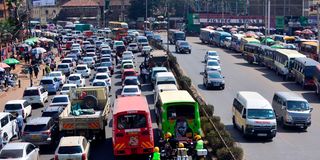
At the Muthurwa roundabout in downtown Nairobi, the morning rush hour unfolds in slow motion. Traders spill out of the Sh700 million Muthurwa Market, spreading their wares onto Landhies Road until they’ve occupied nearly half the tarmac.
The road has slowly transformed into a marketplace where hawkers shout over honking matatus as both fight for space in the choking congestion.
Above the chaos looms the once-promising Landhies Road footbridge, now a stark monument to failed urban planning. Built to ease congestion and protect pedestrians, it has been taken over by street families.
Human waste and litter carpet its walkway; at night, it turns into a mugger’s den. Ms Martha Wangari, a trader who regularly travels to Muthurwa market after being dropped off at the Bus Station, told Daily Nation it is too risky to use the footbridge.
“No one dares to use it,” says a shoe vendor nearby. “It’s safer to cross the road than to climb that bridge.”
The County Executive Committee Member (CECM) for Mobility and Works in Nairobi County Mr Ibrahim Auma Nyangoya, however, argues that part of the reason the footbridge has not been used is the nature of people who visit the market.
“Muthurwa serves areas where the majority of the users going to or coming from the market with luggage find it difficult to use the bridge,” Mr Nyangoya told Daily Nation.
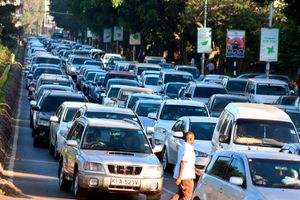
From Muthurwa to Nation Centre along Kimathi Street — a distance that should take five minutes — the drive now lasts nearly half an hour as you inch forward through the traffic gridlock that has become a daily ritual for thousands of Nairobians.
Traffic marshals, meant to restore order, stand idly by, their signals swallowed by the din of engines. Some scroll on their phones; others simply watch the chaos unfold.
Across the city, the story repeats itself: traffic lights vandalised and left dead, flyovers crumbling, and costly surveillance cameras that no longer blink.
The solution adds to the problem
Mark Makau, a city resident, argues that the enforcement is part of the problem: the traffic marshals themselves.
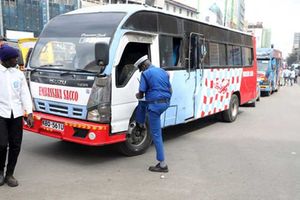
Deployed across Nairobi’s major streets to ease congestion, many rarely perform the duties they were hired for. Along Kenyatta Avenue, for instance, marshals turn a blind eye as matatus stop in the middle of the road to drop passengers.
Nairobi County Traffic Marshal on guard.
Photo credit: File|NationMedia Group
Other motorists behind them have to wait until the matatu finishes dropping passengers before they press the accelerator. The situation is also similar along major highways such as Thika Road.
During a 20-minute observation by the Daily , a curious pattern emerged. A matatu would slow down, a uniformed kanjo marshal would hop in, ride for a short distance, then alight and enter the next vehicle.
This sequence repeated with at least five matatus- each following the same script. Passengers, seemingly aware of the routine, begin to disembark the moment the marshal steps in. It’s an unspoken signal - a green light to stop wherever they please.
The result is inevitable gridlock. Vehicles behind are forced to halt as matatus linger mid-lane. “It’s just normal now,” Mr Makau, a Kasarani resident who commutes daily to Upper Hill. “Once he gets into the matatu, we all know it’s time to alight and give way.”
Plans made, no change observed
In a bid to rescue Nairobi from its perpetual traffic nightmare, President William Ruto’s Cabinet last year announced a partnership between the national and county governments to craft a long-term solution.
President William Ruto addressing at Mumias Sports Complex Stadium in Kakamega County on November 7, 2025.
Photo credit: Isaac Wale | Nation Media Group
The centrepiece of this plan was the Nairobi Intelligent Transport System (ITS), a modern, technology-driven framework meant to replace the chaotic, human-dependent traffic management model that has long failed the city.
“The Cabinet has given the green light for the implementation of the Nairobi Intelligent Transport System (ITS) Establishment and Junction Improvement Project,” read part of the Cabinet dispatch.
“This third phase of the project is anticipated to bring a paradigm shift in traffic management within Kenya, eliminating human involvement in traffic control and simplifying the process of penalising traffic violations.”
The system was billed as transformative — designed to deliver real-time traffic updates, vehicle data tracking, and rapid emergency response. It was also seen as a diplomatic necessity, with Nairobi frequently hosting international meetings and summits that laid bare the city’s chronic gridlock.
But one year after that Cabinet resolution, nothing has changed. The intelligent system remains largely on paper. Instead, traffic marshals — the very “human involvement” the system sought to eliminate — still man the intersections, waving frantically at the flood of matatus and private vehicles. Kenya Urban Roads Authority John Cheboi however said the contractor has already hit the ground for the project.
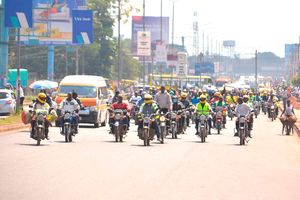
City Hall also insists it is not asleep at the wheel. The county government, through Mr Nyangoya, says it has rolled out a series of interventions to ease the gridlock choking the capital. Among them are four specialized traffic units: the Public Transport Unit to manage matatus, the Traffic Marshal Unit to direct flow at major intersections, the Motorcycle Transport Unit to regulate boda bodas and tuk-tuks, and the County Parking Unit to oversee parking compliance and enforcement.
In collaboration with development agencies such as KURA and KeNHA, Nairobi is also rehabilitating and expanding key roads aimed at relieving traffic bottlenecks. These include major corridors like Uhuru Highway, Kilimani, and Kileleshwa, as well as crucial junction upgrades at Kenyatta Avenue–Ngong Road, Haile Selassie–Uhuru Highway, Upper Hill Close–Haile Selassie Viaduct, and the Ngong–Naivasha–Kingara Road intersection.