The Senate has called for the suspension of the Sh80 billion cooperation agreement between the National Government and Nairobi City County citing a number of unclear provisions in the deal.
In a report tabled in the Senate, the committee on Intergovernmental relations on its consideration of the deal expressed that the cooperation agreement as drawn constituted a transfer of functions under Article 187 disguised as cooperation.
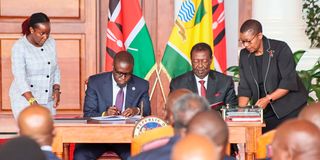
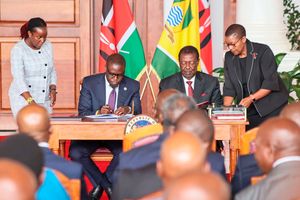
The 17-clause document was signed in February 2026 at State House, under the title Cooperation Agreement between the National Government and the Nairobi City County Government.
“The cooperation agreement between the National Government and Nairobi City County government be temporarily suspended pending the resolution by the parties of the issues arising from the committee’s observations and analysis of the agreement,” reads the report.
The committee has now directed the National Government and Nairobi City County government to submit a report to the Senate within 60 days indicating progress made in resolving the issues noted.
In its report, the committee noted that the governance structure established under the agreements vests policy-level oversight in a steering committee which is dominated by national government representatives of which the Governor only chairs the implementation committee.
“This leaves unclear whether the arrangement in substance, remains one of cooperation under Article 189 or has taken on characteristics more consistent with a transfer of functions under Article 187 without the safeguards that would ordinarily attend such a transfer,” reads the report.
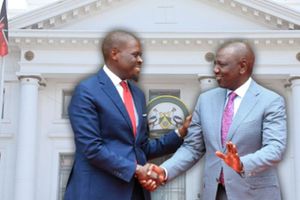
President William Ruto and Nairobi Governor Johnson Sakaja.
Photo credit: File | Nation Media Group
The committee also pointed out that the agreement is silent on the source and mechanism of financing for its implementation saying the Sh80 billion cited in the cooperation as cost implementation appears nowhere in the agreement.
The committee says that the amount was only mentioned by Prime Cabinet Secretary Musalia Mudavadi and the Governor when they appeared before the committee.
In its report, the committee also noted that the already Sh270 million had already been factored in in the 2026/27 financial year budget, an amount that will be used to improve roads in Nairobi, a county function for direct expenditure by a national government agency rather than as a conditional allocation to the county government.
The committee also noted that the agreement does not clearly provide specific roles, responsibilities and financial contributions of each party.
“The absence of this specificity makes it difficult to establish where the National Government’s role ends and where the County Government’s role begins blurring the line between cooperation and assumption of county functions,” reads the report.
The committee also poured cold water on the public participation exercise noting that it was done after the agreement had already been signed rather than before as required by Article 118 of the constitution.
“The exercise conducted on the agreement took place after its execution and coming into force,” reads the report.
The committee also wants the deal suspended as it does not provide any legislative oversight despite the billions allocated for its execution.
“The agreement does not provide for any reporting to the Nairobi City County Assembly or the Senate, notwithstanding the commitment of substantial public resources to the implementation of core county functions,” reads the report.
In its report, the committee also raised concerns with the formation of the Nairobi Metropolitan Police formation saying the proposals as proposed in the white paper 7 is not referenced anywhere in the text of the agreement.
President William Ruto and Nairobi Governor Johnson Sakaja at a past event.
Photo credit: Dennis Onsongo | Nation Media Group
Appearing before on February 26, 2026 Nairobi governor Johnson Sakaja told the committee that the capital city which also serves as the seat of the national government is not comparable to other counties and therefore require substantial resources and support to discharge its unique national and metropolitan functions.
Citing section 6 (5) of the Urban Areas and Cities Act, the governor justified the cooperation saying the law requires the capital city to be governed and managed in the same manner as other counties and that the two levels of government shall enter into an agreement on the performance of functions and delivery of services.
According to the governor, the Sh33.8 billion which Nairobi county gets from the equitable share and own source revenue is insufficient for a city serving an estimated seven million people.
For instance, Mr Sakaja pointed out the implementation of the 54 kilometre sewer line on each side of the Nairobi river at a cost of Sh50 billion which he pointed out that, the county on its own could have not mobilised the resources.
He maintained that the county will continue to discharge its constitutional functions but the agreement now paves the way for the National government through appropriations done by the National Assembly to allocate more resources to support Nairobi County.
Mr Sakaja told the committee that the county is open to review provisions that require adjustment admitting that no Cooperation agreement is perfect.
On March 31, Prime Cabinet Secretary Musalia Mudavadi while appearing before the committee said the National Government has no intention of undermining the principles of devolution.
Mr Mudavadi while justifying the cooperation agreement said there is need for substantial investments in infrastructure within densely populated areas such as Kibera, Kasarani and Mathare as part of the long term plan to improve the city.
Article 175 (a) provides that county governments shall have reliable sources of revenue to enable them to govern and deliver services effectively. The move is aimed at protecting financial autonomy of counties so that they can perform their functions without undue dependence on the national government
Section 23 (a) provides that the national or a county government may establish a joint committee with a specific mandate where such a committee is necessary for the achievement of objects and principles of devolution.
The agreement was made pursuant to section 6 of the Urban Areas and Cities Act which establishes a framework for collaboration between the two levels of government on refuse collection and solid waste management, county roads, street lighting, markets, housing infrastructure and water sanitation within Nairobi City County.