Under the cover of darkness and with little regard for danger, young fishermen slip into the deep waters of Lake Nakuru.
Driven by the rising cost of living and the need to survive, they risk their lives nightly venturing into a protected wildlife park, dodging armed rangers and braving deadly animals all in pursuit of fish officially declared poisonous.
For many, it is a gamble between survival and death.
Over the past four years, dozens of youth have been injured during violent confrontations with Kenya Wildlife Service (KWS) officers as they attempt illegal fishing expeditions in Lake Nakuru National Park. Others have died either in clashes with law enforcement, attacks by wild animals such as hippos or while fleeing arrest.
Among the missing are Brian Odhiambo and Brian Stingo, who disappeared during fishing expeditions and have never been traced.
Nakuru City-based butcher Brian Stingo, who has been missing since July 24, 2022 (left), and fisherman Brian Odhiambo.
Despite the risks, the illicit trade in fish from the lake continues to thrive.
The irony is stark that even after the government declared fish from Lake Nakuru unsafe for human consumption due to high levels of toxic metals, the underground market has only grown. The fish is still sold to unsuspecting consumers across the region.
The Senate Committee on National Security has ordered an immediate halt to all fishing activities at the lake, citing rising cases of deaths and alleged forced disappearances.
“Any fishing at Lake Nakuru must stop immediately. We want KWS to ensure there is no fishing taking place, and that thorough investigations are conducted into reported disappearances and deaths,” said committee chairperson Fatuma Dullo.
The directive followed a petition by Gaplink International, which accused KWS officers of intimidation and human rights abuses against local fishermen. The petitioners called for investigations, policy reforms, and stronger safeguards for communities living around the park.
However, KWS has strongly denied the allegations. KWS Director General Prof Erustus Kanga told the committee the agency had received no formal complaints regarding forced disappearances.
“KWS remains open to engaging with any documented complaints submitted through the appropriate channels,” he said, maintaining that records do not show missing persons linked to the park.
He acknowledged, however, that illegal fishing persists, with fishermen cutting through park fences to access the lake.
“Illegal fishermen are destroying sections of the fence. We are urging communities to turn to fish farming instead of risking their lives fishing in toxic waters,” Prof Kanga said.
Independent investigations reveal the economic lure behind the dangerous trade. On a good day, fishermen earn between Sh800 and Sh1,000 enough to sustain households struggling with poverty.
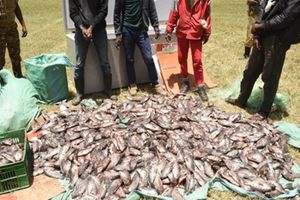
Suspected illegal fishermen in handcuffs with their harvest of fish after being arrested at Lake Nakuru National Park.
Photo credit: Boniface Mwangi | Nation Media Group
“But we endanger our lives because of the wildlife and the restrictions,” admitted Vitalis Odhiambo, a fisherman from Mwariki.
The risks are real. Fishermen have been mauled by hippos, drowned while escaping patrols or allegedly injured by enforcement officers with the controversy also spilling into the courts.
Six KWS officers are facing trial over the alleged abduction of Brian Odhiambo, who went missing in January 2025 after reportedly being arrested during an operation at the park. A Nakuru court has ruled that the officers have a case to answer.
Even as the legal battles unfold, the health risks remain alarming.
In 2024, the government confirmed that fish from Lake Nakuru contain dangerously high levels of arsenic. Former Mining and Blue Economy Cabinet Secretary Salim Mvurya warned that the fish could contain up to 32 percent toxic metal content.
Medical experts say prolonged exposure to arsenic can cause severe health complications, including cancer and respiratory diseases.
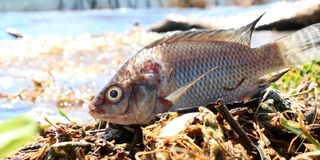
A dead fish at the shores of Lake Nakuru National Park on October, 10, 2025.
Photo credit: Boniface Mwangi | Nation Media Group
Despite repeated warnings from authorities including the Kenya Marine and Fisheries Research Institute (KMFRI), the trade continues unabated.
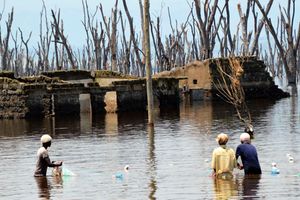
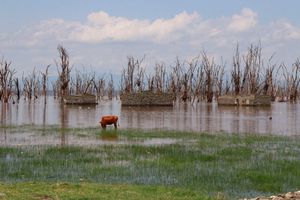
The roots of the crisis trace back to 2020 when rising lake water levels displaced hundreds of residents in surrounding areas such as Mwariki, Lake View and Barut. With livelihoods destroyed, many turned to fishing as a survival strategy.
What began as a desperate measure has since evolved into a structured underground economy, complete with makeshift fish kiosks operating along the lake’s edges.
Today, even with a government ban in place, fishermen still sneak into the lake at dawn or late at night feeding a black market that continues to grow despite the risks.
But for the youth risking everything on the lake, the choice is simple to face certain poverty on land or take their chances in the toxic waters of Lake Nakuru.