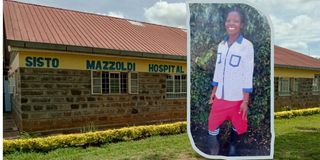
In February 2025, Justus* (not his real name) was admitted at the Sisto Mazzoldi Hospital in Nakuru where he underwent a thyroidectomy surgery at a cost of Sh134,400.
The surgery was authorised by the Social Health Authority (SHA), and the money was disbursed to the hospital. Except that Justus’s thyroid is intact.
The surgery was never conducted, and he was never a patient at Sisto Mazzoldi. He was, in fact, an employee of the hospital.
“In February, a colleague approached me and told me there was a trend where employees are being asked to produce details such as their ID number so that they could be registered by SHA, that a procedure would be done and paid for by SHA, and the minute it is paid, the individual would get 50% of the cash.
“The colleague said the hospital management was aware, so if I had declined, it could have put my job or my position at risk. I had to comply,” says Justus (not his real name).
A hospital that used the cloak of religion to carry out evil acts
After the pre-authorisation code was sent, the hospital waited for the money to be sent.
“The money was to come through the hospital account, then shared among us. SHA paid the hospital. The person who had also approached me received the money, but never shared it with us,” says Justus.
The Nation has obtained evidence showing that Justus's case is not isolated. In fact, it appears to be a clandestine side project involving the embezzlement of millions of shillings through ghost procedures and patients.
The pharmacy and theatre wing at Sisto Mazzoldi Hospital in Rongai, Nakuru County.
Photo credit: Ngina Kirori | Nation Media Group
When we were doing the rounds at the hospital, I would go to the ward. When you asked any patient what their name was, they would remove their phone and go through some messages before telling you. They were being given the names of other people.” This is according to Amos Kiprop, a former radiographer at Sisto Mazzoldi Hospital.
In one incident, a patient came in, and he ran through various tests. Later, when he reviewed the patient’s file, he noticed that his name was similar to that of one of his colleagues.
“Later on, the sister in charge admitted that we were using a staff member’s insurance to assist another person,” he says.
Wycliffe Nyachuba, a former nurse at Sisto Mazzoldi Hospital.
Photo credit: Francis Kariuki | Nation Media Group
A video clip recorded undercover shows Wycliffe Nyachuba, a former nursing officer at the hospital, handling the file of a patient, only to find out that it belonged to his colleague, Milkah Kwamboka, who registered to undergo a medical procedure. Once the money was disbursed, the hospital would give her a percentage.
When contacted, Milkah said she could not recall signing up as a patient to defraud the then National Health Insurance Fund.
Cases of unexplained maternal deaths at the hospital were reported to the authorities several times by Wycliffe and Amos.
Reached for comment, Health CS Duale said that multiple variations of fraud are being carried out by health facilities. We asked him what SHA was doing to detect fraud.
“Before we introduced biometrics, there was misuse of the one-time password (OTP) system, but now it is solid. A lot of abuse of the system occurred while the fraud engine was being developed, but now hospitals — public, private and faith-based — that want to conduct legitimate business are happy with the system,” said CS Duale.
So far, the ministry says Sh13 billion has been recovered in false claims. The Ministry has also suspended 1,118 facilities, and some 118 files have been submitted to the DCI.
“It is criminal… We have many patients who have recorded statements with DCI and our forensic unit,” the CS said.
While the hospital management conjured up phantom patients, their fraud took on an agreeable symmetry in other areas. Specifically, there was tax evasion, which Amos tried to alert the Kenya Revenue Authority (KRA) about.
Amos Kiprop, a former radiographer at Sisto Mazzoldi Hospital.
Photo credit: Francis Kariuki | Nation Media Group
A secret recording Nation obtained shows the members of the management, also known as “the sisters”, dishing out cash to some of their employees to evade paying higher statutory deductions.
In his signed contract, Amos was meant to be paid Sh36,000 as his net salary, but the hospital paid him Sh30,000 via his bank account and Sh6,000 in cash. When he challenged the hospital management, he was told to stop complaining as he had received his money.
This appeared in the KRA system as an under-representation of the tax remitted, and Amos was penalised thousands of shillings as a result.
“I posted my story about tax evasion on the KRA portal with evidence. I still owe the government some money, but this is not my fault,” Amos says.
The Nation undercover team went through triage and observed streams of patients coming into the facility, many of them with their babies. It quickly became evident that this was the main focus of the hospital: maternal and post-natal care.
For the most part, everything appeared to move regularly. That is, until the doctor finished our undercover reporter’s consultation and lab tests and referred him to the cashier to make the payment. He requested his lab results, and they declined to hand them to him. Later, he paid Sh500 for the consultation and the lab tests done, but they also declined to give him a receipt. This, we established, helped the facility create parallel lab reports for tests of a higher amount, which are claimed through the country’s national health insurance, even though a patient had already paid cash for them.
The faith-based hospital prioritises making money over helping patients,” said Amos.
Dr David Kariuki, CEO of the Kenya Medical Practitioners Council, says that health professionals in the country are held to a higher standard of behaviour than those in other professions, due to the fine line between life and death and the promise to honour this at the start of every professional's career.
“Generally, in medicine, we have a principle of first, do no harm.” And that is why every practitioner at the beginning of their career takes a Hippocratic Oath,” Dr Kariuki says.
Jackline Chebet who died at Sisto Mazzoldi Hospital.
Photo credit: Pool
Jackline was not meant to die. Indeed, when a mother gives birth, the fragility of life is cast into sharp relief, as is the light of a new soul brought into the world after nine months of anticipation and love from the mother.
This is the energy Jackline emulated as her due date drew closer, according to her family.
Faced with the dilemma of where to give birth, Jackline chose Sisto Mazzoldi Hospital because it was faith-based.
Jackline’s mother-in-law said: The day before, Jackline had gone to Sisto Mazzoldi Hospital for a check-up, as her due date was approaching. She had taken a few clothes and other essentials with her, just in case she went into labour. As this was her third child, she knew when labour was close, and she was excited to complete her family with her newborn baby.
At around midnight, the doctor called and told me that Jackline had given birth, but the baby had died,” says Jackline’s mother-in-law.
Upon hearing the news, Jackline’s husband rushed to Sisto Mazzoldi Hospital, where he was reportedly told to let his wife rest and to come back the following morning.
Jackline’s husband returned home, and the family agreed to visit her together early the next morning.
“When we went to see Jackline, a member of staff told us that Jackline had died,” she told Nation.
The double tragedy was devastating, but the questions lingered more.
Jackline’s baby died at around midnight. Her husband rushed to the hospital, but was prevented from seeing her.
She passed away at around 3 am, but the hospital did not notify her family. Instead, they waited for visiting hours later in the morning to inform them.
“The doctors said they were shocked by her death, too. I asked them why they had initially told us that it was only her child, but had not informed us that Jackie was dead. They kept quiet,” Jackline’s mother-in-law states.
The most disturbing part of this twisted tale came when Jackline’s family discovered that someone had interfered with their communication with her.
“Her sister tried calling her several times that night to check on her condition. However, when we went to collect Jackline’s belongings, we saw that someone had put her phone on flight mode,” Jackline’s-mother-in-law told Nation.
Two years after Jackline’s mysterious death, Nation attempted to reconstruct what happened on the night in question and how actions by the hospital contributed to this.
Jackline arrived at Sisto Mazzoldi at approximately 6pm in good health. At 12am, she developed complications and had a stillbirth. Shortly after, her condition deteriorated. She started gasping for air, convulsing, and bleeding. This called for critical and emergency care.
A team member on duty called an ambulance from Nakuru Provincial General Hospital to pick Jackline up for referral.
'The ambulance from Nakuru County waited for about an hour and a half. The driver tried to persuade the management to let them take her, as everything was ready on the other side to receive her. However, the hospital management refused to refer her. After waiting for an hour and a half, the driver was called to Mogotio for another emergency,” Wycliffe says.
The Nation viewed a video taken undercover that confirmed the management’s role in Jackline’s death.
Despite a referral being required, Sister Redempta made the decision to keep Jackline in the hospital. She called the Nakuru sub-county coordinator.
“I know I will be in s***. I will be told I sent an ambulance, and you refused to refer the patient, and the outcome is now death. I spoke with one of the members of staff, and she told me her pupils were dilating, and she was gasping for breath, so when I called the county, I told them to prepare because this may be an ICU case, because the mother was still in labour at the time and was in bad condition. So now they will tell me we sent you the ambulance, and the ICU was alerted.”
The waiting bay at Sisto Mazzoldi Hospital in Rongai, Nakuru County
Photo credit: Ngina Kirori | Nation Media Group
We reached out to officials from Nakuru County to find out whether an audit was launched into her case. They said Jackline had suffered from high blood pressure, which escalated into pre-eclampsia.
When pressed on whether they established any negligence, they said that fault could only be declared by the medical board. This is especially strange considering that the sub-county team was aware of the delay in the referral.
“Similarly, for health facilities, that is why we have a referral mechanism. That if a facility is not able to provide services at a certain level, there is another facility that can treat, whether in terms of equipment, doctors, specialists or other professionals that may be required.” Dr David Kariuki, the KMPDC CEO, states.
The management was aware that Jackie’s case had deteriorated into an emergency. The fact that they refused to refer her and let her bleed to death while an ambulance waited outside for approximately one hour and thirty minutes illustrates the hospital's lack of effort to save her life.
The negligence that shrouded Jackline’s delivery comes out in waves. One of the highest tides is a report that one of the nurses who attended to her that night was not licensed.
Nation: Actually, it is also a public matter because you are the one treating patients in the public eye, so those patients need to be aware that you are licensed.
Nation: So, you are confirming that you are licensed?
Sheila Kandie: No, I’m not confirming. Why are you asking me such questions?
Nation: It’s a simple question, yes or no…do you have a valid ID under the Nursing Council of Kenya?
Yet again, the question is why the hospital went to these lengths.
“Because of the trend of the hospital, my own understanding is that they kept this mother for financial reasons. She was using NHIF, and they wanted to claim that money,” Wycliffe states.
We reached out to the hospital to verify these claims, but we still did not receive any response.
Jackline’s grave rests next to her baby’s. Her mother-in-law reflects on the last goodbye she bid to Jackie, which she says was different.
“Jackie was a happy soul. Even as she left, I asked her why she was going so late in the evening for a checkup. She laughed it off, telling me she would be back home soon. She then walked for a few metres but returned and called out to me. I responded, asking her if she had forgotten something, but she said she just wanted to tell me goodbye again,” Jackline’s mother-in-law states.
Fed up with the spate of gross medical negligence, Amos and Wycliffe challenged the management about their actions.
They also questioned why medication was being hidden to force mothers to undergo caesarean sections, and why emergency cases weren’t being referred.
Beyond the fraud and cruelty that characterised the stay of many patients at Sisto Mazzoldi, this report also illuminates how a religious cloak adorned by the hospital was misused and played a role in drawing in hopeful patients, especially mothers, who believed they would be guarded under the wings of faith and good.