President William Ruto on Monday announced that the government has lifted the Mau Forest logging ban, as he asked Trade Cabinet Secretary Lee Kinyanjui to ban furniture imports to promote local manufacturing.
President Ruto spoke at Michinda in Molo, where he launched the construction of more than Sh400 million Michinda Social Housing Project, on his first day of a three-day development tour of Nakuru County.
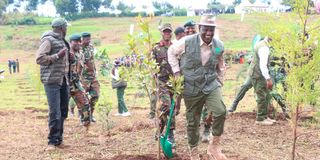
Residents of Kuresoi-North in Nakuru County participate in tree planning within Mau Forest on October 27, 2025, during an exercise attended by President William Ruto to restore the complex.
Photo credit: Boniface Mwangi | Nation
"I have directed Trade CS to revive sawmills and sell mature trees to local millers, to enable them to manufacture furniture here at home. Kenya has enough timber to create jobs and grow the economy," stated President Ruto.
"We must stop importing furniture from other countries like China and Dubai to boost the manufacturing capacity in our country. Why should we continue importing beds, chairs and tables yet we have the raw materials to make these things?" posed Ruto.
Elburgon and other neighbouring towns have for years heavily relied on the timber industry as their economic mainstay.
However, the President said the government will only allow the cutting of mature trees. The State is also set to roll out an elaborate plan on how to ensure responsible cutting of trees.
Beginning next week, the government will begin selling mature trees in all forests across the country to local sawmillers, according to President Ruto.
He assured that this will play a key role in creating job opportunities for the youth and boosting the country's economy.
"We will start selling mature trees in our forests to local sawmillers from next week and tomorrow I will have a conversation with sawmillers here so that they may revive the wood processing factory that was here," Dr Ruto said.
The Head of State further reiterated that his administration will ensure that the country plants 15 billion trees within the next 10 years.
The multi-billion timber industry has over the past decades been one of Kenya’s best employers, especially to the uneducated youth in various towns surrounding the Mau Forest Complex.
Various South Rift areas, including Elburgon, Molo and Total areas in Nakuru as well as Maji Mazuri in Eldama Ravine, depended on the timber industry before a ban on logging was imposed.
The youth worked as loaders, tree cutters (power saw operators), transporters and millers.
In the past nearly eight years, the impact of the ban on logging has been felt in the towns, especially Elburgon, which initially enjoyed a vibrant economy supported by the lucrative timber industry.
From the 1990s, Elburgon and Molo towns enjoyed the boom of timber trade.
A moratorium on logging had been in place since 2018, following a public outcry over illegal logging that was blamed for the diminishing water levels in the country's key rivers.
A recent study by the Kenya Forestry Research Institute (Kefri), indicated that the Kenya Forestry Service had lost over Sh5 billion in revenue in the last few years, following the ban on logging in public and community forests, shedding 44,000 jobs.
The study further revealed that the ban has also contributed to the economic collapse of forest-dependent centres and communities.
In 2020, then President Uhuru Kenyatta's regime instituted a ban on the importation of furniture, blocking State agencies and ministries from importing furniture.
Earlier, President Ruto presided over the launch of the Mau Forest Complex Integrated Conservation and Livelihood Improvement Programme, aimed at conserving the Mau Forest water tower.
He led national, county leaders and locals in planting 5000 trees at Gacharage section of the Mau Forest Complex.
According to President Ruto, the State seeks to restore 33,000 hectares of the Mau Forest Complex.
At Sirikwa, in Kuresoi North, Ruto launched the Livelihoods Programme that includes the distribution of tree seedlings,10,000 pyrethrum splits,5000 tea seedlings, milk coolers,50 beehives and last-mile electricity connectivity, which will benefit more than 3,500 households.
The Head of State later launched the Sh700million Kinamba-Mengit-Murinduku road in Kuresoi North and also commissioned the 250 Affordable Housing Units in Elburgon, Molo.
President Ruto further announced that his administration has allocated Sh400 million to help construct the Faith Kipyegon stadium in Olenguruone and Sh550 million to complete the upgrade of Afraha stadium to international standards.
Ruto was accompanied by Governor Susan Kihika, Cabinet secretaries Lee Kinyanjui (Trade), Deborah Barasa (Environment and Forestry) and a host of local leaders.