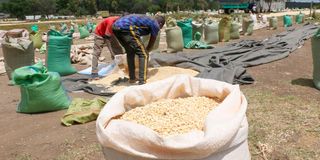
Loaders spread maize grains for drying at Railways ground in Nakuru City on January 19, 2026.

As maize flour prices continue to rise after some millers exhausted their stocks, farmers in the North Rift region are hoarding grain in anticipation of an impending shortage and higher prices.
Some farmers are stockpiling maize despite the government issuing a 30-day ultimatum ordering them to release their reserves or risk duty-free maize imports aimed at stabilising flour prices.
A 90-kilogramme bag of maize is currently selling at Sh4,200, up from Sh3,800, as many farmers hold onto their produce in expectation of further price increases.
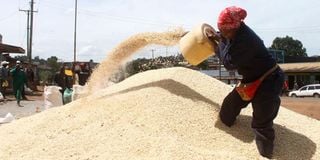
Farmers dry maize in Elburgon town, Nakuru County.
“Food shortage is unavoidable after most millers depleted their stocks coupled with the anticipated low yield this season caused by erratic climatic conditions during planting,” said Jackson Kosgei, a farmer from Moiben, Uasin Gishu County.
Maize flour prices have risen sharply in retail shops across the North Rift with a two-kilogramme packet now selling at Sh160 up from Sh120.
The price surge comes as more than 2.5 million Kenyans face worsening food insecurity due to crop failure linked to prolonged drought.
A spot check by Nation indicated that most retail outlets have increased maize flour prices despite the government’s attempt to introduce price controls.
“The increased cost of maize due to declining supply has forced us to raise flour prices to sustain operations,” said David Maina, a miller.
Millers are calling for market forces of supply and demand to determine maize flour prices, arguing that government intervention distorts competition in the liberalised market.
“The government should not dictate that farmers release grain or face cheap imports. Such a scheme may favour consumers in the short term but hurts farmers and millers who incur extra costs securing markets at competitive rates,” said Wilson Lang’at, a farmer and agricultural expert from Ziwa, Uasin Gishu County.
Agriculture Cabinet Secretary Mutahi Kagwe has urged maize farmers to comply with the directive to avoid losses if duty-free imports are approved.

Agriculture Cabinet Secretary Mutahi Kagwe.
He noted that the National Cereals and Produce Board (NCPB) is struggling to purchase two million bags of maize for the national strategic food reserve due to stiff competition from millers despite revising its buying price from Sh3,500 to Sh4,000 per 90-kilogramme bag.
“We are offering Sh4,000 per bag and we have Sh1.7 billion for payments. We must stock our strategic reserves and be prepared for emergencies. Our priority is not to import but to buy from farmers,” said the CS.
So far, the NCPB has purchased fewer than 200,000 bags against its target of two million, as millers and traders have raised maize prices to as high as Sh4,400 per bag to bolster their own stocks.
The government is required to maintain either four million bags of grains including maize, rice and beans as emergency reserves or hold cash equivalent to that quantity.
The government has also warned that 2.5 million citizens are at risk of severe hunger and water scarcity if the drought persists.
“Acute food insecurity in Arid and Semi-Arid Land counties could surge from 1.8 million to 3.5 million people if interventions stall,” CS Kagwe disclosed.
According to the National Drought Management Authority (NDMA), nine counties are currently experiencing drought worsening food security. State data, however, shows that 10 counties are facing drought conditions.
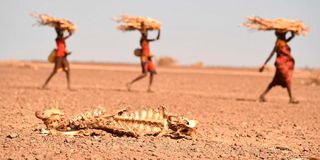
Women carrying firewood walk past a carcass of a cow in Loiyangalan in Marsabit, northern Kenya, on July 12, 2022.
Counties in the alert phase include Wajir, Garissa, Kilifi, Marsabit, Kitui, Kwale, Kajiado, Isiolo and Tana River while Mandera is in the critical “alarm” phase.
Agriculture experts have warned of looming food insecurity as cereal farmers in traditional maize-producing zones such as Uasin Gishu, Nandi and Trans Nzoia diversify into sugarcane and coffee farming.
President William Ruto’s administration has pledged to implement measures to ensure the country does not import maize by 2025.
Dr Ruto has noted that Kenya spends about Sh500 billion annually on food imports, including maize and wheat, arguing that the country should instead be exporting essential commodities.
The Ministry of Agriculture projected a maize yield of 70 million bags last season, attributing the bumper harvest to favourable weather and the supply of subsidised fertiliser.
Follow our WhatsApp channel for breaking news updates and more stories like this.