If Margaret Agness Collyer came back from the world of the dead, she would, of course, marvel at what has become of the place she only considered good for dog breeding and wildlife watching.
Born in 1872 in Lavington, Margaret, who was also a judge, was the first colonial settler in Ol Kalou in January 1918, at the age of 46.
The location where the Nyandarua County headquarters stands today was still largely bushy, a one-street town, by the time Margaret died in June 1944.
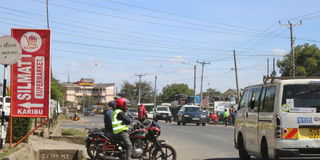
New Ol Kalou Town look in the photo taken on February 22, 2026.
Photo credit: Waikwa Maina | Nation
Despite Ol Kalou’s rich colonial history, the town’s growth stagnated for decades.
Known as home to Mau Mau freedom fighters, Ol Kalou was also home to Josiah Mwangi Kariūki, famously known as JM, the socialist politician in the Jomo Kenyatta government who was assassinated in 1975.
At the centre of the town is a tree popularly known as Mutiini wa Kenyatta (Kenyatta’s tree), where the founding father is said to have addressed one of his biggest political rallies before independence.
But with devolution, the urban centre is rapidly growing, both in terms of population and investment.
The town’s population was 13,234 in the 2019 census, and it has grown to 78,502, according to Ol Kalou Municipality manager Eric Igogo.
Mr George Rugene, a trader, arrived in Ol Kalou in 1995 and invested in a butchery.
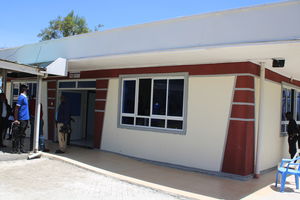
New Ol Kalou Town look in the photo taken on February 22, 2026.
Photo credit: Waikwa Maina | Nation
He says that business premises whose rent was then between Sh500 and Sh1,000 are currently going for between Sh10,000 and Sh15,000, adding that the cheapest business space one can get in Ol Kalou costs Sh10,000, which is a small unit not in a very busy area.
“At that time, business was good because there were very few shops and rural shopping centres. Customers travelled long distances to buy meat and do major shopping. But then, the town had very few shops, and they were all semi-permanent buildings constructed using timber or iron sheets,” says Rugene.
He attributes the growth to devolution but notes that the high cost of rent for residential and commercial buildings is affecting the town’s growth.
“We still have an acute shortage of houses within Ol Kalou Municipality. Landlords take advantage of the shortage to exploit investors. I have witnessed some new investors close shops soon after arrival due to the high cost of doing business. I know of a building whose rent was Sh4, 000 about 10 years ago, but today it goes for Sh25, 000. It’s the high cost of housing that is hurting investors and forcing county and national government employees to reside in neighbouring towns such as Nyahururu, Gilgil and Nakuru,” says Rugene.
He attributes the shortage of housing to the double allocation of land within the township and is optimistic that rent will go down once the issue of double land allocation is addressed.
Mr Rugene recalls that in the 1990s, the town had no water supply, and residents relied on a colonial borehole, which experienced electricity challenges most of the time.
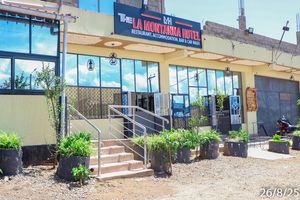
New Ol Kalou Town look in the photo taken on February 22, 2026.
Photo credit: Waikwa Maina | Nation
Mr John Maina, a trader who moved to Ol Kalou in 2001, also attributes the growth to devolution.
“Business was not as good in 2001, the population was low. We had just about five shops along the busy Nakuru–Ol Kalou highway, but the place is fully occupied today. An increased population means improved business. Devolution came with county employees; the number of employees in the private sector has also more than doubled as investors come,” says Mr Maina.
He also attributes the growth to easy access to banks and saccos, making it easier to secure business loans.
On the double allocation of land, Nyandarua Governor Kiarie Badilisha says a task force has been formed to validate land ownership within the municipality.
“Verification of land ownership will address the housing problem. The task force is at an advanced stage of completing the exercise. We also have the affordable housing project, which is near completion, as well as the ongoing upgrade of Huruma slums to ease congestion and give the community dignified living standards,” says the governor.
As the town rapidly grows, the county government has had to deal innovatively with emerging challenges such as health, roads, sanitation and other essential services.
To address sanitation and the road network within the township, the county government has established its own cabro production plant.
“The introduction of the newly established Nyandarua University at Captain Market will further propel Ol Kalou’s growth, with an increased investor and student population. When fully established, we are optimistic that business infrastructure will connect Ol Kalou town to Captain Market. The number of upcoming modern buildings along the Gilgil–Captain–Ol Kalou highway is enough evidence of where we are headed. We have also upgraded and expanded JM Memorial Hospital, introducing more services to cater to the growing population,” says the governor.
Governor Badilisha adds that utility services, including water, electricity and ICT, have been enhanced. The establishment of institutional structures promoting trade and investment, environmental conservation initiatives and the development of a spatial plan to guide orderly urban growth are also in place.
“Investment incentives, such as faster approval of building plans for individuals and companies, are also encouraging more investors, while the establishment of Nyandarua University is contributing to economic growth, skills development and demand for housing and services,” says the governor.
The county boss adds that other interventions include supporting youth and small businesses through training, equipment and empowerment programmes; formalising urban centres to enhance planning, service delivery and investor confidence; and adopting supportive policies that promote trade, cooperatives and business expansion.
Mr Igogo, the municipality manager, says the area’s population, comprising 38,951 males and 39,551 females, reflects a balanced structure that provides a strong labour force and consumer base, which is critical for economic growth and investment attraction.
“As the county headquarters of Nyandarua, Ol Kalou continues to attract public and private investments, including government offices, educational institutions, housing projects and small- and medium-scale enterprises. This population growth directly contributes to increased economic activity and municipal revenue,” says Mr Igogo.
The municipal manager notes that despite positive growth, Nyandarua County still has several untapped and underutilised business opportunities.
Among the unexploited areas is tourism development, though the county hosts attractions such as Lake Ol’Bolossat, the Aberdare Range and scenic landscapes.
“These sites lack adequate facilities, accommodation, structured tourism products and effective marketing, limiting tourism revenue. There is also a shortage of sports grounds and entertainment facilities, limiting talent development, recreation and youth engagement. Agricultural production is high, yet there are very few cold rooms and storage facilities, leading to post-harvest losses and reduced farmer incomes. The renewable energy sector also remains largely unexploited but has great potential,” says Mr Igogo.
Other underutilised areas, the municipality manager says, include value addition and agro-processing industries, manufacturing and light industries.
Small-scale manufacturing, such as furniture making, animal feed production and building materials, exists but has not expanded to an industrial scale.
“Demand for housing is increasing due to urbanisation, yet the supply of modern and affordable housing remains inadequate. Traditional shops and markets dominate, while modern shopping centres, entertainment hubs and service malls are still limited,” adds Mr Igogo.
In its five-year strategic plan, the Ol Kalou Municipality plans to establish stronger infrastructure, including improved roads, water supply and sewer systems; increased housing development and job creation; vibrant businesses, markets and investment activity; expanded economic opportunities for residents and investors; and improved service delivery and quality of life, positioning Ol Kalou as a leading urban centre in the region, says the municipality manager.