The only way Bibiana Wangari had hoped to secure the release of her son was by faking her death.
On Friday, she stood before a sombre congregation to bid final goodbyes to her only son, 30-year-old Charles Waithaka, who had been ordered unwillingly into the frontline of the Russia-Ukraine war.
Distraught, teary and devastated, Bibiana told the gathering that had she successfully executed her plan, the mourners would not have been there.
But even on Friday, it was only a symbolic burial: Her son’s body far away, her mind far away, lingering between his photos, in whose warmth she found comfort.
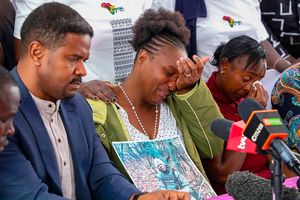
Bibiana Wangari, the mother of Charles Waithaka, holds his portrait during his symbolic burial in Mukurweini, Nyeri County, on February 5, 2026.
Photo credit: Mercy Mwende | Nation
“My toto (child), it is only you and I who know the amount of psychological torture we went through in that duration of three months. We cried daily. As a mother, I tried all I could to rescue you in vain… I may not even see your remains, but I am convinced that I have buried you,” she said.
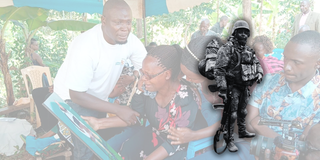
The family did not manage to repatriate Charles’ body. For his burial, a photo was mounted on top of a stool, sheltered by a tent and surrounded by mourners.
It was before this photo, with mourners in the background, that his mother spoke.
“I thank God for the years, memories and the gift of being your mother. Not every woman is blessed to have a son like you. I release you into God’s hands, my child,” she said.
When they last spoke in December last year, her son was headed to the frontline of the Russia-Ukraine war.
Trained as a plant operator at the National Youth Service, he travelled to Russia in October after being recruited by a Kenya-based agent.
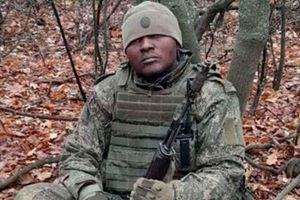
Charles Waithaka, a Kenyan national, died in the Russia–Ukraine war on December 25, 2025.
Photo credit: Pool | Nation
He was promised work as a plant operator in the construction of a Russian military camp. But upon arrival, he was instead admitted into a military training programme.
They spoke often, his mother narrated, and he usually reassured her that everything was fine when nothing really was.
He told his mother that they were attending some classes, and she believed it was a refresher course for his plant mechanics job, when he was instead undergoing a crash course in paramilitary training for a fortnight.
“I was listening to a newspaper review on the radio one morning,” she narrated.
“The presenters were discussing Kenyans who had been lured into the Russian-Ukraine war in the disguise of short-term job arrangements. They said some young men had been lured abroad with promises of work as drivers or cleaners, only to be forced into military service,” she added.
That was the moment she felt something was amiss. Several relatives also reached out to her, inquiring how her son was faring.
“When I confronted Charles, he broke down and told me everything that had been happening. He said that immediately he arrived, he had been forced to sign a contract written in Russian, and that he had since been recruited into the Russian military,” she said.
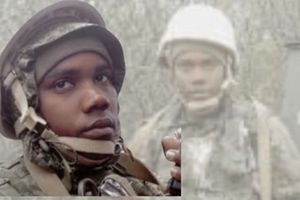
Charles Waithaka, a Kenyan national who died in the Russia–Ukraine war on December 25, 2025, is pictured in military attire.
Photo credit: Pool | Nation
He sent her photos of himself in a military uniform. In some, he stood next to his commander, smiling.
“But he would later call me and tell me not to be deceived by the happy photos that they had been asked to take happy photos and send them back home just to show that everything was okay. During the phone calls, he would cry, begging me to try all means and rescue him,” she said.
As his situation worsened, his mother explored every option to get him out.
At one point, she sought a death notification issued in her own name, hoping it would allow him to return home to bury her.
“I was willing to spend any amount of money to bring him home, and so I called a friend who works in a local morgue and asked him to help me process my death notification, so that my son could use it to convince the Russian authorities to let him go,” she recalled.
“He was told that he could not go back to bury relatives, that I would be buried by those who are in Kenya,” Bibiana said.
His travel documents had been taken from him immediately he arrived in the country, and his identity changed.
Upon his arrival, he had also been asked to open a bank account, which was also registered under the agent’s name. His mother said part of the requirements was signing a form that gave the agent consent to access the bank account.
“There was some construction work that he had asked me to do for him at home before he left for Russia. He had promised that he would repay me using his salary, but whenever we talked and I asked for the money, he would tell me that his agent had withdrawn all of it,” she said.
Three days before he was killed in action on December 25, Charles called his mother in tears to tell her that he was going to the front line.
“I asked him, what do you know about war? You are going to face people who have been at war for over 30 years. You are only 30 — how are you going to do it?” she recalled.
Bibiana would later learn through social media that her son had died in the war. A friend of his who was with him at the time of his death told the family that he stepped on a landmine and died.
“I have gone to the Foreign Affairs office hoping to repatriate his body, but they have told me that getting the body is impossible because once you die in war, you are left there. Nobody is there to collect the bodies. They focus on the strong men who are alive,” she narrated.
The family also tried reaching the agent who transported Charles, to no avail. They do not know the agency’s full name, only that her first name is Elizabeth.
Charles Waithaka's symbolic burial grounds in Mukurweini, Nyeri County, on February 5, 2026. The ceremony was held after efforts to repatriate his body from Russia, where he had been duped into joining the military and later died in the Russia–Ukraine war.
Photo credit: Mercy Mwende | Nation
The burial ceremony, held in Mukurweini, Nyeri County, and presided over by Gathugu Catholic Parish, was marked by a requiem mass, tributes and a candle-lighting ceremony at a symbolic grave.
A tent pitched in front of the clergy held not a coffin, but a portrait of Charles. A banner bearing his photograph stood beside it.
During the service, mourners called on the government to intervene in what they described as illegal military recruitment and to take responsibility for Kenyan citizens caught up in the war.
Odhiambo Ojiro, Rapid Response Officer at Vocal Africa, a human rights organisation, urged the government to investigate and find out how Kenyans have been sent to the Russia-Ukraine war through recruitment agents.
“We have established that there are youths who have also been recruited by the Ukrainian military, kidnapped and jailed in Russia. We have more than 70 families who are looking for their sons abroad,” he said.
A tent shelters the portrait of Charles Waithaka during his symbolic burial in Mukurweini, Nyeri County, on 5 February 2026. The ceremony took place after attempts to repatriate his body from Russia failed.
Photo credit: Mercy Mwende | Nation
Ojiro said the organisation would convene affected families and plan a peaceful protest at State House if necessary to draw the government’s attention to the matter.
Duncan Chege, a survivor of the Russia-Ukraine war, narrated to the mourners that he escaped Russia by pretending to be mentally ill.
Recruited as a driver, Chege returned to Kenya two weeks ago after being admitted to a mental health facility.
“What is killing people in this war are drones and landmines. The people I travelled with in October are all dead. This is an urgent matter that the government must intervene in. I would not wish it on anyone,” he said.