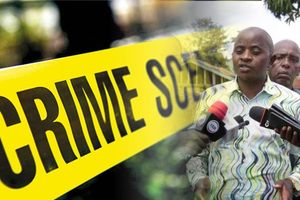
On a Friday in March 2023, Julia Gathoni went to bed unaware it would be her final night. She was brutally attacked and beheaded; her killers fled, taking her head with them.
The 85-year-old grandmother was attacked in her sleep inside her home in Miiri village, Mukurweini in Nyeri County. The attackers took her head, despite extensive searches, it has never been recovered.
Nearly three years later, the brutal murder of the devoted member of Gathundu Mundu Catholic Church and the Catholic Women’s Association (CWA) remains unsolved.
Interviews with family members and legal experts paint a troubling picture of an investigation marked by missteps, unexplained decisions, and procedural lapses by detectives in Nyeri.
Rose Wathei, the seventh-born in a family of nine siblings, says the family has never recovered from the horror of that morning.
It was on a Friday night when the family went to bed at around 10 pm. On most nights, one of Wathei’s daughters would sleep at their grandmother’s house. But that evening, the girls stayed longer than usual, finishing their homework after supper. By the time they were done, it was too late to leave.
At about 6:30 am, the household woke up to begin the day. Wathei was in the kitchen preparing breakfast when her 15-year-old daughter said she would remain behind to do laundry before heading to the farm.
As part of her chores, the teenager went to pick up her grandmother’s clothes. Instead, she found her lying in a pool of blood. She ran back, calling out in panic.
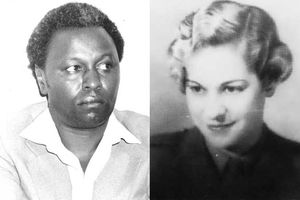
Rose Ngunjiri and Trasicio Wambugu, children of Julia Gathoni, who was murdered in her sleep at their home in Mukurwe-ini, Nyeri County. Inset: A photo of Julia Gathoni.
Photo credit: Irene Mugo | Nation Media Group
Wathei rushed to the house. At first, she struggled to comprehend what she was seeing. Her mother’s body lay on the bed, tied with a leso. The scene had been staged to make it look as though she was calmly asleep.
For a moment, she could not believe her mother had no head. She stepped out screaming, then went back in to confirm what she had seen. It was then that the full reality sank in — only her mother’s torso remained.
Her body was covered, while pieces of cloth had been coiled into a sphere to resemble the shape of a head. No one heard any commotion during the night, except for dogs barking.
“I have two daughters. One usually slept with the grandmother while the other remained behind, but on that day it was not the case. Ever since, we have wrestled with the haunting question of whether it was a blessing or a missed chance. Had the teenager slept at her grandmother’s house that night, she might have been harmed too, or perhaps her presence would have raised an alarm and saved her grandmother’s life,” she told NTV’s Murder Tapes .
Amid the uncertainty, the family faced an agonising decision: whether to bury their mother without her missing head.
The body lay in the mortuary as days stretched into weeks. Family members initially resisted burial, clinging to the hope that the missing part would be recovered so she could be laid to rest whole.
After weeks, Ms Wathei said the family decided to bury her without her head due to mounting mortuary bills. The fees had accumulated to more than Sh70, 000 at the Mukurwe-ini Sub-County Hospital morgue.
According to Ms Wathei, two months after the murder, several people were arrested. One of them allegedly confessed to killing their mother and was brought to Mukurweini Police Station. However, the suspect was later released under unclear circumstances. She says the family was not formally informed of the reasons behind the decision.
“We just heard he was out. Since then, silence. After following up, we were told that he was mentally challenged. He confessed to killing her and even told police he was not alone. Some officers who interrogated him told us he was very much okay when giving his account. We wonder why he was released. To this day, we have never gotten any justice,” she said.
Ms Wathei said, despite officers from the DCI recovering a bloodied carton suspected to have been used to carry the head and a blood-stained T-shirt, which were later forwarded to the government chemist, the family has never been given the results.
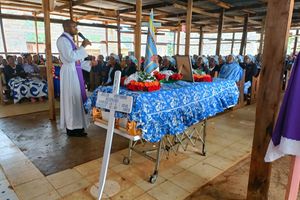
Funeral ceremony of Julia Gathoni at Gathuki Mundu Catholic Church in Mukurwe-ini, Nyeri County. The granny was beheaded while asleep.
Photo credit: Irene Mugo I Nation Media Group
She said that at the time of her mother’s murder, the family was involved in a long-standing land dispute that is still ongoing in court. A five-acre piece of land contested by two brothers has been in court since 1971.
“With no closure and no recovery of her head, we have been left with painful questions. We do not know whether she was killed because of the land dispute or for reasons that may never come to light. What remains is the memory of our mother, who went to bed one night and never lived to see another dawn,” she said.
Margaret Mwangi, the acting chief of Mohito location and assistant chief of Morundi sub-location, still recalls the morning the news spread across the village.
Residents who had gone to check on Gathoni found her lying on her bed with a deep wound, blood splattered across the bedding and floor. The shock was immediate. Word travelled quickly, and within hours the matter had been reported to Mukurwe-ini Police Station.
Officers from the DCI, the OCS and the officer in charge of crime, accompanied by the area assistant county commissioner, arrived at the scene. A team from the Scene of Crime unit in Nyeri processed the house, taking photographs before the body was transferred to the mortuary. Investigations began immediately.
But as police combed through the evidence, fear gripped the community. The elderly woman, known affectionately as “Shosh,” was widely regarded as humble and devout. Her killing and the removal of her head left residents terrified and confused.
Many struggled to understand who would target such an elderly, innocent woman and for what reason. The mood in the area shifted overnight; neighbours locked their doors earlier. Conversations in shops and along village paths revolved around the same haunting question: why?
Relief appeared to come months later when a man confessed, claiming he had been part of the group that killed the grandmother. According to his statement, he’d been sent to take something from her and admitted to carrying away the head.
“For the first time, the community felt a glimmer of hope. Residents believed investigators were finally closing in on the truth. There was comfort in the thought that the suspect was not a member of the family or the immediate community. Many hoped his confession would unravel who had ordered the killing and why,” she said.
Several arrests followed, but the case soon went quiet again. The head was never recovered. Investigations, Ms Mwangi says, are still ongoing.
Gathoni was remembered as a steadfast Catholic who had remained devoted to the church throughout her life. She was an active member of the Catholic Women’s Association and was known for her quiet faith and humility. In the eyes of many, her life stood in stark contrast to the violence of her death.
When asked about the man who confessed — a stranger to the area who described the crime in detail — Ms Mwangi said the matter ultimately rests with investigators and the courts.
The confession was reported to the relevant authorities, and the expectation was that police would pursue it fully.
Speculation swirled about possible family disputes over land boundaries. Mwangi acknowledges that boundary disagreements are common in rural settings and often require intervention from local administrators. However, she maintains that such issues were routine and not unique to Julia’s household.
Demarcation of land between siblings, she says, is a normal administrative matter and not necessarily indicative of deep conflict. Alexander Muchangi, the family advocate, said he became involved in the murder case while handling a separate succession dispute over the family land. He said he was approached for legal representation just as a suspect had been arrested in connection with the murder.
He was requested to appear in court as their lawyer and hold brief for them when the matter came up for mention at the Mukurweini Law Courts.
According to Mr Muchangi, the arrest of the suspect had been triggered by information from a convict already serving a sentence in Nanyuki. While in custody, the convict claimed he and another man had committed the murder of an elderly woman and fled with her head.
The case he described closely matched the widely known killing in Mukurweini, where an elderly woman had been murdered and beheaded, with the head never recovered.
According to Muchangi, the convict mentioned the suspect by name and provided detailed accounts of how the crime had allegedly been carried out, including descriptions of the home and the manner in which they gained entry. Acting on this information, police conducted investigations and arrested the named suspect.
When the suspect was presented in court, the magistrate ordered that he be held for 14 days pending further investigations.
However, the case took a dramatic turn when police and the prosecution applied to have the suspect released. Investigations revealed the convict who provided the information was mentally unstable and had been admitted to Mathari Hospital in Nairobi.
“Under Section 12 of the Penal Code, a person who is legally deemed insane cannot be held criminally responsible for their actions. This also cast doubt on the reliability of the information he had provided. With the key informant considered legally unreliable, the prosecution concluded that they could not sustain charges against the suspect. The court subsequently allowed the application for release,” he said.
While acknowledging that the law does not permit reliance on testimony from a person declared mentally unstable, he argues that the information itself should not have been dismissed outright.
In his view, intelligence from any source can serve as a lead, guiding investigators to independent evidence such as a murder weapon or the missing head. He notes that police are not obligated to call informers as witnesses in court, but they can use tips to uncover corroborative evidence that stands on its own.
In this case, he believes investigators failed to pursue the leads far enough to establish additional incriminating evidence that could have strengthened the case, regardless of the informant’s mental state.
Muchangi stops short of terming the investigators incompetent or reluctant. Instead, he attributes the apparent gaps to under-resourcing within investigative departments. With more personnel, funding, and technical capacity, he argues, officers would be better placed to follow through on complex leads.
“The murder remains one of the most emotionally charged cases in the area. Beyond the loss of life, the fact that the victim’s head was never recovered continues to haunt the family. She was buried without it, denying relatives full closure,” he noted.