Tucked on the busy Nairobi-Nyeri highway, Kambiti town remains a ghostly presence, stubbornly refusing to thrive despite efforts by Murang’a County government to unlock its potential.
From the highway, it looks old and worn; inside, eeriness lingers in the town's quiet streets, leaving residents to whisper that the town is jinxed.
An aerial view of Kambiti trading centre in Murang'a.
Photo credit: Joseph Kanyi | Nation
Even as roads are upgraded and plans for modernisation unfold, Kambiti town’s transformation into a bustling transit town seems elusive.
“We are working hard to modernise this town through upgrading its face,” said Murang’a Deputy Governor Stephen Munania.
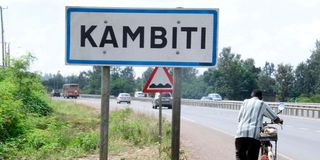
Signage at Kambiti Trading Centre in Murang'a county along the Nyeri–Nairobi Highway.
Photo credit: Joseph Kanyi | Nation
Longtime resident Julius Kamande, who has watched Kambiti grow from a single mud-walled hotel in the 1980s to more than 20 dingy bars today, says progress has been painfully slow.
“The best the town has seen are dilapidated buildings kept lively only by layers of paint applied annually to meet Public Health requirements,” he said.
Part of the problem, locals believe, is the town’s association with the nearby market centre known as Kwa Muthike, which is notorious for its alleged witchcraft.
Traders in Kwa Muthike confidently leave goods unattended, especially charcoal in gunny bags, trusting in supernatural protection against thieves.
Such perceptions of the supernatural, combined with years of neglect, have discouraged progressive real estate investment in Kambiti.
“Take anything you find here and it will either stall your vehicle, catch fire or force you to return it,” said Magdalena Mwende, a 58-year-old charcoal trader.
Yet some residents dismiss the superstitions, arguing that government neglect is the real barrier to growth.
“We have potential to grow and become a fabulous modern town. But government inaction is stifling us,” said 85-year-old Mzee James Macharia.
A backstreet view of Kambiti Trading Centre, Murang’a County.
Photo credit: Joseph Kanyi | Nation
The highway was tarmacked in 1975, and a single bus once linked Meru to Nairobi.
Land, initially sold in shareholding plots after independence, was gradually titled in 1985 following a visit by President Daniel Moi.
Yet even with formal ownership, economic activity remained minimal, limited largely to sand harvesting.
Mzee Macharia added that one share that guaranteed a buyer 2.9 acres of land was going for Sh1,100, and in 1985, title deeds were issued after President Daniel Moi visited the area.
A sign indicating Maranjau GK Prison in Murang’a County.
Photo credit: Joseph Kanyi | Nation
Residents recount how Kwa Muthike’s reputation for witchcraft drove investors away, leaving Kambiti to develop haphazardly.
“We became a town of illicit brews, narcotics and low-income housing, which fueled crime,” said Patricia Ndida, 76, adding that "Kwa Muthike town became notorious for witchcraft perceptions and investors shunned the area, moving to nearby towns of Kenol, Sagana and Makutano".
Even Maranjau Prison, established in 1973 near Kambiti, has done little to improve the town’s fortunes.
“We have complained to authorities but no action is taken,” said Benson Maina of the Nyumba Kumi security committee.
A sign indicating the Maranjau area, Murang’a County.
Photo credit: Joseph Kanyi | Nation
Murang’a County Commissioner Hassn Bule on Jamhuri Day warned that “any criminal networks limiting growth must be dealt with,” while prison officials defend staff, citing awards for distinguished service.
Still, warders are said to frequent local bars, fueling the very problems meant to be controlled.
Stephen Muguro, who is planning a concrete bricks factory, said Kambiti is largely low-income, suitable only for small retail businesses for now. “The town needs industries that attract outsiders and innovative mindsets to unlock its potential,” he said.
A muddy house at Kwa Muthike shopping centre in Murang'a County.
Photo credit: Joseph Kanyi | Nation
Residents also point to social challenges that compound economic stagnation: rental families survive on as little as Sh1,000 a month, children drop out or engage in risky behaviors and traders face theft and break-ins due to widespread poverty.
Yet, paradoxically, land values continue to rise—from Sh370 per acre in the 1970s to Sh3–5 million today, depending on location.
“Unilateral projects have ignored community input, public utilities have been grabbed, and buildings go unchecked. Above all, security must be restored,” he said.
Businesses at Kwa Muthike shopping centre in Murang'a County.
Photo credit: Joseph Kanyi | Nation
Maragua MP Mary Wa Maua has echoed concerns about drugs, crime and poverty. She cited theft fueled by a narcotics syndicate and said, “Insecurity forces residents to close shops by 6.30 pm and crimes happen even in daylight. We are working to improve roads and listen to residents’ complaints.”
Despite the town’s challenges, residents remain hopeful that with proper planning, engagement and enforcement, Kambiti can shed its ghost-town reputation and emerge as a vibrant, economically thriving hub.