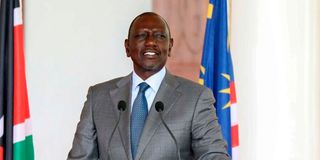
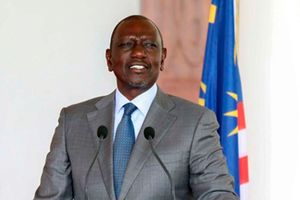
President William Ruto has allocated more than half of the next budget to his pet projects, housing, education, health and infrastructure, data contained in the draft Budget Policy Statement (BPS) for financial year 2026/27 shows.
The National Treasury has allocated Sh1.66 trillion to the four sectors out of the total annual budget of Sh2.88 trillion for the financial year starting July 1, 2025.
According to the Treasury document that is yet to be submitted to Parliament, the Health sector has been allocated Sh167.4 billion, which includes Sh136 billion for recurrent expenditure and Sh31.4 billion for development.
The Education sector will receive Sh7 67.3 billion, out of which Sh737.2 billion will go to recurrent spending and Sh30.1 billion for development.
In the Energy, Infrastructure and ICT sectors, the Treasury has allocated Sh54,5 billion, which includes Sh151.6 billion for recurrent and Sh42.3 billion for development.
The Housing sector, which Dr Ruto targets to fulfil his campaign promise of delivering affordable and decent houses, the Treasury has allocated Sh139.3 billion out of which Sh133.6 billion will be spent on housing development, and Sh5.7 billion will go to recurrent spending.
A section of the Affordable Housing Project in Mukuru, Nairobi on December 11, 2024. The Institute of Quantity Surveyors of Kenya has questioned why they are not involved in key government projects, including the Affordable Housing Programme.
Photo credit: Evans Habil | Nation Media Group
Under the Health sector, the Treasury says the government has allocated funds to employ Community Health Promoters (CHPs), and enroll 35 million Kenyans in the Social Health Authority (SHA).
So far, the government says it has enrolled over 27 million Kenyans in the Social Health Authority by 2025, representing more than 200 percent growth from fewer than 9 million under NHIF, with over 21 million entirely new members.
“Over the medium term, the government plans to complete enrolment of all eligible Kenyans in the Social Health Authority, targeting 35 million people,” reads the draft BPS
“The government also intends to expand Primary Healthcare Networks in all 47 counties, integrating community health units, health centers, and hospitals into coordinated systems that provide a continuum of care.”
The government says the networks will promote effective referrals and integrated community-based care. Infrastructure investments include construction of new health facilities, equipping existing facilities with modern medical equipment, and full rehabilitation of hospitals.
The government has also deployed 107,831 Community Health Promoters (CHPs) supporting 8.8 million households and established 228 Primary Care Networks, sponsored by approximately 2.49 million vulnerable households.
“Community health services will be strengthened through expansion of the Community Health Promoter workforce to 120,000 CHPs receiving monthly stipends, ensuring at least two CHPs serve each community health unit.,” the draft report states.
The government says it has established 228 Primary Healthcare Networks (PHCNs) across all 47 counties, out of a target of 315 networks.
The networks integrate community health units, dispensaries, health centres, and hospitals, facilitating seamless referrals, continuity of care, and coordinated health service delivery.
In the Affordable Housing Programme (AHP) front, the government intends to establish 15 Constituency Appropriate Building Materials and Technologies (ABMTs) centres.
“These centres will promote use of locally-sourced, climate-appropriate building materials and provide technical training in modern construction methods,” the Treasury draft document reads.
‘Additionally, 506 markets will be constructed to enhance commercial infrastructure and support local economic activities.”
The National Treasury building.
Photo credit: Dennis Onsongo | Nation
The Treasury says the government will continue to support the development of satellite cities and implement urban renewal programs in major urban areas to decongest existing urban centers and create planned, livable communities with integrated infrastructure and amenities.
According to the draft BPS, the government will also scale up capitalisation of the Housing Fund by expanding the Boma Yangu affordable mortgage product, partnering with financial institutions to provide long-term, low-interest mortgages, and disbursing Sh1 billion in rural housing loans to underserved areas.
“The Kenya Mortgage Refinance Company (KMRC) has been pivotal in this process, disbursing Sh21.4 billion by August 2025, and unlocking over 4,500 affordable home loans across 39 counties,” the BPS states.
“Reduced interest rates for refinanced mortgages (10 percent vs. commercial average of 16.2 percent in 2024) have made homeownership more affordable for low- and middle-income households.”
Currently, the government says 214,057 housing units are under construction across all 47 counties, marking significant progress toward national housing objectives.
Out of the Sh767.3 billion allocated to the Education sector, the Treasury has proposed to allocate TVET Sh39.8 billion, out of which Sh39.9 billion is for recurrent and Sh7.1 billion for development.
The State Department for Higher Education and Research will receive Sh155.2 billion for recurrent and Sh4.9 billion for development.
Basic Education has been allocated Sh119.7 billion for recurrent spending and Sh16.1 billion for capital expenditure.
Teachers Service Commission (TSC) headquarters in Upper Hill, Nairobi.
Photo credit: File | Nation Media Group
The teachers’ employer TSC, will get Sh422.2 billion for recurrent expenditure and Sh742 million for development.
The said government has given priority to the rollout of Competency-Based Education and Training from Grade nine to Tertiary Vocational Education Training (TVET) and University levels as the country transitions from the 8-4-4 to the 2-6-3-3-3 system.
In addition, the government also intends to support the construction of specialised Junior Secondary School learning spaces and train 50,000 teachers in competency-based pedagogies.
“To achieve optimal teacher-pupil ratios, the Government will recruit 30,000 additional teachers with priority given to Science, Technology, Engineering and Mathematics (STEM) and technical subjects,” the draft report states.
“Classroom infrastructure will be expanded through construction of 20,000 new classrooms and rehabilitation of 15,000 existing classrooms to eliminate overcrowding.”
Under TVET, the government plans to establish an additional 100 TVET centres equipped with modern equipment and offering industry-relevant curricula. The centres will train 200,000 youth annually in skills demanded by the labour market.
In order to improve education outcomes, the government will expand the school feeding program to cover 3 million learners in arid and semi-arid counties, providing nutritious meals that improve enrollment, retention, and learning outcomes.
In the infrastructure sector, the government says it will prioritise funding for construction of water pans, small, large and mega dams and associated irrigation infrastructure, expansion of roads and transport network, clean energy generation and distribution capacity, exploration and commercialisation of oil and gas.
Under the roads sector, the government targets to construct 1,891 kilometres of roads, rehabilitate 515 kilometres of roads, and continue with the periodic maintenance of 1,224 kilometres of roads.
Additionally, 78,320 kilometres of roads will receive routine maintenance, while 10,153 kilometres will be maintained under Performance Management contracts.
“These investments will link major economic centres through trunk roads. County roads will connect rural areas to markets, while rural access roads will open agricultural zones to trade,” states the BPS.
To meet rising demand for electricity, the government will increase national power generation capacity by an additional 10,000 megawatts (MW) through geothermal, wind, solar, and hydroelectric projects.
“This expansion is designed to support growing industrial activity and drive sustained economic growth. Reliable and affordable energy supply remains central to powering manufacturing, promoting agricultural value addition, and enabling digital transformation across all sectors of the economy.”