In the quiet afternoons of Mikinduni village in Tana River County, a strange rhythm settles over the homesteads.
As schoolchildren return home and livestock settle under trees, a different kind of gathering brews in hushed secrecy behind one particular mud-walled home. Women and men arrive in twos and threes, speaking little. Word has come in, that bushmeat is on the way.
Inside, Mwanahamisi Ade shuffles through a small notebook, collecting orders in whispers. Sh100 for half a kilo of antelope. Sh500 for a whole dikdik, six kilograms of tender meat. Her job is simple. Make collections, scan for snitches, and coordinate the drop-off.
“All rangers have been spotted,” she warns. “Let’s keep it fast.”
There is no room for error. With poaching outlawed under Kenya’s Wildlife Conservation and Management Act, arrests can carry stiff penalties, including jail terms. But in the weeks of full moon and pounding rains, demand surges. Hunters, undeterred, take to the forest armed with torches, clubs, and vuvuzelas to flush out game from the thickets.
In five minutes, all is done. Every client walks out briskly with chunks of meat wrapped tightly under clothes, or stuffed into plastic bags. No one looks back. The hunter disappears into the fading afternoon.
“It’s the only way I can feed my children well. Half a kilo of antelope feeds us for two meals, dinner and lunch. It’s sweet, tender, and satisfying. With beef, I’d need more, and even then, the weighing scales are rigged. You buy what you think is a kilo, but it’s barely a quarter,” says Halima Salim (real name withheld for fear of reprisals), a mother of six.
“For weeks, we’ve eaten meat at least twice. This is something I couldn’t afford before. I know it’s risky, but it’s survival,” she says with a shrug.
Mr Mohamed Maro, another regular buyer, agrees.
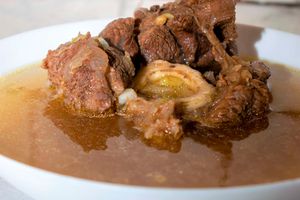
“A full dikdik lasts us two weeks. I roast some to preserve, fry the rest in oil. It saves me a lot of money. Honestly, it’s sweeter than goat meat,” he says.
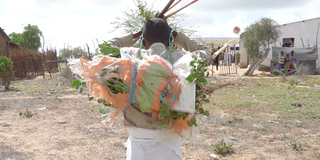
A hunter in Tana River County demonstrates how to use a bow and an arrow in this picture taken on July 21, 2025.
Photo credit: Stephen Oduor | Nation Media Group
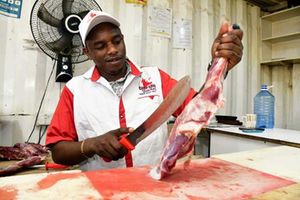
This thriving black market has left legal meat sellers reeling. Mr Elijah Muchai, a butcher in Hola, says the impact has been devastating.
“In May, I could slaughter and sell up to five goats in a day. Since June, I can barely move two. Meat just hangs on display. By nightfall, we’re forced to throw it away or roast it into jerky,” he says.
Next door, Mr Abdirahman Ahmed has faced similar losses.
“We’ve thrown out over 17 kilograms of unsold meat in two weeks. People want bushmeat now. It’s cheap, abundant, and unregulated,” he says.
To cope, he has hired someone to roast and dry beef to keep it from going stale.
Poachers getting more sophisticated
“Even that doesn’t always work. This season is the hardest I’ve seen in years. The game meat is everywhere, very few are buying from us. Majority, especially our clients from the villages, are not coming as they used to,” he says.
Kenya Wildlife Service (KWS) enforcement is struggling to keep up. The poachers are getting more sophisticated, monitoring KWS vehicles, tracking ranger movements, and operating in tight, silent networks supported by residents.
Sought for comment, KWS Tana River Senior Warden George Bakari said he was quite engaged to respond. He did not respond to text messages either.
Community support is mixed. While some help with tip-offs, others protect the poachers because of economic desperation.
According to KWS’s 2025 mid-year report, Kenya has recorded 287 poaching-related arrests between January and June. The Coast region, particularly Tana River, Kilifi, and Lamu Counties, accounts for 26 per cent of these cases. Among the most poached species are dikdiks and antelopes, targeted for their soft meat and ease of capture.
Prosecutions, however, lag. Only 113 convictions have been secured so far, many of them resulting in fines rather than jail time. Wildlife experts warn that without stronger deterrents, poaching networks will continue to flourish.
Apart from the conservation and threat to legitimate business issues, bushmeat has also been found to have food safety hazards.
A 2024 report by the International Livestock Research Institute (ILRI) warned of rising zoonotic disease risks from wild meat consumption, urging Kenya and other countries to improve hygiene in informal markets and invest in safer protein sources like livestock.
It recommended community-led wildlife management, discouraged wildlife farming, and promoted a holistic approach balancing health, welfare, and biodiversity. With wild meat vital to food security in many rural areas, the report rejected outright bans, instead calling for practical, science-based reforms to reduce spillover risk while preserving livelihoods.
"There is little consensus on what are likely to be the most effective means of managing wild meat hunting while addressing the needs of rural communities. The starting point would be a blueprint of how to safely butcher/slaughter wild animals depending on the species and category," the report stated.