Live update: Senators discuss governors snubbing summons
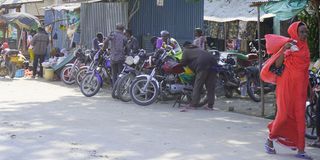
Boda-Boda riders parked at the Hola Market on September 17, 2025.

When the county government delayed salaries for months, Hola, the administrative heart of Tana River County, fell eerily quiet.
Shops that once bustled with buyers reduced their stock, hotels watched tables remain empty, and boda-boda riders lingered idly at their stages with no customers to ferry.
The salary dry spell exposed a fragile truth, that Hola’s lifeline is tied almost entirely to government pay checks and that despite being the county headquarters, the town has never outgrown its identity as a “civil servants’ town”.
With no strong industries, vibrant private sector, or alternative income streams, the local economy rises and falls with the fortunes of county workers.
At the Hola stage, motorcycles stand lined up like parked bicycles, their riders leaning against walls or scrolling idly through phones. Mr Stephen Kanumba, the chairman of the boda-boda association, shakes his head as he describes the dry spell.
“This has been one of the toughest periods for us. Some riders have actually hidden their motorcycles from creditors because they cannot pay their daily loans. You go out, spend the whole day, and return home empty-handed,” Mr Kanumba said.
He explained that county government workers, who are their main clients, either walk to work or ask riders to ferry them on credit.
“Imagine ferrying a customer for a week without pay, hoping they will settle the bill when salaries come. That has become normal. But meanwhile, fuel stations don’t give us fuel on credit, and creditors don’t wait,” he added.
The ripple effect is painful. Fewer rides mean less income, which translates to unpaid loans, family struggles, and sometimes outright abandoning of the boda-boda business.
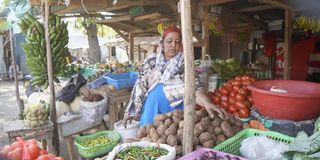
Habiba Abdullahi arranges her products at her grocery store at the Hola Town Open Market, Tana River County on September 17, 2025.
At Hola’s open-air market, Ms Habiba Abdulahi arranges a modest pile of tomatoes and sukuma wiki. She has been forced to reduce her stock because many of her loyal customers, county government workers, now survive on credit.
“Some of them with families owe me so much that I’ve lost count. After they got their July pay, they only managed to settle half of it,” she said, her voice carrying both sympathy and fatigue.
She explains that selling on credit is the only way to keep customers, but this puts her business under severe pressure.
“I used to sell a crate of tomatoes in two days, now it takes me almost a week. I have had to reduce stock since I'm making losses having a huge stock with a low consumer base. If they don’t get paid, I don’t get paid,” she said.
For hotel owners such as Ms Peninah Mwikali, the salary freeze has forced her to rethink survival. Once a vibrant meeting spot for government workshops and staff retreats, her hotel now echoes with empty chairs.
“We used to host big delegations, full-day meetings, and trainings. Nowadays, the county government has cut down. They hold meetings in their offices or in public halls, and when they do spend, they prefer kiosks for cheaper food,” Ms Mwikali said.
According to her, this shift has robbed hotels of reliable income, and smaller suppliers who depend on them, such as vegetable vendors and caterers, are also suffering.
“A hotel without guests is like a kitchen without fire. Even weekends are slow. People no longer come for nyama choma or soft drinks. They cut down to just the basics,” she added.
For landlords, unpaid rent has become a familiar refrain. Mr Michael Gachau owns several houses in Hola, mostly occupied by teachers and junior clerks. He admits he has had to relax his collection.
“When tenants cannot pay, what do you do? You either throw them out or give them time. I chose the latter because I know their situation. But at the same time, I depend on rent to maintain these houses. It’s a struggle,” Mr Gachau explained.
He noted that some tenants have not paid for two months, yet he continues to carry their debts, fearing to add more stress to already strained families.
The wider impact of the salary freeze is visible everywhere. Entertainment joints that once throbbed with music over the weekends now echo with silence. Pool tables are gathering dust and bar owners are lament their worst sales in years.
Traffic too has thinned out. Few cars cruise Hola’s dusty streets, and petrol stations have reported a sharp decline in fuel sales.
“When county workers cut down on fun and luxury, the town looks like a ghost town,” said Mr Mohamed Ibrahim, a taxi driver.
According to Mr Hassan Barisa, chairperson of the Tana River Chamber of Commerce, Hola’s economic fragility is not new.
“This town has been running on salaries since its establishment as a county headquarters. The majority of businesses here rely on the government payroll cycle. Once salaries delay, the entire town goes into a chokehold,” Mr Barisa said.
He observed that the lack of alternative industries or investment opportunities has left Hola vulnerable. Unlike other county towns that have diversified into agribusiness, trade, or small industries, Hola remains a “salary town”.
“We need to rethink Hola’s economy. There is potential in agribusiness, livestock, and even small-scale manufacturing. But until we diversify, this cycle of economic suffocation will continue every time there is a salary hitch,” he cautioned.
Despite the gloom, some residents are finding creative ways to cope. A few boda-boda riders now double as delivery men for market traders. Women groups pool savings to cushion each other, while shopkeepers diversify into mobile money services.
“You cannot sit and wait for salaries to move the town. You have to innovate,” said Ms Asha Salim, a young trader who has started selling second-hand clothes alongside groceries.
As salaries slowly trickle in again with payment of the July arrears, Hola is beginning to stir back to life. Shops are reopening with more stock, boda-bodas are returning to the roads, and hotels are welcome the occasional meeting. But the fragility remains. However, for residents, the fear lingers that the next delay could plunge the town back into silence.