In the quiet, wind-swept village of Haroresa in Tana River County, the nights are usually defined by the hum of insects and the distant bleating of goats.
But on this night, Mohammed Hassan remembers only the scream of his wife, Luli Mohammed.
A mother of nine, heavily expectant with their tenth child, Luli had just tucked her children into bed after a simple evening meal.
“She groaned and staggered back to me. At first, we thought it was a scorpion. It is normal here. We live with such dangers,” Mr Hassan recalls, staring at the ground as though the memory is too heavy to hold.
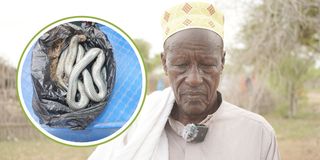
Mohammed Hassan, whose wife Luli Hassan died from a snakebite, at his home in Haroresa Village, Tana River County on November 20, 2025.
Photo credit: Stephen Oduor | Nation Media Group
Still determined to protect his children, he walked out to kill the scorpion he believed had attacked his wife. Instead, he came face-to-face with a motionless black snake, poised to strike again.
“My heart stopped. I knew we were in trouble,” he says.
He called his brother-in-law and with sharp blows, they killed the snake and stuffed it into a black polythene bag before he hired a motorbike to transport his wife to hospital.
“It was night, no lights, just bush. I held her waist the whole way, telling her we were almost safe. I promised her she would live,” Mr Hassan recalls.
But the promise broke the moment they reached the hospital gates. Inside the emergency room, no one rushed to help.
Mr Hassan remembers shouting, pleading, begging.
“The nurses looked at us like we were disturbing them. They kept us waiting for an hour. My wife was dying,” he says.
When a specialist finally showed up, Mr Hassan says he appeared “sluggish, uninterested, like someone who had been forced to wake up from sleep.”
“He didn’t ask what bit her. He didn’t even look at the dead snake that we had come with. He just said he was giving her painkillers,” Mr Hassan says.
“He told me, ‘It’s just a painkiller. Don’t worry.’ How could I not worry? My wife was shaking, sweating, crying,” he recalls.
When he pushed for more urgent intervention, he says they were dismissed.
“They discharged us and told us to come back in the morning. Who discharges a woman bitten by a snake at night?” he poses in disbelief.
The next morning, at 8am, Mr Hassan returned carrying both his weakened wife and the dead snake in the plastic bag. The only intervention they received was a drip.
“They told me there was no anti-venom and that they were trying to get some from private hospitals,” he says.
Unborn baby began kicking in the womb
By that time, 12 hours had passed since the snake attack and Luli’s condition continued to worsen with her skin colour gradually changing.
“I begged for a referral to Garissa or Kilifi. They told me to calm down. They said they could handle the case. But they were doing nothing,” Mr Hassan says, voice breaking.
By 1pm, Luli was losing the battle. Mr Hassan remembers how a woman ran to call him when the unborn baby began kicking in the womb.
“I put my hand on her stomach. At that moment, I knew my unborn child was fighting for the last time. I felt him die. I felt it,” he says quietly.
“They gave it to her when she was already gone. Thirty minutes later, I watched my wife kick and breathe her last, just like the baby. They waited until I had no one left to save,” Mr Hassan whispers.
“Death is God’s will. But negligence is not. I would have accepted her death if I saw effort. But I saw none. My wife died because people did not care,” he adds.
Family members of the late Luli Hassan say prayers at the gravesite shortly after the burial in Haroresa Village, Tana River County on November 20, 2025.
Photo credit: Stephen Oduor | Nation Media Group
Beside him sits his mother-in-law, Isha Kosar, a seasoned midwife who had traveled with them to the hospital that morning. The grief has carved itself sharply into her face.
“I watched my daughter die slowly. And no one cared,” she says.
“I told them, ‘Please, remove the baby, he is strong, he is kicking, don’t let him die.’ But they ignored me. Maybe they looked at me and saw an old woman from the bush. They didn’t listen,” she says.
“Her stomach went quiet. I knew the child was gone. I cried and pleaded with them, but they still ignored me,” she says.
Isha spent the night at the hospital, nursing her daughter while watching her life slip away.
“I left home hoping to save a life. I returned with a body. That pain, I cannot forget,” she says.
Standing at a distance, village elder Dakane Bosh shakes his head repeatedly. The incident, he says, has torn open wounds the community has carried silently for years.
“This hospital has caused us enough pain. And this time, we will not take it lying low,” Mr Bosh says.
Family of the late Luli Hassan, who was fatally bitten by a snake, watch as her body is moved from hospital for burial in Haroresa Village, Tana River County November 19, 2025.
Photo credit: Stephen Oduor | Nation Media Group
“Years ago, we lost a child because of the same negligence. We forgave. We moved on. But it has become a pattern,” he says.
“They treat us like lesser beings. Like bandits who do not deserve healthcare. We are human beings too. We bleed the same,” he says, anger rising.
According to Mr Bosh, even the local dispensary is dysfunctional. The specialist, he says, comes when he wants. Most times he just comes to throw expired drugs away.
“We have a governor. We have a Department of Health. But it is like we do not exist. We are forced to travel 36 kilometres to Hola because our own dispensary cannot help women or children,” he says, rubbing his forehead in frustration.
Back in Hola Town, County Assembly Health Committee Chairperson Semi Dumba has termed the incident “a tragic failure of duty.”
"This is an unfortunate incident that must be investigated. People must be held responsible,” Mr Dumba says.
“Those drugs were delivered barely three months ago. Yet today, anti-venom cannot be found. Where did it go?” he poses.
“There is blatant disregard of human life. What happened to this woman is unacceptable. It shows deep rot in administration,” he said, adding that he will push for accountability.
“We cannot say we care about residents but allow such preventable deaths. Someone must answer for this,” he said.
“The misery people in Tana River face under this system is heartbreaking. The Department of Health receives the biggest budget, Sh1.4 billion, but it is the worst performing,” Mr Bare said.
“Money meant for healthcare is swallowed by endless construction contracts. Service delivery is forgotten. People are dying,” he said.
“The Health Executive must be impeached. The Chief Officer must go. The Director and Hospital Administrator must be suspended. They cannot preside over so much suffering,” he said, adding that Luli’s death should be the turning point.
“If this county cannot protect pregnant women from preventable deaths, then what is the purpose of leadership? This should be the moment we say enough is enough,” he said.
Tana River County Director of Health Oscar Endekwa confirmed the gap that likely sealed the woman’s fate.
“There was absolutely no anti-venom in Hola or the neighbouring counties. Our teams attempted to source it immediately, but every effort failed,” Dr Endekwa said.
As the woman’s condition worsened, her unborn child still kicking inside her, clinicians struggled to stabilise her.
But according to Dr Endekwa, who was on leave at the time, the staff on duty that night lacked the specialised experience required for snakebite cases.
“They did not ascertain the type of snake involved, and that is crucial. Proper identification guides treatment decisions, including the correct anti-venom and dosage,” he explained.
Later, it was established that the attacker was an Ashe’s spitting cobra, one of the region’s most dangerous species.
Remains of the dead snake that fatally bit Luli Hassan at her home in Haroresa Village, Tana River County.
Photo credit: Stephen Oduor | Nation Media Group
“Given the potency of that venom, she was actually fortunate to have survived as long as she did,” Dr Endekwa noted.
As the poison spread rapidly, a referral was recommended, not as an administrative step, but to secure a High Dependency Unit, where more advanced monitoring could be offered.
But before any transfer could be arranged, Luli’s condition deteriorated beyond recovery.
A single vial of anti-venom was eventually found “from an unknown source”, but it arrived too late, and was insufficient.
“Anti-venom is costly, in some cases up to Sh20,000 per vial. For cobra bites, the venom load can be high, and without knowing how much venom was injected, even one vial may not be enough,” Dr Endekwa explained.
As families mourn, health officials warn that the danger is far from over. With the rainy season pushing snakes closer to human settlements, Dr Endekwa appealed for vigilance.
“Communities should report the types of snakes they see early enough. That information helps us prevent cases and prepare appropriate responses,” he said.
Back in Haroresa village, Mr Hassan stares at the cluster of huts in his homestead, where nine children now wait for a mother they will never see again.
“My children ask me where their mother is. I tell them she is with God. But I know she should still be here. If only they tried... if only they tried,” he says, his voice breaking.