With the groundbreaking of the proposed Dangote East Africa Refinery in Lamu on Wednesday, attention in Turkana County is shifting beyond the familiar demands for jobs and contracts to a bigger question of how the oil-rich county can secure a lasting stake in the value created from its crude.
At the centre of that debate is the infrastructure needed to connect Turkana’s oilfields to the coast and, ultimately, the proposed Lamu refinery.
As Kenya prepares to start commercial production from the South Lokichar Basin, Turkana professionals are calling for a clear, costed and time-bound plan to connect the oilfields to the refinery through a dedicated crude-oil pipeline.
For the arid county in Kenya’s far north, the refinery represents more than a major industrial project on the coast. It raises the prospect of linking Turkana’s oilfields, transport infrastructure, skilled workforce and communities to a wider petroleum value chain and ensuring that the county supplying the crude does not remain merely a source of raw material.
Turkana hosts the South Lokichar Basin, where recoverable crude oil resources have been estimated at between 560 million and 585 million barrels.
For the county, the proposed pipeline could determine whether its crude is integrated into Kenya’s downstream petroleum industry or continues to be treated primarily as an export commodity.
Local professionals and community groups now want the county’s political leadership, from the governor and senator to the Woman Representative and all six MPs, to speak with one voice in seeking Turkana’s inclusion from planning and financing through construction, operation and future expansion.
“Turkana, with their well-informed leaders, should bank on relevant laws to secure an equity stake or other long-term economic interest in the refinery and related petroleum infrastructure. A generational wealth creation concept needs to be developed not only for Turkana but Kenya as a whole,” said former Turkana East Sub-County administrator Christopher Eregae.
Mr Eregae said Turkana leaders should use the refinery’s launch to ask a question that goes beyond what the county will receive.
“While there, they should, on behalf of Turkana, not only ask what the county will receive. We must ask: what will Turkana own? Turkana has the resource. Turkana must have a stake in the value created by Dangote oil refinery in Lamu,” he said.
But for Turkana crude to become part of the Lamu refinery story, a major piece of infrastructure must first be put in place.
The Turkana Upstream Petroleum Professionals Association (TUPPA), a non-political and non-profit organisation bringing together more than 60 local professionals specialising in petroleum exploration and production, geology, petroleum engineering, petroleum chemistry, energy and related disciplines, sees the refinery as a potential game changer.
The proposed Lamu facility is designed to process up to 700,000 barrels of crude oil a day and is expected to be completed in 2030. The groundbreaking took place in Lamu on Wednesday, with President William Ruto and Nigerian businessman Aliko Dangote among those attending.
For Turkana professionals, the timing is significant as Kenya is scheduled to begin commercial crude oil production from the South Lokichar Basin on December 1, 2026, with first exports expected in the first quarter of 2027.
President William Ruto and President of the Dangote Group Aliko Dangote during the groundbreaking ceremony for the Dangote East African Refinery in Lamu County, Kenya.
Photo credit: PCS
The professionals' lobby , however, says the refinery will only become a meaningful market for Turkana crude if national planning deliberately connects the upstream and downstream projects.
“The refinery provides a market and value-addition anchor,” said TUPPA technical adviser Stanley Loter.
He said a regional refinery on Kenyan soil could offer South Lokichar crude a potential home market, reducing dependence on raw crude exports while retaining refining value, jobs and industrial linkages within Kenya and East Africa.
Phase One of the South Lokichar Oil Project is planned to produce 20,000 barrels per day, rising to 50,000 barrels per day in Phase Two.
Government projections put Kenya’s eventual contribution at about 120,000 barrels per day, still far below the refinery’s planned 700,000 barrels per day capacity.
“Energy Cabinet Secretary Opiyo Wandayi has already acknowledged that initial output will not support a commercial refinery. Turkana crude will therefore be a feeder, not the backbone, unless national production grows,” Mr Loter said.
That leaves Kenya facing a fundamental question of how a refinery of regional scale will secure enough crude, and what role Kenyan oil will play in its supply mix.
Recent analysis of the project has similarly identified crude supply as one of the central challenges facing the proposed 700,000-barrel-per-day facility.
Mr Loter said the refinery nevertheless strengthens the case for accelerated exploration and appraisal beyond the six South Lokichar discoveries, including other blocks in Turkana and Northern Kenya.
Kenya’s share of the regional crude supply mix, he said, should increasingly be driven by new discoveries rather than reliance on imports from neighbouring countries.
Long-awaited oil development
The immediate challenge for Turkana is transportation. Early crude oil is expected to be trucked to Mombasa, with first exports expected in the first quarter of 2027.
But the lobby says that arrangement cannot be the long-term answer if Kenya intends to integrate Turkana’s crude with the Lamu refinery.
Without a firm timeline for the Lokichar-Lamu crude-oil pipeline under the Lamu Port-South Sudan-Ethiopia Transport (LAPSSET) corridor, the association warns that Turkana’s oilfields and the Lamu refinery could develop as separate projects rather than as parts of one national value chain.
President William Ruto has linked the refinery to Turkana’s long-awaited oil development, saying the government is in discussions with Dangote over a crude-oil pipeline connecting the South Lokichar oilfields to the coast.
TUPPA has called on the National Government, the Ministry of Energy and Petroleum, the Energy and Petroleum Regulatory Authority (EPRA), the Turkana County Government, Gulf Energy and the refinery developers to prioritise Kenyan crude in supply arrangements.
The association wants the parties to negotiate a clear crude offtake framework that gives South Lokichar crude access to the Lamu refinery on fair, market-based terms.
Mr Loter also called on the Ministry of Energy and Petroleum to publish a pipeline roadmap setting out a costed and time-bound plan for the Lokichar-Lamu pipeline, aligned with the refinery’s construction timetable.
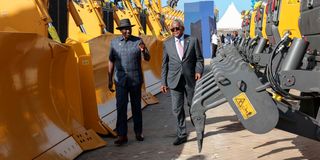
The call comes as the Lamu project itself moves into the construction phase. Heavy machinery has already arrived at Lamu Port ahead of the groundbreaking, underlining the scale of the logistics operation that will support the project.
The issue of ownership has gained prominence, particularly the equity stakes available to regional governments in the refinery and mechanisms through which producing counties and communities can participate in the downstream value created from their resources.
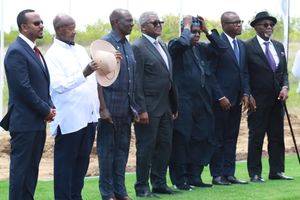
President William Ruto with Aliko Dangote and other Heads of State during the groundbreaking ceremony for the East African Refinery in Lamu.
Photo credit: Kevin Odit | Nation Media Group
TUPPA wants the government to fully uphold the revenue-sharing provisions of the Petroleum Act, 2019 for the Turkana County Government and host communities, while ensuring downstream arrangements do not dilute upstream obligations.
The association is also calling for local content to extend across the entire value chain, with Turkana professionals, technicians, youth and enterprises deliberately included in employment, training, supply and service contracts both in the oilfields and at the Lamu refinery.
It is further calling for structured technical training, internships and graduate programmes in drilling, production, refining and petrochemical operations targeting young people from Turkana and other host counties.
It says security along the oil corridor must also be strengthened, while water scarcity in oil-producing villages and environmental and social safeguards in both Turkana and Lamu must be addressed.
Turkana Professional Association chairman Jackson Nakusa said the prospect of a refinery on Kenyan soil represented a new opportunity for the country’s upstream petroleum sector.
He contrasted the current situation with the period after Tullow Oil discovered crude in Turkana in 2012, when protests erupted as local communities demanded jobs and tenders, with some protesters storming oilfields and camps to force skilled workers and expatriates out of the region.
Mr Nakusa said local communities should instead prepare for opportunities requiring highly specialised technical skills across the petroleum value chain.
With the refinery expected to provide a major market and processing facility for crude oil, he said Turkana must position itself to benefit fully.
“The refinery is a very important infrastructure for upstream oil. We have to make use of it as county leadership and professionals to push for investment and development in related multibillion-dollar projects that will link Lamu (Kenya) to Juba (South Sudan) and Addis Ababa (Ethiopia),” he said.
The LAPSSET corridor is planned to include a standard-gauge railway line, a mega port, a superhighway, a regional international airport, an ultra-modern tourist resort, an oil pipeline and a fibre-optic cable.
Mr Nakusa described the developments as a potential turning point for professionals and experts, with opportunities for long-term employment and businesses along the corridor.
“We only need to depoliticise the operations and allow professionals and government agencies to take the lead. Transparency and openness by Gulf Energy and other investors will also inform the success of the upstream sector,” Mr Nakusa said.
Community-based organisations led by the Nakukulas Economic Development Organisation (NEDO) want residents to be educated about the direct benefits and implications of the developments, including compensation for land and revenue sharing.
The National Land Commission (NLC) has indicated that it wants to acquire 15,686 acres for the South Lokichar Basin oil project and 50,948 acres for implementation of the LAPSSET corridor project and other activities.
NEDO secretary James Namuron said many locals have limited power over community land and need help obtaining formal documentation to secure their land rights.
“We call on relevant authorities to ensure locals in mapped areas have registered their community land so that they can easily be compensated for land to be acquired for the Lamu Port-South Sudan-Ethiopia Transport (LAPSSET) Corridor project and petroleum activities,” Mr Namuron said.
He said the organisation wants to strengthen the capacity of communities living in areas affected by natural-resource extraction to participate meaningfully in decisions concerning their land, environment and livelihoods.
“We are promoting community awareness on extractive-sector activities, facilitating meaningful participation of communities in development processes as well as pushing for responsible and sustainable natural-resource governance,” Mr Namuron said.