A party nomination is defined by Section 2 of the Political Parties Act as a process by which a political party selects its candidates to run for elective seats, such as President, Governor, Senator, Member of Parliament, Woman Representative and Member of County Assembly, in an election.
In Kenya, political party nominations, often called party primaries, are heavily regulated by law, governed by the Office of the Registrar of Political Parties (ORPP) and overseen by the Independent Electoral and Boundaries Commission (IEBC).
Long before voting happens in a General Election, the ORPP and IEBC enforce strict deadlines set by law to ensure transparency and prevent chaotic, last-minute party hopping.
For instance, Section 13 of the Act says:
"A political party shall nominate its candidates for an election at least 90 days before a General Election."
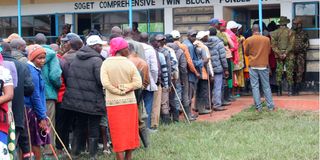
Voters queue at Soget Primary School polling station in Emurua Dikirr Constituency during the United Democratic Alliance (UDA) party nominations on March 27, 2026.
Photo credit: Vitalis Kimutai | Nation Media Group
It prohibits parties from changing their nomination lists and binds them to hear and resolve internal nomination disputes within 30 days.
How parties nominate candidates for an election:
By law, parties are required to submit their internal nomination rules and procedures to the IEBC at least six months before the nomination of candidates.
Aspirants seeking a party ticket must apply directly to their party's National Elections Board (NEB). To qualify for nomination, an individual must:
Be a fully registered member of that specific political party. Be a registered voter and possess a valid Kenyan National ID or passport. Pay a non-refundable nomination fee, which varies drastically by party and position (e.g., presidential tickets cost significantly more than County Assembly seats). Sign the party's Code of Conduct
Parties use different approaches to decide who gets the ticket, depending on their budget and regional dynamics.
They can conduct direct nominations. If only one candidate expresses interest in a seat, or if the party chooses to issue a direct ticket based on consensus or internal polling, that individual is declared unopposed. Party primaries. Members vote for their preferred candidate. This can happen through universal suffrage, where all registered members of the party cast a secret ballot at a local polling station, or through a delegates system, where selected regional party representatives vote on behalf of the membership.
ODM members cast ballot during the party nominations at Kamuma Sub-location's chief camp in Kasipul Constituency, Homa Bay County, on September 24, 2025.
Photo credit: George Odiwuor | Nation
Parties therefore must establish an independent internal dispute resolution mechanism (such as an Appeals Board) to handle complaints from disgruntled losers within a tight 24-to-72-hour window. If an aspirant is unsatisfied with the internal party outcome, they can escalate the matter to the Political Parties Disputes Tribunal (PPDT), before the IEBC gazettes the final candidate list.
Once all primaries and disputes are settled, the party leader and authorised signatories submit the final list of nominees to the IEBC.
This must happen at least 45 days before the General Election. After receiving these lists, parties are legally barred from changing their nominated candidates. Nominated individuals then present their nomination certificates and credentials to IEBC Returning Officers for final clearance to appear on the ballot.
Separate from the candidates running via the ballot, parties must submit Party Lists. These are rosters of individuals designated to take up special seats (such as nominated MPs, Senators or MCAs) allocated proportionally based on how many seats the party wins overall. These lists must alternate by gender to ensure fair representation of women, youth and persons living with disabilities.