As aircraft engines fell silent over Lamu on Wednesday evening and the bustle of dignitaries and preparations subsided, the county returned to its familiar calm.
But beneath the tranquillity, the region had crossed a threshold that could reshape its economic future. For the first time, Manda Airport received international flights, including a Boeing 737-800 carrying Ethiopian Prime Minister Abiy Ahmed, which landed at 10:14am.
Flights from Nigeria, Ethiopia and Uganda turned the usually domestic facility into a temporary hub for regional and international traffic, while a parade of private aircraft underscored Lamu’s growing importance as a destination.
The airport received Gulfstream G500 and G600 jets, an Embraer Legacy 600 and a Global Express 900, among others. Some international aircraft used the Manda military airstrip, while dozens of helicopters landed at Lamu Port.
The traffic was made possible by upgrades to the airport’s two-kilometre-long, 30-metre-wide runway and expansion of its aircraft parking apron. The latest works were undertaken in September ahead of the groundbreaking of the Sh2 trillion Dangote East Africa Refinery.
“This is more than an aircraft landing. It is Lamu taking off onto the global stage,” the Kenya Airports Authority said.
Transport and Infrastructure Cabinet Secretary Davis Chirchir said the improvements were part of a broader plan to rebuild the airport and develop a masterplan covering the Lamu Port-South Sudan-Ethiopia-Transport (Lapsset) corridor and Lamu metropolis.
“We have refurbished the airport, and we will rebuild it completely,” he said.
The improved air links could make it easier for visitors, business travellers, investors and other stakeholders to reach the region, opening opportunities in tourism, trade and related services in the region.
Located on Manda Island across the channel from historic Lamu Island, the airport provides access to the Lamu archipelago, known for its cultural heritage, coastal scenery and tourism attractions.
The refinery, designed to process up to 700,000 barrels of oil a day, is expected to bring further investment and international attention.
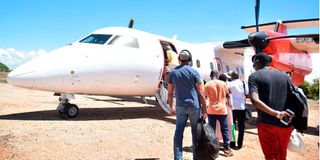
Passengers board an aircraft at Manda Airport in Lamu County.
Photo credit: Kevin Odit | Nation Media Group
The airport upgrade could have significance beyond the influx of VIPs and jets. International connectivity would reduce the distance between Lamu and markets where investors, tourists and workers are based.
For the hospitality industry, improved access could support stays and make it easier to combine Lamu’s heritage attractions with business trips linked to the port and projects. Local traders could benefit from increased demand for accommodation, transport, food and services.
Yet the investment is likely to bring pressure as well as opportunity. A larger workforce and urban settlement will increase demand for land, housing, water, health services and infrastructure, making planning and participation critical.
The county’s challenge will be to ensure the infrastructure boom translates into opportunities for residents.
Kenya National Chamber of Commerce and Industry president Erick Rutto said the project’s projected workforce of 60,000 would create a large market for local businesses.
“Creation of 60,000 workers isn’t a joke,” Dr Rutto said, arguing that construction workers, engineers and technical staff would increase demand for housing, food and other services.
He urged businesses to position themselves for opportunities, particularly in real estate, while encouraging local communities to prepare for the expected economic changes.
Security strategist Fidelis Maina said major investments could also strengthen security by demonstrating government commitment to development in a region long affected by marginalisation.
Such investment, he said, could weaken the influence of criminals and terror groups that exploit perceptions of exclusion to radicalise young people.
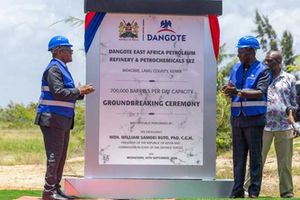
At the groundbreaking ceremony, Lamu Governor Issa Timamy assured Nigerian industrialist Aliko Dangote of the county government’s cooperation and urged residents to acquire skills that could qualify them for jobs.
He also asked the investor to prioritise Lamu residents in employment, while acknowledging concerns over the project’s potential impact on the environment and livelihoods.
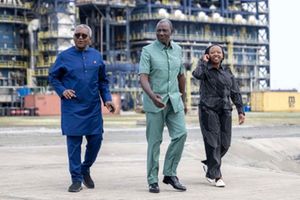
President William Ruto and President and Chief Executive Officer (CEO) of Dangote Group Aliko Dangote walk amid heavy machinery, on the day of a groundbreaking ceremony for the construction of an East African oil refinery in Lamu, Kenya, September 30, 2026.
Photo credit: PCS
“My people care deeply about the environment and livelihoods, the ocean, mangroves, beaches and our cultural heritage which define who we are,” Mr Timamy said.
Mr Dangote promised to work with stakeholders and said the project would be undertaken responsibly, with more than 60,000 jobs expected during construction.
“We shall work to ensure the project adheres to the highest standard of environmental safeguards,” he said.
President Ruto told Lamu residents to prepare to benefit from the investment, saying the county had been marginalised for decades partly because of its small population.
He said plans were at an advanced stage for a new town on the mainland to meet rising demand for housing, and urged residents to participate in shaping its growth.
According to Kenya National Bureau of Statistics 2019 census population projections, Lamu County’s population was estimated at 175,705 in 2025, making it the least populous county in Kenya.
For a county long defined by its remoteness, the international flights offered a glimpse of a different future — one in which Lamu’s geography could become an economic advantage rather than a barrier.