A dusty settlement in Turkana County, once only marked by manyattas, is rapidly transforming into a commercial hub, complete with hotels, fuel stations and new businesses, all powered by the gold economy.
A gold rush in Naduat and Lomeguro villages has triggered a dramatic economic transformation, turning the once quiet settlement of Makutano into one of the region’s fastest-growing emerging towns.
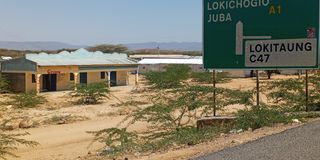
Strategically located along the busy Lodwar-Kakuma highway, Makutano sits at a crucial junction connecting travellers heading towards Kakuma through the upgraded South Sudan Link Road and those travelling northwards to Lokitaung – the historic town where founding President Mzee Jomo Kenyatta and other members of the Kapenguria Six were detained by the colonial government in the 1950s.
One of the gold mining sites at Makutano town along Lodwar - Kakuma road on August 3, 2026.
Photo credit: Sammy Lutta | Nation Media Group
Today, the landscape between Lodwar and Makutano tells a story of rapid change. Water bowsers weave through dusty roads, traders move goods, refugees search for opportunities, and miners stream into the area drawn by the promise of gold.
The population boom has created new business opportunities, with water trucking emerging as one of the fastest-growing enterprises in the area. The business is supporting gold mining operations, supplying households that have settled in the expanding town and serving other growing enterprises, including hotels, restaurants and lodgings.
What was once dominated by traditional manyatta structures is now evolving into a semi-urban commercial centre, with permanent and semi-permanent buildings made from corrugated iron sheets replacing temporary settlements.
Makutano now hosts petrol stations, entertainment joints, mobile money outlets, boutiques, courier services and public service vehicle booking offices, signs of a town adapting to a sudden economic boom.
For some residents of Lodwar, the changes have been impossible to ignore. Mr Ekal Ngasike, a Lodwar resident, said he was considering relocating to Lomeguro after several of his former friends moved to Makutano in search of better opportunities.
“I am informed they chose to move away from the ‘boring’ life of Lodwar, citing lack of opportunities due to the changing political dynamics,” he said.
Local professional Dennis Erot said the emergence of mining activities in Naduat and Lomeguro had attracted thousands of young people, both skilled and unskilled, seeking livelihoods from artisanal gold mining. He said the growing number of youth engaging in mining represented a shift in attitudes among young people who had traditionally focused mainly on formal employment.
“The common denominator is the pursuit of a coin to sustain themselves and their families. This resilience is truly impressive. I have observed a redefined paradigm shift in the perception of Turkana youth who would only sit back for white-collar jobs, now going for the dirty gold mining jobs,” Mr Erot said.
However, he warned that miners must learn to invest their earnings to create long-term wealth rather than repeating past cycles where mineral discoveries left little lasting impact on communities. He called for entrepreneurship training to help young miners convert short-term gains into sustainable businesses.
“Entrepreneurship shapes resilience among youth who do not find space in formal employment. By nurturing innovation and enterprise, the youth of Turkana can transform hard work into sustainable prosperity,” he said.
The mining boom has also offered a lifeline to pastoralist communities whose livestock were wiped out by prolonged drought.
It has equally attracted refugees from Kakuma, some of whom had been considering returning to their home countries because of worsening economic hardships, food shortages and reduced humanitarian assistance.
The situation has been compounded by cuts in foreign aid and humanitarian funding that have affected support programmes in refugee camps.
At Naduat and Lomeguro, refugees and locals now work side by side in search of income, with some entering dangerous open pits and unstable shafts in pursuit of gold deposits. Mr Ahmed Ahmed, an Ethiopian refugee, said refugees from different nationalities had joined mining activities while others had ventured into businesses such as electronics, phone accessories, clothing and food vending.
He said economic hardship had pushed many refugees to seek alternative sources of income outside the camps.
“At the refugee camp, if you decide to remain at home with your wife and children doing nothing to complement the limited food they may be getting from agencies, you will face severe psychological stress and make regrettable decisions. This is why some of us have left to come to Naduat,” Mr Ahmed said.
Despite awareness of deaths caused by collapsing mining shafts, he said many were willing to take the risk in the hope of improving their lives.
“We know there are reports of people losing their lives in collapsed shafts, but we hope we will survive this new coping strategy to earn and invest enough to change our lives,” he said.
Miraa being offloaded for sale at fast growing Makutano town along Lodwar - Kakuma road on August 3, 2026.
Photo credit: Sammy Lutta | Nation Media Group
Authorities, however, are pushing for safer and more organised mining practices as the gold rush continues attracting more people.
Turkana County Chief Officer for Energy, Petroleum and Mineral Resources Triza Amoni urged miners to comply with mining regulations and form cooperative societies to access support, funding and safety training. She said the county government was working to formalise artisanal mining, a manual or low-technology form of mineral extraction, by organising miners into registered cooperatives.
“As a devolved unit, we will work with registered cooperative societies to transform the gold mining sector so that it operates within the law and members have access to funding opportunities for focused and sustainable operations,” Ms Amoni said.
County Director of Mining Merimug Eloto said the county was committed to ensuring mining activities met safety and environmental standards while benefiting local communities.
“Our interest is to ensure that mining activities are safe, environmentally sound and inclusive of the community to contribute to sustainable development in respective villages and nearby towns,” Mr Eloto said.