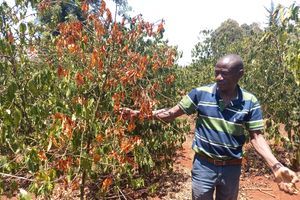
Multinational tea companies and small-scale farmers are staring at massive losses due to a decline in yields as a result of a prolonged drought that has damaged crops.
Some firms have been forced to prune crops and lay off workers to cut operational costs in the past four months.
The prolonged drought spells doom for the production of cash crops such as tea, coffee, pyrethrum and sugarcane.
“The decreased rain has affected the development of cash crops such as tea, coffee, sugarcane and pyrethrum,” an annual agricultural report stated.
The Tea Directorate said that cumulative tea production has in the past four months declined by five million kilograms — from 140.98 million to 135.83 million due to adverse weather conditions.
Production is expected to decline further because of the current dry spell, which could translate to low revenue for farmers.
The Ministry of Agriculture, in its report, said that many fields have been neglected and coffee production in the Rift Valley region is expected to decline.
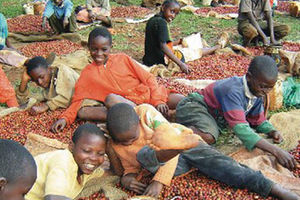
The region produced 65,618.50 tonnes of coffee last season, but the harvest is projected to be reduced this season due to the effects of drought, diseases and negligence of the fields by some farmers.
“Coffee production has been a profitable venture just like maize and wheat farming despite the challenges facing the sector,” Mr Peter Boit, a coffee farmer from Uasin Gishu County, said.
A truck delivers green leaves at a factory. Farmers are staring at losses due to prolonged drought.
Photo credit: Vitalis Kimutai | Nation Media Group
Wheat production in the Rift Valley region declined from six million to four million bags this season due to what the Ministry of Agriculture said was erratic rainfall that interrupted the smooth germination of the crop.
Last season, the Rift Valley region produced an average of 4.5 million bags of wheat from 127,825 hectares of land. Kenya produces an average of 365,600 tonnes of wheat against consumption of 8.4 million (90-kilogram bags), forcing the country to import the deficit.
Acreage under wheat production has reduced in Uasin Gishu County from 40,000 hectares to 18,000 hectares as farmers diversify to other lucrative investments like horticulture and dairy farming.
“There is a huge decline in acreage under wheat production in the last 10 years, which has negatively impacted consumption and the cost of wheat products,” said a county agriculture report.
Most millers are buying wheat at Sh5,200 per 90kg bag, which farmers claim is too low compared to the high production cost.
“Wheat production is a mechanical process, and subdivision of land into smaller units due to population pressure renders cultivation of the crop uneconomical,” Mr Wilson Kosgei, a wheat farmer from Moiben in Uasin Gishu County, said.
“Local farmers produce wheat that is superior in quality to what millers import into the country, but they continue to receive low prices for their produce. This has discouraged them from investing in the crop,” added Mr Kosgei.
Wheat farmers expressed fears of stagnating yield due to a repeated outbreak of stem rust and Ug99 — a highly virulent and devastating strain of the wheat stem rust fungus. They want new technology introduced so as to increase production and to get better returns.
“Apart from adapting new technology, wheat farmers need to access superior seeds that adapt to climate change and are disease-resistant for them to increase production,” Mr Jackson Kosgei, a farmer from Sergoit in Uasin Gishu County, said.
Wheat was the second most important cereal in the country after maize five years ago, in terms of production and consumption. But the trend has since changed as more farmers have diversified to other, more profitable investments.
Inadequate information and limited access to suitable varieties and processing technologies from research institutions have been identified by the Ministry of Agriculture as other factors contributing to the decline of wheat production in the country.
Limited availability of breeder and certified seed and instability in producer prices following limited government intervention in wheat marketing, coupled with a malfunctioning deregulated cereals market, are other contributors to low wheat production.
“The failure by the private sector to take up marketing functions previously undertaken by the National Cereals and Produce Board due to low capital investment and weak bargaining powers of farmers has contributed to low wheat production as the sub-sector struggles to reclaim its lost glory”, Mr James Kiptoo, a farmer from Kaptagat in Uasin Gishu County, said.