As Eldoret races to modernise, the youngest city in Kenya is steadily losing its identity as celebrated buildings face extinction. Eldoret is a place where history, culture and commerce intertwine beneath open skies.
The heritage of the country’s fifth city is being eroded as commercial towers replace the ancient, red-brick buildings that characterised the Boer legacy for decades. The Boers settled there after escaping British rule following the Anglo-Boer War.
Some of the buildings that formed this robust heritage and inspired British royalty are being replaced by skyscrapers, driven by the increasing demand for commercial and industrial space. Eldoret, which has earned itself the name ‘City of Champions’, was divided between Boer and British settlers, with the current Uganda Highway forming the boundary.
The Boers frequented the Wagon Wheel Hotel for recreation, while the British favoured New Lincoln Hotel, located along the current Oloo Street.
The Asian community was restricted to the West Indies area, while Africans occupied Eldoret West, popularly known as Kihuga Square.
The Boers mainly occupied Northern Avenue, where they engaged in farming. The British were on the southern side of the town.
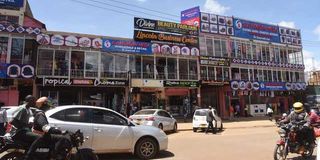
However, Eldoret City, with a population of 500,000, is gradually losing its Boer and British legacy. The latest significant building to be demolished is the colonial British recreational club, the Lincoln Hotel, along the busy Oloo Street. The hotel symbolised Eldoret’s colonial past and has been demolished to make way for modern commercial buildings.
“First, the hotel was subdivided to create smaller businesses, and then the premises were destroyed to make way for modern commercial buildings,” said Mr George Maina, a former reveller at the club.
“Prominent farmers and political leaders would hold meetings here while enjoying drinks and meals served on British silverware.”
However, this is all history now, as Eldoret, the industrial hub of North Rift, sheds its past and embarks on a new chapter as a city.
A view of Lincoln Business Centre in Eldoret City, Uasin Gishu County. The site once hosted the famous Lincoln Hotel.
Photo credit: Jared Nyataya | Nation Media Group
Also undergoing renovation is the Wagon Wheel Hotel, which was built on three acres. The hotel has retained its wagon-shaped design. It was a traditional meeting place for Boer settlers who owned thousands of acres of land for agricultural purposes.
The hotel’s main dining room is shaped like an elongated wagon coach. The renovated shutters and wings maintain its typical ox-cart appearance. “We’ve modernised the hotel but retained the original features as part of its history,” said a hotel manager who requested anonymity.
Also being renovated is the historic Soy Club, which played a part in Kenya’s history when Queen Elizabeth II (then Princess Elizabeth) visited the country on her honeymoon with Prince Philip. The club sits on 20 acres and boasts an important yet overlooked heritage, giving Uasin Gishu County a royal connection that is rivalled only by Nyeri’s Treetops Hotel. It was there that Princess Elizabeth was declared Queen upon the death of her father, King George VI, in 1952.
Many people have been flocking to the club to experience its royal connection, especially to Room 20, where Queen Elizabeth II spent the night during her honeymoon.
Political leaders allied to the Kenya African Democratic Union (KADU) — including the second President Daniel arap Moi, as well as Masinde Muliro, Ronald Ngala and Martin Shikuku — used to meet liberal white farmers there to plan Kenya’s independence.
Kihuga Square, once a vibrant trading hub for Africans, was established at a time when colonial policies rigidly separated communities along racial lines. However, it is now facing a loss of identity due to the rapid urbanisation and commercialisation that followed Eldoret’s elevation to city status three years ago.
“Kihuga Square, popularly referred to as Eldoret West, is rapidly losing its identity. Its historic landmarks and identity are quickly disappearing due to rapid modernisation. What was once a social space has been taken over by second-hand clothing businesses — mitumba,” said Mr Philip Mwanje, a resident of the formerly popular town located close to the main Eldoret–Old Uganda Road.
Born out of racial segregation in 1959, Kihuga Square evolved from a confined African trading and social space into a dynamic hub for emerging entrepreneurs and a focal point for social activity. In fact, the main Eldoret social hall is located in this area. “Apart from being an open market for African traders, Kihuga was a place to socialise and discuss politics and business. It was the heartbeat of Eldoret and the centre of community life, but that is no more,” said Wilson Maina, another resident.
European settlers developed structured town centres with permanent buildings and paved streets along Eastern Avenue, and Asians occupied the high-status West Indies, but Africans were confined to Kihuga Square — popularly known as Eldoret West — where they ran open-air markets.
“For many years, a visit to Eldoret could not be considered complete without an expedition to Eldoret West, particularly to Kihuga Square. It was like a town within a town, where history, culture, and commerce intertwined. But that is all gone now. The once-famous trading centre is now a shadow of its former self,” said Mercy Wanjiru, a local trader.
However, over the decades, Kihuga Square has lost its identity as Eldoret has experienced rapid growth, driven by rural-urban migration, transforming from a town into a city.
“Kihuga Square is undergoing a lot of transformation. The old landmarks are being phased out and replaced by modern structures. Some of the buildings have been refurbished and converted into shops. Open spaces have been redesigned and are now occupied by informal traders and street children, leaving little room for the trading centre to maintain its former appearance,” said Mr Samuel Koech.
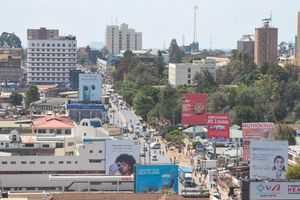
An ongoing construction next to Lincoln Business Centre in Eldoret City, Uasin Gishu County.
Photo credit: Jared Nyataya | Nation Media Group
Kihuga Square, which was a hub for the Afrikaner/Boer community in the 1900s, is home to one of Kenya’s oldest churches — the 100-year-old Emmanuel Dutch Reformed Church.
The church remains a testament to the historical ties between the Dutch Reformed Church and the Reformed Church of East Africa.
In the 1940s, the grandfather of former South African president F. W. de Klerk, Rev Willem de Klerk, preached at the Dutch Reformed Church, which is now known as the Immanuel Church or the Mungu Nasi Reformed Church of East Africa.
When F. W. de Klerk visited Kenya in June 1991, he attended a service at the Immanuel Church to commemorate his family’s history. The church remains a landmark testament to the historical ties between the Dutch Reformed Church and the Reformed Church of East Africa, whose headquarters are in Eldoret City.
Urban planners say modernisation is necessary to meet the demands of rapid population growth and the conditions required for city status.
These include proper solid waste management and sewage systems, beautification of city streets and highways, provision of social amenities, pedestrianisation of pavements, implementation of a traffic management plan and establishment and operation of a national museum.
“We’ve developed a roadmap to guide our policies in achieving the benchmarks that will establish the city as one of the best in Africa,” said Elzeba Busienei, Eldoret City Manager, noting that most of the conditions for city status have been met.
“We have made significant progress in solid waste management, and our infrastructure development master plan will ensure a closed drainage system and effective solid waste management and recycling to generate manure,” Ms Busienei said.
While awarding the charter to Eldoret town on August 15, 2024, President William Ruto asked the management to be ready for the challenges of providing quality services befitting city status.
“It is essential that Eldoret focuses on the significant opportunities and challenges ahead, because it has what it takes to become the ultimate city of the future,” said Dr Ruto.
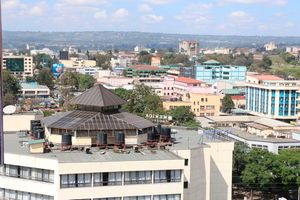
The 2019 Kenya Population and Housing Census showed that Eldoret is the fifth most populous urban area after Nairobi, Mombasa, Nakuru and Ruiru. While Eldoret’s rapid growth has transformed the town, resulting in new commercial buildings, paved walkways, structured stalls and other business opportunities, these developments have also erased historic landmarks such as Kihuga Square.
The buildings that shaped the identity of the once vibrant trading centre have been demolished and replaced with modern, high-rise commercial buildings and skyscrapers.
However, historians and cultural observers caution that development should not come at the expense of heritage. Places such as Kihuga Square are living archives — physical spaces where stories reside.