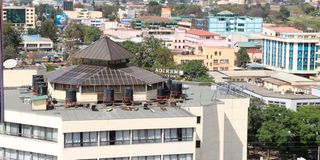
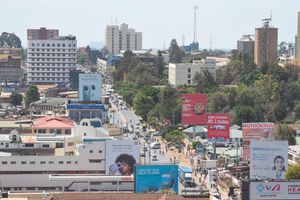
Nearly four years after Nakuru attained city status, the Rift Valley capital’s skyline is rapidly changing, with modern high-rises replacing the old colonial roofs and low-rise buildings that once dominated the city.
The surge in tall developments spans the Central Business District and residential areas, signalling a bold shift in urban planning.
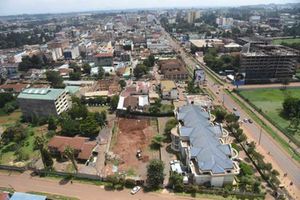
Aerial view of a section of Nakuru City.
Photo credit: Bonface Mwangi | Nation Media Group
But for decades, urban planners and geologists had cautioned against constructing buildings above four or five storeys.
In June 2020, seismologists Cyrus Karingiti and Kizito Opondo, alongside Geothermal Development Company geologist Paul Ngugi, warned that Nakuru sits on an active fault line, making some areas prone to sinkholes and vulnerable to structural failure.
The report highlighted weak spots in neighbourhoods including Kaptembwo, London, Kiamunyi, Shabab, Ngata, Team Sales, Pyrethrum Estate and Koinange Primary, especially during heavy rains.
Despite these warnings, high-rise projects are underway throughout the city. Developers, driven by demand for modern housing and office space, are increasingly building higher and higher.
Sound today, catastrophe tomorrow
Aerial view of a section of Nakuru City.
Photo credit: Bonface Mwangi | Nation Media Group
Architect David Mwangi says advanced technologies such as base isolation, vibration dampers, reinforced foundations, and earthquake-resistant materials are used to enhance structural safety.
“We are not leaving anything to chance due to previous reports of a fault line in Nakuru City. We prioritise deep, reinforced foundations and advanced pillars to ensure the buildings’ structural integrity. We also employ rigorous engineering designs to prevent any risk of collapse,” he added.
Nakuru City manager Gitau Thabanja adds that all high-rise plans undergo rigorous approval by county and national authorities.
However, geoscientist Dr Isaac Kanda warns that subsurface instability and underground cavities remain a serious risk. He calls for a city-wide geotechnical survey, stricter zoning, and review of existing buildings to prevent potential disasters.
“What appears structurally sound today could become tomorrow’s catastrophe,” he cautions.