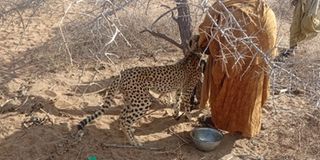
Kenya Wildlife Service has safely recovered a cheetah from a woman in Garissa who had raised it like a pet for nearly two years after rescuing it as a cub.

When Bishara Abdinoor saw her teenage son returning home one evening in April 2023 carrying a baby cheetah, she was terrified.
The boy had spent the whole day grazing cattle within their Kursi Village, which borders the Sabuli Wildlife Conservancy in Wajir County, where he stumbled upon the emaciated cub that had been abandoned by its mother.
The mother was not even aware or concerned about the legal consequences of handling a wild animal without a permit from the Kenya Wildlife Service (KWS), but rather about the risk her naïve son had taken by bringing the cheetah home.
With cases of human-wildlife conflict being common in Wajir, Mrs Abdinoor’s biggest worry was that her 14-year-old son could have been attacked if he had encountered the mother cheetah looking for the cub and become just another statistic of lives lost through wild animal attacks.
“I even contemplated throwing the cub away, fearing the cheetahs might trace its smell and come for it, but my son pleaded with me to allow him to feed the cub before releasing it back to the wild,” she explained in a telephone interview with the Nation.
Kenya Wildlife Service has safely recovered a cheetah from a woman in Garissa who had raised it like a pet for nearly two years after rescuing it as a cub.
The interview had been organized by Kenya Wildlife Service Senior Assistant Director in charge of the Northern Conservation Region, Bakari Chongwa, during which Mrs Abdinoor, a housewife, spoke through a translator.
“My son fed the baby cheetah with the same food that we had that evening — a meal of rice and beef stew — and also arranged a warm makeshift cage for it to sleep in,” she narrated.
Bathed, nursed and fed
The following day, the teenage boy also bathed the cub as part of the nursing. The idea was to nurse it and release it back into the wild in the adjacent Sabuli Wildlife Conservancy area.
The family feared the cheetah might start feasting on their livestock, especially goats, once it grew up in their midst, or worse still, cause problems in the village by attacking people.
After a few weeks of nursing, the cub regained its health and became strong, so they decided to return it to the wild.
However, the baby cheetah would hear none of it. It found its way back to the family every time it was taken to the jungle and seemed to enjoy the cooked human food.
“Over the months, we grew a bond with the wild cat. It was friendly and could recognize every member of our family. We then began to tether it under a tree shade and continued feeding it, still fearing it could attack people,” she said.
Their home became a no-go zone for marauding dogs and other predators as the cheetah grew in size.
For more than two years, the baby cheetah once rescued in the jungle by a herdsboy became a domesticated wild cat by default, with the family not knowing what to do with it.
One day, a vernacular radio station hosted the KWS Warden in charge of Wajir County, Mr Rashid Jimale, for a morning show on ways of tackling stray wild animals, during which he urged communities to report such cases to the authorities.
Upon hearing the show, Mrs Abdinoor sent word to KWS that she had been raising a cheetah they had rescued in the wild.
Mr Chongwa thanked the woman for taking care of the baby cheetah the way she would her own domestic dogs or cats.
Illegal
In a statement on Thursday, KWS said the woman rescued and took care of the animal by feeding, bathing, and treating it as a pet cat for two years.
“In Kursi Village, Wajir County, a compassionate woman once rescued a stranded cheetah cub and lovingly raised it as her own for nearly two years — feeding, bathing, and even leashing it like a pet cat,” the KWS statement read.
KWS stated that while the intentions of Mrs Abdinoor were noble, the Community and Wildlife Service Division learned of the case and rescued the animal.
Mr Chongwa said it was illegal for the woman to keep the animal without a permit, but the necessity of rescuing and nursing the cheetah was greater than obeying the law.
Keeping wild animals is against the Wildlife Conservation and Management Act (WCMA), which requires that wild animals remain in their natural habitats.
KWS officers visited the home on Wednesday and took custody of the cheetah for examination by veterinary teams.
Health check
According to KWS, the animal underwent a full health check, laboratory tests, and treatment for parasites, and was later transported to the Nairobi Animal Orphanage, where it is still being observed.
It confirmed that the cheetah is now under expert care at the Nairobi Safari Walk to thrive and contribute to conservation and education efforts.
The agency appreciated the woman for her compassion and for taking care of the animal.
“We deeply appreciate the Good Samaritan’s compassion and remind all Kenyans that true coexistence means protecting wildlife where they belong — in the wild,” the statement added.
Under Kenya's Wildlife Conservation and Management Act of 2013, it is unlawful to keep any wild animal in captivity without a license from the Director General of the KWS.
In Kenya, keeping wild animals as pets is therefore prohibited unless you have obtained a specific permit for that purpose.
Before the agency issues a license, KWS evaluates your capacity to care for the animal long-term and the suitability of your facilities — a process that mostly applies to individuals, groups, or organizations.
Follow our WhatsApp channel for breaking news updates and more stories like this.