Governors have rejected a proposed five percent allocation from the Roads Maintenance Levy Fund (RMLF) and are pushing for at least 42 percent of funds collected, setting the stage for a fresh battle for control of the billions.
The county chiefs said the proposed five percent allocation contained in the Kenya Roads (Amendment) Bill, 2025 is a drop in the ocean for the counties as they are responsible for management of over 76 percent of the country's road network.
Last year, a landmark High Court decision in June 2025 declared the exclusion of counties from direct allocation of the RMLF unconstitutional.
The court faulted provisions of the Kenya Roads Act and Kenya Roads Board Act, prompting the Court of Appeal to grant Parliament a 12-month window, until July 2026, to amend the law and avoid disruption of road maintenance funding.
Milimani Law Courts in Nairobi.
Photo credit: File | Nation Media Group
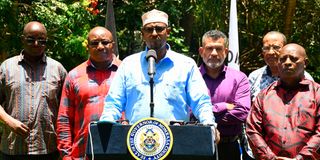
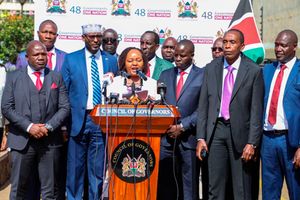
Appearing before the Senate Committee on Roads, Transportation and Housing on Tuesday, Council of Governors (CoG) Transport, Infrastructure, and Energy Committee Chairperson Kimani Wamatangi said they will not settle for anything less than the 42 percent.
The Kiambu governor described the proposed five percent allocation as restrictive, arguing it is inconsistent with both the Constitution and the reality on the ground.
Under the proposed allocation structure, the Kenya National Highways Authority (Kenha) will receive 36 percent, Kenya Rural Roads Authority (Kerra) 21 percent for constituency roads and 10 percent for link roads between constituencies, Kenya Urban Roads Authority (Kura) 14 percent, Kenya Wildlife Service one percent, and the Kenya Roads Board (KRB) 1.5 percent. The State Department for Roads and the Ministry will receive 1.5 percent and 10 percent, respectively.
However, Governor Wamatangi argues that the original intent of the RMLF law was to channel more than 50 percent of the funds to the then local authorities—now succeeded by county governments—which bear the primary responsibility for road maintenance.
He told the committee chaired by Migori Senator Eddy Oketch that counties currently manage 182,092 kilometres of roads, representing 76 percent of the national road network, compared to the national government’s 57,030 kilometres (24 percent).
“The Bill’s proposal to allocate counties only five percent of the non-securitised portion of the RMLF—effectively translating to just 2.5 percent overall—is impractical and inequitable,” said Mr Wamatangi.
“Governors are therefore advocating for a minimum allocation of 42 percent to ensure fairness, sustainability and effective service delivery.”
The governor observed that in the financial year ended June 30, 2025, the total RMLF collection stood at Sh119.7 billion with counties getting only Sh6 billion.
On the other hand, the national agencies such as Kerra continue to receive substantial resources — more than Sh400 billion cumulatively since 2013/14 and Sh35.8 billion in the last financial year alone — for functions that both the High Court and successive government policy reviews have identified as largely devolved, with the merger of Kerra and Kura being proposed.
The reforms, Mr Wamatangi said, would align with the 2013 Presidential Taskforce on Parastatal Reforms — known as the Abdikadir Report — and Cabinet’s January 2025 decision to merge the two agencies.
Mr Wamatangi said the current legal framework, establishing the three road agencies, predates the 2010 Constitution, which now assigns national trunk roads to the national government and county roads exclusively to county governments.
County governments are tasked with the planning, development, rehabilitation and maintenance of county roads, among other responsibilities.
The Bill, sponsored in the Senate by Majority Leader Aaron Cheruiyot, seeks to amend the Kenya Roads Act, Cap. 408 to reclassify public roads into two broad categories – national trunk roads and county roads.
Clause 3 of the Bill amends section 47 of the Kenya Roads Act to provide for the classification of roads into national trunk roads and county roads as set out in the First Schedule.
It further mandates the Cabinet Secretary for Roads and Transport to review the classification and assignment of roads at least once every five years, ensuring that the country’s road network keeps pace with infrastructural developments and emerging needs.
A new section, 47A, introduced under Clause 4, outlines the responsibilities of county governments with respect to roads within their jurisdictions.
The Council has proposed further amendments to ensure classification aligns with constitutional functions.
Some of the proposals include having minor urban arterials in central business districts classified as county roads; secondary rural roads linking major towns placed under counties; urban collector streets and shopping streets assigned to counties; and security roads retained nationally but with clearer definitions to avoid overlap.
The CoG further proposes that road classification and reclassification be handled through a joint intergovernmental mechanism involving the national government and counties to ensure consultation.
The Bill is currently before the Senate Committee on Roads, Transportation and Housing for consideration before submission of its report to the House.