Ebola response: 108 contacts in quarantine as Kenya receives Sh61m supplies
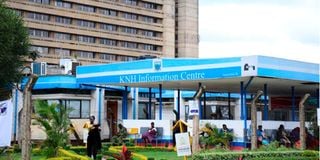
Kenyatta National Hospital in Nairobi.

A total of 108 people linked to Kenya’s two Ebola cases are in quarantine at Kenyatta National Hospital (KNH) and the National Police Service Hospital, even as a new report revealed that the country has 211 beds available for Ebola patients.
According to the latest situation report dated October 14, a total of 128 contacts of the first case had been traced. Of the 128 contacts, 108, or 84.4 per cent, were in quarantine, with follow-up among them at 100 per cent. A total of 20 were not in quarantine, and contact tracing was continuing for 15, while five were outside the country.
Regarding capacity, the report says 211 beds are available for Ebola patients, with the number potentially rising to 241. These include 130 beds at The Nairobi Hospital, 49 at the National Police Service Hospital, 20 intensive care-grade beds at Moi Teaching and Referral Hospital, with the number there potentially rising to 50, eight at KNH and four at Port Reitz Hospital in Mombasa.
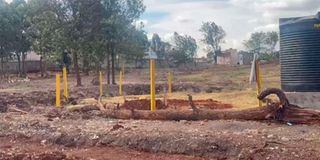
Gravesite of Kenya’s first Ebola patient, who travelled from the Democratic Republic of Congo through Uganda before arriving at Jomo Kenyatta International Airport in Nairobi.
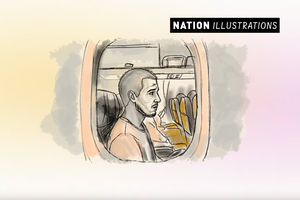
Kenya has two confirmed Ebola cases and one death. The first case involved a Kenyan who travelled from the Democratic Republic of Congo through Uganda. He died on October 5.
The second patient is a 39-year-old man and a close contact of the first patient. He developed a fever, fatigue and joint pains while in quarantine on October 13. He was isolated, and his sample tested positive at both the National Virology Reference Laboratory and the KEMRI-CDC laboratory. He is receiving supportive care.
The report says 324 samples from 18 counties have been tested, with two returning positive results. Results take six to 12 hours, including confirmation at a second laboratory.
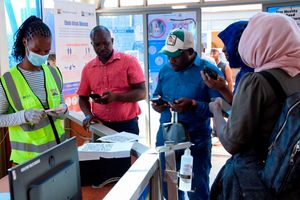
The report also says 685,027 travellers have been screened at 26 points of entry, including 3,816 in the last 24 hours. Five laboratories have been designated to conduct tests, including mobile laboratories at the Lwakhakha and Busia border points.
A surge team of 343 trained responders is on standby. It includes 102 people who worked during the West African outbreak of 2014 to 2016. A total of 4,917 health workers have been trained.
Eleven counties are setting up public health emergency operations centres, and 71 officers have been deployed to them.
The figures come as new supplies arrive to support the response. Kenya has received infection prevention and protective supplies worth Sh61.1 million, funded by the United States.
The supplies include personal protective equipment and laboratory equipment. They comprise 3,600 N95 respirators, 9,000 bottles of hand rub, 18,000 waste bags, 1,080 pairs of rubber boots and 60 body bags for safe burials. The supplies were donated by the US government and UNICEF.

Public Health Principal Secretary Mary Muthoni.
Public Health Principal Secretary Mary Muthoni Muriuki and Dr Runa Gokhale, director of the US Centers for Disease Control and Prevention in Kenya, led the flag-off at Afya House in Nairobi on October 15.
“It’s a serious moment, but not an unprepared one,” said PS Muriuki. “Every item protects a health care worker and a patient or a family at home.”
Amref Health Africa handed over infection prevention and control supplies valued at Sh14.4 million, funded by the US Department of State. FHI 360 contributed Sh46.7 million through its Strides project, bringing the total to Sh61.1 million.
Dr Gokhale said supplies alone were not enough.
“Preparedness is not just about having supplies on hand. It is about building the systems, skills and partnerships that allow health workers to detect cases early, protect themselves and patients, and act quickly when an outbreak occurs. The United States is proud to support Kenya as it strengthens these capabilities,” she said.
The Ministry of Health and the Kenya National Public Health Institute will develop a plan to distribute Ebola response supplies to high-risk counties, with the Mission for Essential Drugs and Supplies handling delivery. The plan has not been published, and the Ministry has yet to announce which counties will receive supplies first or when distribution will begin. County authorities will be responsible for proper use, storage and accountability, with every consignment tracked to its destination.
Earlier donations included 1,000 protective equipment sets from the WHO and 6,000 from India.
A US Department of State-funded programme worth USD 2.4 million has supported Ebola preparedness since July, working with the Ministry, the Kenya National Public Health Institute, the Council of Governors and 13 high-risk counties. It has trained 1,469 frontline health workers, contracted 134 workers for rapid deployment, trained 163 officers in safe burials and sensitised 3,384 community actors. A radio campaign reached an estimated seven million people.
Follow our WhatsApp channel for breaking news updates and more stories like this.