Where are the 15 ‘missing’ contacts linked to first Ebola patient?
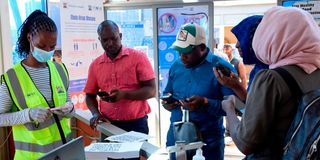
Travellers register their personal details at port health services at the Busia One Stop Border Post in Busia, Kenya on October 8, 2026.

What you need to know:
- Contact tracing is ongoing, with the Health ministry saying it has no evidence of wider community spread.
- Before the ministry announced the second case on Wednesday, the last update had been on Sunday, October 11.
Experts are urging the Ministry of Health to move quickly to trace 15 people said to have had some form of contact with Kenya’s first Ebola patient, warning that they increase the risk of local transmission.
The 15 are among 128 contacts of the country’s first Ebola patient, who died last week. The Health ministry said it had traced 113 as of October 13, 108 of them in quarantine in Kenya. The other five are outside the country.
“Finding and assessing these individuals remains an urgent priority. If they are still in the community, there is a risk of more exposure and more cases,” said Dr Ahmed Kalebi, a pathologist and public health researcher.
Contact tracing is ongoing, with the Health ministry saying it has no evidence of wider community spread, and that Kenya remains open with no limitations on travel, trade or public gatherings.
The call comes after Kenya confirmed a second case on Wednesday; a close relative of the first patient who fell ill while already in quarantine.
Dr Kalebi said that people who shared exposure with the second patient needed particularly close attention, and their exposure histories should be reviewed.
Every contact must be monitored for the full 21 days from their own last possible exposure.
“Teams are assessing people who may have been in contact with the second patient, including quarantine staff and health workers, since his symptoms began while he was in quarantine,” said Dr Patrick Amoth, Director-General for Health.
Dr Kalebi said the early detection of the second case is good news, but not proof of containment.
“The ministry indicated they’re still looking for 15 contacts who are linked to the first case and they’re at large. Where does that leave Kenya? Now, when we’re talking about the second case, we are talking about secondary transmission, we need to be vigilant,” said Prof Shem Otoi, an infectious disease modelling expert at Daystar University.
He said the secondary case meant that there is local transmission and that the level of exposure among the 15 people still at large needed to be established.
“Were they among those who were in very close proximity with the patient or those who are just in the same space but not in very close proximity. We need to move with speed and have them quarantined because they are a threat to the community,” Prof Otoi said.
The experts also called on the Health ministry to provide daily public situation updates covering all quarantined contacts, including how many remained symptom-free, how many had developed symptoms or undergone testing, and how many had completed monitoring.

Members of the public walk past the Busia One Stop Border Post crossing-point between Kenya and Uganda on October 8, 2026.
“Even when there are no new cases, a daily situation report is essential. Silence creates an information vacuum, fuels speculation and makes public reassurance harder to sustain,” Dr Kalebi said.
Before the ministry announced the second case on Wednesday, the last update had been on Sunday, October 11.
“We can give daily, short, fixed-time updates with a few lines. Giving updates of contacts verified, in quarantine and cleared, and whether any has developed symptoms. Samples tested and results, and any suspected cases and how they ended. How many isolation beds are occupied and how many travellers have been screened,” he said. “None of that identifies a person, but it assures Kenyans something is happening.”
Prof Otoi, said the briefing matters for three groups.
“The daily briefing matters for the people on the list, who need to trust the process enough to report symptoms early. It matters for health workers, who are being asked to cope with quarantine and fear. And it matters for a government that says Kenya is open, because a country that says little is easy to doubt,” he said.
Prof Omu Anzala, a virologist and member of the National Task Force for Ebola, said the government had not yet begun reassuring the public.
“You must deal with this thing with the sensitivity that it requires. We need to be reassuring Kenyans every day that they should not panic. Silence might cause panic in some instances,” he said.
In the first week, the ministry had briefings almost daily – a release on October 6, a hospital tour on October 7, interviews on October 8, a task force briefing and an airport visit on October 9, and the statement of October 11. The only official step after that was the gazettement of the Ebola rules on October 12.
“Communication must be concise and clear to avoid confusion and mass panic,” Prof Otoi said. “People must be told what to do, how to protect themselves from any infection. And this should be done in both the national TV stations and also local media. One thing we must never do, we must never let panic set in.”
The experts’ concern is consistent with a wider body of evidence from the outbreak in the Democratic Republic of Congo and Uganda. A Nature analysis reported that officials are battling fear, mistrust and competing political narratives as well as the virus.
Researchers cited in the analysis describe community trust as a critical determinant of outbreak control. Resistance to public health measures, they say, often reflects deeper social, political and historical grievances and not simple misunderstandings about the disease.
Mr Daudi Ochieng, a senior risk communication and community engagement advisor, said: “Global health agencies tend to emphasise precaution and urgency while national governments are also thinking about public confidence, tourism, trade and economic stability. Alarmist messaging can fuel panic and stigma, while downplaying an outbreak may reduce vigilance and delay reporting.”
Officials say the best way to counter misinformation is through trusted local networks as well as top-down messaging. In the DRC, authorities are working with religious leaders, teachers, civil society groups and traditional healers to counter false claims and encourage early reporting of symptoms.
Africa CDC Director-General Jean Kaseya has stressed stronger coordination between surveillance, community engagement and public communication.
Follow our WhatsApp channel for breaking news updates and more stories like this.