30 years of fighting 'demons': Fred Gori's long road from sleep paralysis to mental health advocacy

47-year-old Fred Gori, who battled sleep paralysis for 30 years. He is on a mission to create awareness about mental health and galvanise support for those battling mental health issues

What you need to know:
- Every night, as sleep pulled him under, he felt as though something was pinning him to the bed.
- He could hear children playing outside his window and conversations around him, but he could not move, could not speak, and could not fight back.
For most of his life, Fred Otieno Gori believed he was fighting demons. Every night, as sleep pulled him under, he felt as though something was pinning him to the bed. He could hear children playing outside his window and conversations around him, but he could not move, could not speak, and could not fight back. In the morning, he would rise hollowed out, ashamed, certain that a demon had visited him in the dark and left something broken behind.
He was around five years old the first time it happened. He is 47 now. It took him three decades, eight job changes, a stint on eight different medications in a single day, and a near-decision to declare himself legally disabled before anyone told him that he was not actually battling demons but sleep paralysis. Over the years, the sleep struggles led to high blood pressure, compounded by depression and anxiety so severe that, by his own account, it nearly ended his life.
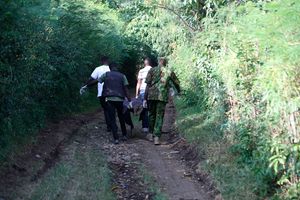
Today, Gori is trekking from Migori to Nairobi on a mental health awareness walk, determined to ensure that no one else endures what he did.
Gori was born in Obere, then part of Homa Bay County, to a mother who was the third of four wives. His father held a modest civil service job with the Ministry of Public Works, not enough to comfortably support such a large family. The co-wives and their children lived crowded together on the same compound.
His mother bore the brunt of the household's hostility. She was, in Gori's words, "extremely unpopular," accused of witchcraft whenever misfortune struck the village. By the time Gori was old enough to notice the whispers, his body already carried two scars: a burn across his left shoulder from a paraffin lamp that toppled onto his bed while his mother stepped outside, and the memory, told to him rather than remembered, of nearly drowning in the Kuja River as his mother carried him across on the way to hospital.
"It was against this backdrop that the night terrors began," Gori says. "When I tried to describe to the adults in the compound what was happening to me in my sleep, I was told plainly that demons were attacking me because of the terrible things my mother was doing. My mother came to believe it too. How we interpret things in a village where people are very poor, where there's not much education; everything is caused by witchcraft."
He grew up believing the story. And medically, he says now, the symptoms fit the folklore almost too well. Sleep paralysis is often described by those who experience it as a presence pinning the sleeper down, a struggle to move, and a sense of being watched or attacked.
"It is a terrible experience. You wake up every morning tired, exhausted, and feeling violated. Every time I drifted to sleep, I got the paralysis, the same in the morning when I was trying to wake up. For my entire life in primary school, I dealt with sleep paralysis twice every night," he explains.
A lifetime of misdiagnosis
The paralysis followed him to secondary school in 1993, where, by his account, it worsened, possibly, he now believes, aggravated by cold weather, a pattern he later noticed tracked with his depressive episodes. The distress became severe enough that the school arranged for him to see a psychiatrist, who prescribed medication to help him sleep.
"He told me I was finally going to sleep undisturbed, and indeed I slept. But it was a dreamless sleep, and when the prescription ran out, I was too embarrassed to ask for more. I let the paralysis return rather than go back," he recalls.
During a school holiday, grieving his mother's recent death, he tried once more to get help, this time from his father, who took him to a traditional healer in the village. Gori was given a paste, wrapped in cloth, to lick before bed each night. It did nothing. He carried it back to school anyway, still hoping, until a classmate spotted it in his box and reacted with alarm, mistaking it for evidence of witchcraft. Frightened of the rumour spreading, Gori threw it away.
"From then on, I said, okay, let me just talk to God. Maybe one day He'll help me. If He doesn't, maybe death is not too bad. At least it's better to die than to live a life like this one. It was also around this time that depression and anxiety set in on top of the sleep disorder. It felt like being perpetually sick with malaria, a fever-like exhaustion in my mind," he recalls.
Gori went on to study environmental science at Kenyatta University, then trained in mass communication at the University of Nairobi, financing his education through internships, casual jobs, and, at one point, help from friends and the church. He built a career in corporate communications and public relations, working in media organisations and agencies, never staying anywhere longer than two years.
"I struggled with work a lot because of sleep struggles, depression, and anxiety, yet I was still fearful of going to the doctor. I know now that I was running from a condition I had not named, in workplaces that had no language for it either. I think I was trying to hide what I was experiencing before these people really began asking what I was dealing with; why I was a loner, and why I was different," says Gori.
"The years 2020 and 2021, the height of the Covid-19 pandemic, were the lowest points. Unemployed, with no consultancy work coming in, I would walk to an old stone quarry near my home and ask God what the purpose of my suffering was. I had by then gotten married and had two little sons. I asked God, 'If you take me, if I die, what will happen to these children? But then again, if I continue living, this life is not worth it,'" he remembers.
A glimmer of help and new setbacks
A friend arranged a temporary role for him in late 2021. Around the same time, Gori confessed his struggles to this friend, who suggested he see a psychiatrist and be placed on medication. However, the treatment came with its own complications. One prescription caused memory loss.
"I would meet someone I had known for ten years, but I wouldn't recognise them. Coming off it required medical supervision because of the risk posed by withdrawal. I went from taking two tablets to one, then half, then a quarter to minimise withdrawal symptoms. Another drug produced disturbing dreams. Eventually, I stopped medication altogether and turned instead to a clinical psychologist for talk therapy. It helped a little, but did not fully lift the
depression," recalls Gori.
At his workplace, he made the decision to be open with his supervisor about what he was going through, hoping for understanding. Instead, he says, it worked against him. When his supervisor learned he was in the running for a permanent position, the offer letter never came.
"I think explaining only made things worse. When somebody hears you have a mental health condition, they stigmatise you. it's like you are mad, or you could do something crazy," he says.
"At some point, I went to Mathari National Teaching and Referral Hospital, intending to request that I be formally declared disabled, since I was unable to work or live normally because of my mental health struggles. A doctor persuaded me to try further treatment first. I never went back," he recalls.
The turning point
By late 2024, juggling depression, anxiety, and a diagnosis of high blood pressure on as many as eight different medications a day, Gori feared he was going to die. He had also started getting panic attacks, which made the whole situation more complicated. Feeling overwhelmed, he retreated to Migori, to a piece of land he had bought years earlier and slowly built into a home for his family, precisely because he had always feared a day would come when he could no longer hold down a job.
The return was unexpectedly the beginning of recovery. He was alone, and even though lonely, being in the quiet seemed to help in a way little else had.
Sometime in 2025, he says, the sleep paralysis that had defined his nights since early childhood simply stopped.
"These days, I can go to bed and sleep without any sleep paralysis for months. I still battle anxiety, and it still disturbs my sleep at times, but the nightly paralysis that I spent decades calling a demonic attack has largely receded, returning only under conditions of severe stress," he says.
Advocacy
"I know my classmates from high school who have struggled with mental health. I know my friends whose grown children have committed suicide. But when you look at the policy or the support mental health has, it is really minimal. We don't talk about mental health. The silence is terrible," says Gori.
That silence, he says, is worst outside the country's major towns. Kenya has roughly 150 trained psychiatrists, by his estimate, of whom only about 100 are in active practice, nearly all concentrated in Nairobi, with a handful in Mombasa and Eldoret. The rest of the country has none. Clinical psychologists and psychiatric nurses cluster in the capital because that is where the jobs are.
"That is where the work is. They can't be in Migori, they can't be in Nyeri, they can't be in Lamu or other counties because most likely you won't find any work there," he notes.
It is against this backdrop that Gori has decided to walk publicly, from Migori to Nairobi, to force a mental health conversation the country has largely avoided. He is presenting petitions to all county governments he passes through, asking for four things: That community health promoters be trained to recognise mental distress and act as first responders, offering basic mental health first aid and referring serious cases onwards. That every level-four hospital employ at least one mental health professional, whether a psychiatrist or a clinical psychologist, so that referrals from community health promoters actually lead somewhere. The creation of what he calls "wellness corners" attached to level-four hospitals, a designated, stigma-free space where anyone can go to talk to someone or simply sit with reading material without being marked out as unwell. Greater investment in technology-enabled mental health support, including toll-free telecounselling lines, to reach Kenyans in remote areas who will never see a psychiatrist in person.
"If there is a toll-free number somewhere that I can call, and the person on the other side is competent and knows what they can do to help me, that will make access to mental health services cheaper," he said.
Gori also wants Parliament to pass the pending bill decriminalising attempted suicide. He recalls a woman in his village who was jailed after a first attempt on her life, following her husband's decision to marry another woman. She later died by suicide.
"Can we move from punishment when somebody is trying to end their life to compassion? The person trying to end their life is not doing so because they want to commit a crime. For some people, it is really the last resort," says Gori.
For workplaces, his ask is simpler, if no less urgent: a boss willing to notice struggling employees and offer support, alongside policies that allow workers to freely request mental health breaks when they are overwhelmed.
Gori is careful not to overstate what his walk can achieve.
"Maybe it's a small thing. Maybe it won't even move the needle. But maybe somebody will hear what I did, and maybe the seed will be planted for future action," he says.