A village in mourning: Crocodile attacks turn River Athi into cemetery
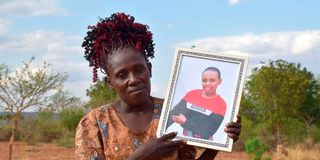
Wilfred Kamene displays a photograph of her daughter Yvonne Nzilani in Kithaayoni Village, Makueni County on July 26, 2026. Yvonne was mauled by a crocodile while drawing water from a section of River Athi that passes through the village.

What you need to know:
- Yvonne Nzilani was 14. She dreamt of becoming a doctor and planted mango trees with a Sh500 gift from her teachers. She died fetching water to keep them alive.
When Yvonne Nzilani set out to fetch water from a section of the River Athi that passes through Kithaayoni Village in Makueni County a fortnight ago, she had no idea it would be her final trip. The Grade 9 student at Ndalani Comprehensive School was mauled by a crocodile, adding to a growing list of residents who have perished the same way in the region. She was 14 years old.
Yvonne had dreamt of becoming a doctor. She had a clear pathway towards her career goal, and a parallel ambition to set up an orchard. Seven young mango trees overlooking a fresh grave now welcome visitors to Bernard Wambua’s homestead. They tell the story of a girl determined to transform her family’s fortunes through environmental restoration.
“Yvonne died while fetching water to keep her upcoming mango orchard alive,” her mother, Winfred Kamene, told Healthy Nation.
The second-born in a family of eight had bought the mango seedlings with a Sh500 gift from her teachers, awarded for topping a test, Kamene revealed. The teenager believed the orchard would one day support her university education. “Yvonne was among a handful of bright students in her class who aspired to study medicine after senior school,”
Daniel Muli, a teacher at Ndalani Comprehensive School, told mourners during her emotional send-off a week ago.
For Wambua, watching helplessly as the reptile dragged his daughter’s lifeless body towards the middle of the river has continued to haunt him. In a desperate bid to rescue Yvonne, he attempted to throw himself into the crocodile-infested waters but was restrained by members of the community. A team of daring youths eventually retrieved her body using machetes and sticks, fighting off the reptile to yank her from its jaws.
The tragedy that befell Wambua’s family is the latest in a region that, according to the Kenya Red Cross and other independent sources, has lost more than 20 residents to crocodile and hippopotamus attacks in the last year.
Two weeks before Yvonne’s death, villagers in the sleepy region set out to recover the body of a local farmhand, Daudi Soo. The father of three is believed to have been mauled by a crocodile while bathing on the riverbank.
In another tragic incident on March 20, Kyumbu Makau lost his life trying to rescue Musenya Wambua from a crocodile attack while she was drawing water from the river at Nzeveni Village in Makueni County. Villagers recovered their bodies three days later. In May, Michael Muindu Mativo was mauled while crossing the river at Kikome, also in Makueni County.
Survivors of these attacks wear their physical scars like badges of honour and live to tell horrifying tales.
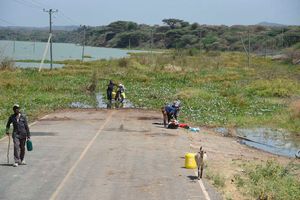
Even during Yvonne’s burial ceremony, the danger remained omnipresent. A neighbour lost a bull to a crocodile attack at the very spot where she had died, adding to the dozens of livestock lost in similar fashion every year. “Crocodiles have turned River Athi into a source of sorrow,” said Andrew Mutuku Kisangi, a resident. Attacks peak during the dry spell, when the river becomes the main water source for humans and animals across both Makueni and neighbouring Kitui counties.
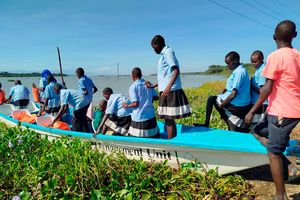
The rampant attacks have sparked intense outcry and fundamentally changed how residents fetch water. It is now unthinkable to go to the river alone; at least two people are required. As one person fills jerricans, the others throw stones into the water to keep crocodiles at bay. This method has not always proven effective in ending the crocodile menace.
Kenya Wildlife Service (KWS) wardens who attended Yvonne’s burial pledged the government’s commitment to compensate Wambua’s family. Meanwhile, Kikumbulyu South MCA Jades Kalunda threatened to lead residents in ridding the river of killer crocodiles. “Crocodiles are useless since they do not attract tourists,” he said.
During a recent forum convened by Utooni Development Organization in Kibwezi Township, Makueni County, to address human-wildlife conflict, environmentalists agreed with KWS that encroachment on riparian zones is to blame for the increased attacks along the Athi River. “Humans have encroached on riparian zones, which are key for the survival of crocodiles and hippos. A solution lies in pumping water from the river,” said Nigel Casmiro De Mello, a city pastor and conservationist.
The administrations of Kitui Governor Julius Malombe and his Makueni counterpart, Mutula Kilonzo Junior, have rolled out ambitious projects to pump water from the river in a bid to ease the conflict. However, not all villages are served by these projects, leaving thousands of residents and their livestock exposed to attacks.
A KWS warden has challenged the two governors to learn from Tana River Governor Dhadho Godhana’s approach to sustainable human-crocodile conflict management, dismissing sustained calls for removing crocodiles from the river as unrealistic. “To enhance the safety of River Tana, the government has collaborated with stakeholders to secure sections infested with crocodiles using meshed wire. Crocodiles cannot swim past the mesh, enabling communities to access water in a secure environment. This is the kind of practical solution we should explore,” said David Kiplangat, a warden at the Kiboko Problematic Animal Management Unit, addressing mourners during Yvonne’s burial.